Research
AI for Green Spaces: Leveraging Autonomous Navigation and Computer Vision for Park Litter Removal
Overview Research area: Field robotics — autonomous ground vehicles combining coverage-path planning, precise outdoor localization, computer-vision-based object detection, and physical manipulation fo
- arXiv
- 2601.11876
- Published
- 2026-01-17
- Authors
- Christopher Kao, Akhil Pathapati, James Davis
AI summary
Overview
Research area: Field robotics — autonomous ground vehicles combining coverage-path planning, precise outdoor localization, computer-vision-based object detection, and physical manipulation for environmental cleanup.
Technical level: Intermediate. The work integrates several established techniques (spanning-tree coverage planning, RTK GPS, a ResNet50 classifier) with custom mechanical design, rather than introducing a fundamentally new algorithm.
Scope in one sentence: The paper describes a park-cleaning robot that plans a coverage path across grass fields, localizes itself with centimeter-level GPS, detects litter using a CNN, and picks it up, reporting an overall task success rate of 80%.
Note: this summary is based solely on the abstract; the full text was not available, so details of the experiments, hardware, and evaluation protocol are not covered here.
What This Paper Is About
The abstract opens with a scale claim: there are 50 billion pieces of litter in the U.S. alone, and grass fields are a notable contributor because picnickers tend to leave trash behind on the field. Cleaning that kind of terrain with a conventional robot is awkward — it is unstructured, open, and mapped poorly relative to indoor spaces. The paper's goal is therefore to build a robot that can autonomously navigate a park, identify trash, and pick it up, and to demonstrate that the whole pipeline works on real grass fields.
Key Contributions
-
A coverage-path navigation approach for open park terrain. The authors apply a Spanning Tree Coverage (STC) algorithm to generate a path that the robot follows to systematically cover the field rather than wandering.
-
Outdoor localization using RTK GPS. They report successfully using Real-Time Kinematic GPS to follow that coverage path, obtaining a centimeter-level position reading once per second.
-
CNN-based litter detection. A ResNet50 convolutional neural network is used to find trash in the field of view, reported at 94.52% detection accuracy.
-
A purpose-built trash pickup mechanism. Multiple design concepts were tested, and the authors selected a new mechanism specifically targeting the types of trash encountered on the field, with an overall end-to-end success rate of 80%.
Main Findings
- System-level viability: The authors claim an overall success rate of 80% for the combined system, which they present as evidence that autonomous trash-pickup robots on grass fields are a viable solution.
- Detection accuracy: The ResNet50 CNN is reported to detect trash with 94.52% accuracy. The abstract does not specify the dataset, class definitions, or evaluation split behind that figure.
- Localization is adequate for path following: RTK GPS provided centimeter-level readings at one update per second, which the authors describe as sufficient to navigate the STC-generated coverage path.
- Pickup design matters: Testing multiple pickup concepts led the team to reject the alternatives in favor of a mechanism tailored to the specific trash encountered on the field — implying general-purpose gripper designs were not the best fit for this setting.
Methodology in Plain English
The approach breaks the task into three chained problems — where to go, what to pick up, and how to pick it up.
For where to go, the team treats the field as an area to be swept systematically. They use Spanning Tree Coverage, a classical planning technique that converts an area into a tree structure and derives a path that covers the ground without needing a pre-existing map of trash locations.
For staying on that path outside, they rely on RTK GPS, a high-precision variant of satellite positioning that corrects errors using a fixed reference station. The abstract reports it delivers centimeter-level accuracy at a one-hertz update rate, which is what makes following a planned path on open grass feasible.
For what to pick up, they run camera images through ResNet50, a well-known deep residual CNN, trained to recognize litter.
For how to pick it up, they prototyped several mechanical designs, evaluated them, and settled on a new mechanism aimed specifically at the trash types they actually encountered on the field. The final reported success rate of 80% reflects the whole stack working together, not any single component.
Why This Matters
Research impact: The paper sits at the intersection of coverage planning, high-precision outdoor localization, and manipulation — a combination more commonly studied indoors or in simulation. Treating a park field as a deployable robotics domain, and reporting end-to-end success rather than component metrics alone, gives a reference point for others working on outdoor service robots in unstructured terrain.
Real-world applications:
- Municipal and campus groundskeeping: Parks, university lawns, and public fields where litter accumulates after events and is currently collected by hand.
- Event cleanup: Picnic areas, festivals, and stadium-adjacent green spaces that need fast turnaround after crowds disperse.
- Environmental remediation: Reducing plastic and other debris on grass before it is washed into drains and waterways.
- Agricultural and turf management: The same coverage-plus-detection pattern could be adapted to field inspection tasks beyond litter.
Industry relevance: The build draws on off-the-shelf components — RTK GPS modules and standard CNN architectures — which lowers the barrier for commercial landscaping and facilities-management robotics. The finding that a specialized pickup mechanism outperformed general alternatives is directly useful to anyone designing end-effectors for field deployment.
Future Directions
- Testing at larger scale and over time: The abstract reports a single overall success rate but does not describe field size, trial count, or how performance held up across sessions, weather, or terrain variation.
- Robustness of the perception stack: A 94.52% detection figure leaves open how the system behaves on the roughly 1-in-20 misses, and whether false detections lead to wasted pickup attempts.
- Generalizing the pickup mechanism: The chosen design targets the trash encountered in this study. Whether it transfers to wet, crushed, or unusually shaped debris is an open question the abstract does not address.
- Failure analysis of the remaining 20%: Breaking down the unsuccessful runs by cause — navigation, detection, or grasping — would clarify which subsystem most limits performance.
Target Audience
Robotics researchers and graduate students working on field robots, coverage path planning, or outdoor perception; engineers building service or groundskeeping robots who want a concrete example of integrating RTK GPS with a CNN detector; and practitioners in landscaping, municipal operations, or environmental cleanup evaluating whether autonomous litter collection is ready for deployment. Readers looking for a deep algorithmic contribution will find less here than readers looking for a system-level integration study — and because only the abstract was available, anyone needing experimental specifics should consult the full paper.
Authors’ abstract
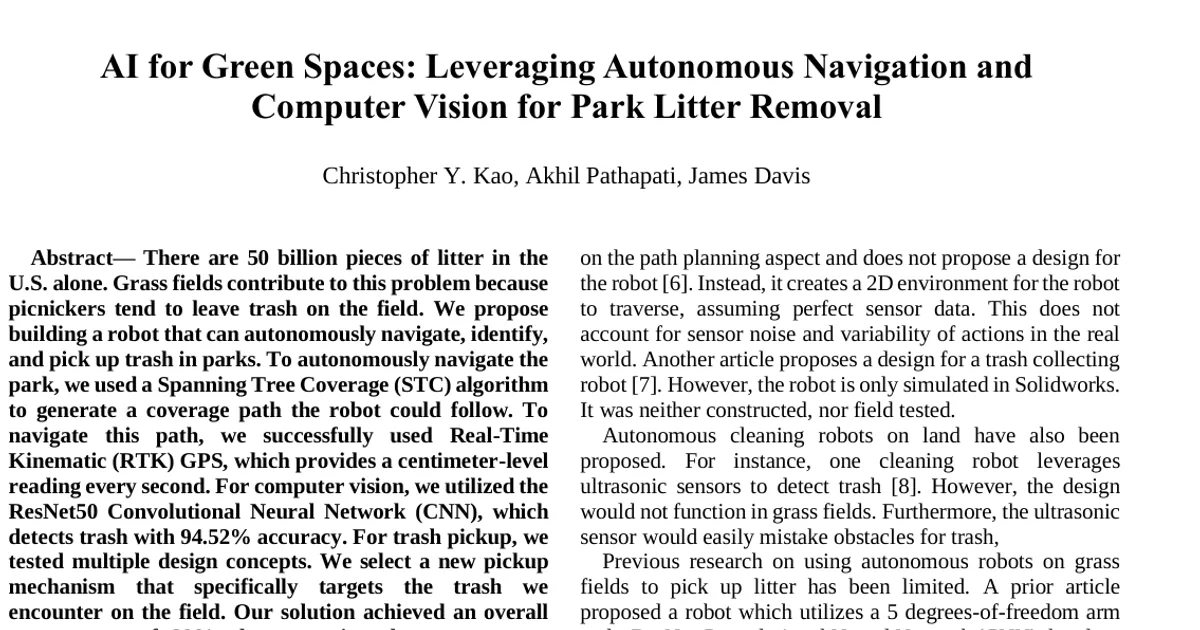
There are 50 billion pieces of litter in the U.S. alone. Grass fields contribute to this problem because picnickers tend to leave trash on the field. We propose building a robot that can autonomously navigate, identify, and pick up trash in parks. To autonomously navigate the park, we used a Spanning Tree Coverage (STC) algorithm to generate a coverage path the robot could follow. To navigate this path, we successfully used Real-Time Kinematic (RTK) GPS, which provides a centimeter-level reading every second. For computer vision, we utilized the ResNet50 Convolutional Neural Network (CNN), which detects trash with 94.52% accuracy. For trash pickup, we tested multiple design concepts. We select a new pickup mechanism that specifically targets the trash we encounter on the field. Our solution achieved an overall success rate of 80%, demonstrating that autonomous trash pickup robots on grass fields are a viable solution.