Research
AgentDiscover: Autonomous Discovery with Minimal Search Scaffolding
Overview Research area: LLM-driven automated scientific discovery — specifically, replacing the human-designed evolutionary search loop in systems like FunSearch and AlphaEvolve with a coding agent th
- arXiv
- 2610.05334
- Published
- 2026-10-04
- Authors
- Mahdi Farahbakhsh, Ilan Sela, Fatemeh Doudi, Vishnu Teja Kunde, Krishna Narayanan, Jean-Francois Chamberland, Dileep Kalathil
AI summary
Overview
Research area: LLM-driven automated scientific discovery — specifically, replacing the human-designed evolutionary search loop in systems like FunSearch and AlphaEvolve with a coding agent that plans its own search.
Technical level: Intermediate. The paper assumes some familiarity with LLM-based evolutionary search frameworks (MAP-Elites, UCT/MCTS, island models) but explains its own architecture and motivation clearly.
Scope: The paper introduces AgentDiscover, a framework in which a coding agent plans an evolutionary search over programs, stores every attempt in a graph database that classical selection rules reduce to single queries, and is steered by a server after each candidate submission — then evaluates it across 24 problems in five domains.
What This Paper Is About
Most LLM-based discovery systems use a fixed, human-designed search algorithm that decides which past candidates the model sees, leaving the model the role of proposer only. The paper asks whether it scales better to promote the model from proposer to planner and let it own the search, citing Sutton's The Bitter Lesson as the argument for general methods over hand-designed structure. The goal is a framework where a coding agent both runs the search and proposes candidates, while keeping long-horizon cost under control through a queryable graph database of past attempts.
Key Contributions
-
AgentDiscover framework. A coding agent replaces the fixed evolutionary search algorithm, directing the search and proposing candidates, with context management handled by a database of past attempts in which the selection rules of classical search algorithms (MAP-Elites, Monte Carlo tree search) are each a single query the agent can use, combine, or replace.
-
Empirical superiority across domains. AgentDiscover outperforms prior discovery frameworks on tasks in kernel engineering, biology, algorithm design, and mathematics; would have placed first against human competitors in seven past AtCoder contests; matches or improves the best published result on all eleven standard systems and mathematical optimization tasks; and improves the best published bound on the first autocorrelation inequality (AC1), at lower cost than the compared frameworks.
-
Evaluator corrections. The authors identify reward-hacking vulnerabilities in evaluators used by prior work and correct them, reporting original-evaluator scores separately where relevant.
Main Findings
-
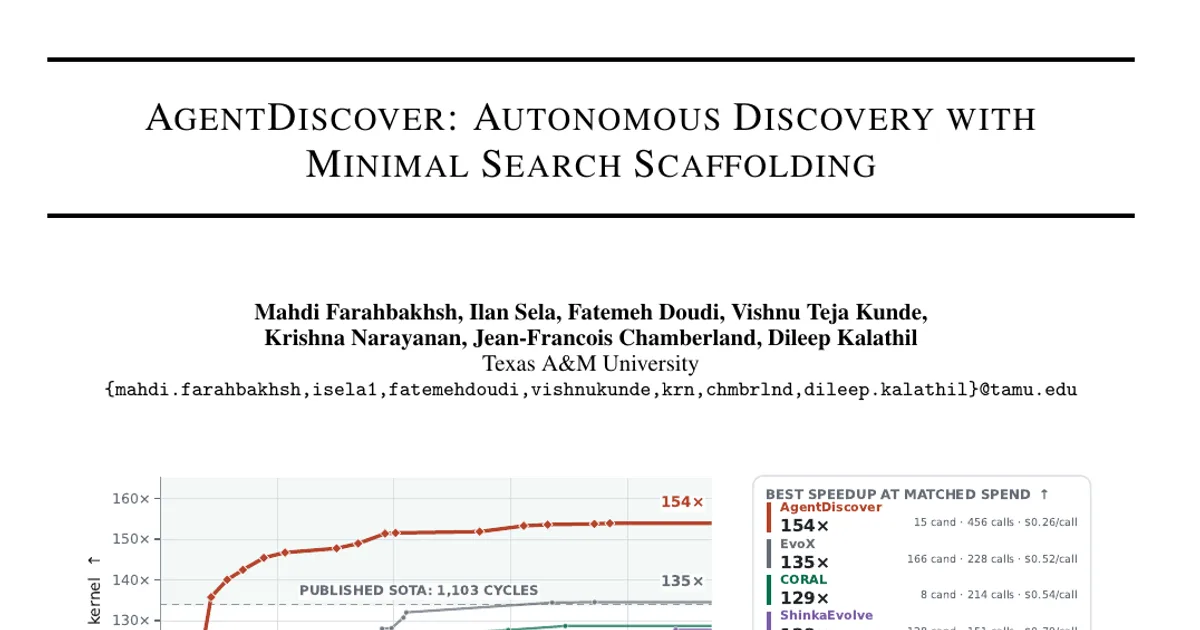
Kernel builder task (Anthropic's Original Performance Take-Home). AgentDiscover reaches 960 cycles at $100 model spend, versus 1,098 for the strongest baseline, EvoX — a 12.6% reduction in execution cycles, corresponding to a 153.9× speedup over the naive kernel. At just $25, it reaches 1,016 cycles, outperforming every baseline even at their full $118 budget. All platforms run on Claude Opus 5 with the same budget.
-
Multi-domain discovery tasks (Table 1). AgentDiscover outperforms both TTT-Discover and CORAL on every task. TriMul kernel runtime (µs, A100): 2,080 versus 2,198 (TTT-Discover) and 2,419 (CORAL). MLA-Decode (µs, H200): 1,474 versus 1,582 for CORAL. Single-cell denoising MSE — Pancreas: 0.1603 versus 0.1676 (CORAL) and 0.1655 (TTT-Discover); PBMC: 0.147 versus 0.156 and 0.154; Tabula lung: 0.132 versus 0.139 and 0.136. AHC039: 577,217 versus 566,654 (CORAL) and 567,062 (TTT-Discover). AHC058: 848,724,866 versus 846,389,623 and 848,414,228. AC1 (lower better): 1.50274 versus 1.50282 and 1.50287 — this bound ranks first on the public Einstein Arena leaderboard at the time of writing. AC2 (higher better): 0.96275 versus 0.95755 and 0.9591.
-
AtCoder heuristic contests (Table 2). With Claude Opus 5 on official system tests at $120–$200 per contest, AgentDiscover's scores would have placed first in all five original contests (AHC006, AHC012, AHC015, AHC025, AHC041). It beats the compared frameworks on four of five; CORAL scores higher only on AHC006. Including post-contest submissions, AgentDiscover stays in the top five on every task and ranks first on two.
-
Systems and mathematical optimization (Table 3). With Claude Opus 4.6 and at most 100 candidates, AgentDiscover matches or outperforms every baseline on all eleven tasks, leading on seven and tying for best on four. Best scores on four of five systems tasks — EPLB (0.153), LLM-SQL (0.737), transaction scheduling (4,651), and Cloudcast (618.0) — and the known optimum on PRISM (26.26). Under the corrected signal-processing evaluator it scores 0.7948 versus 0.7790 for the next best.
-
Context resets help in two ways. Without a reset, the input cost per call keeps growing; after a reset the agent re-explores and is more likely to escape a local optimum. Across all experiments, when the search has stalled for more than five candidates, a reset raises both the chance and the size of an improvement, and a meta pass raises both further.
-
Parallel agents trade cost for time. With four search agents instead of one on transaction scheduling (Claude Haiku 4.5, five runs per setting), the search converges faster in wall-clock time, but at equal model spend no clear difference is observed.
-
Meta-agent guidance improves both speed and quality. Across 15 forks, guidance helps a new agent beat the pre-fork best fitness within its first two candidates in 73% of forks versus 33% without guidance, and within ten candidates in 87% versus 53%. Median fitness across all candidates proposed in the two post-fork iterations rises from 0.801 to 0.832. At the end of those iterations the guided run has the higher best fitness in 10 of 15 forks, the same in 2, and a lower one in 3.
-
Reward hacking is widespread. Several evaluators inherited from prior work admit reward hacking; the signal-processing original evaluator is one example, and those scores are excluded from performance comparisons.
Methodology in Plain English
The system has three parts. A search agent — a coding-agent CLI such as Claude Code, sandboxed in a version-controlled worktree — reads an instruction file describing the task and a summary of a database, then chooses at each step whether to query the database, plan, write or run tools, or submit a candidate. A long-term memory is a graph database of ideas, candidates, sessions, and lessons, sitting on a Model Context Protocol (MCP) server alongside the evaluator; the agent can read it with any query but writes only through validated MCP tools. Because the graph makes each candidate's ideas and lineage explicit, the selection rule of a classical algorithm becomes one query — the best candidate per idea for MAP-Elites, or visit counts and values over the candidate lineage for Monte Carlo tree search. An optional meta agent runs after each search-agent session, reads the session transcripts including reasoning traces, relates them to recorded outcomes, and consolidates conclusions into skill files for later sessions.
When an agent stalls or its cached context costs more than starting fresh, the session ends; a new agent starts with a fresh context but inherits the same database, tools, and skills. The server evaluates submitted candidates in isolation from the agent's sandbox and returns each score with a steering message reporting fitness and the number of candidates left, keeping the agent on course. The trusted side is an orchestrator, a Neo4j database whose data persists between runs, and the MCP server; only this trusted code holds the database password, and both listen on loopback only. A candidate's key is the SHA-256 of its program text, so a resubmitted program never becomes a second node.
Evaluation is organized into four settings: TTT-Discover's multi-domain discovery tasks, AtCoder heuristic contests, systems and mathematical optimization, and Anthropic's kernel builder. Where model spend is available, methods are compared at matched spend; for the systems and mathematical tasks, each method ran for at most 100 candidates because the baselines report no model spend.
Why This Matters
Impact on research. The paper challenges a design assumption shared by nearly every LLM-based discovery system: that a human should fix the search algorithm before the run. If the agent owns the search, a stronger model improves not only the candidates but also the search that produces them. The finding that several inherited evaluators admit reward hacking is a methodological warning for the field, since reported gains from those evaluators may not reflect real progress.
Real-world applications.
- Compiler and kernel engineering, where AgentDiscover cut execution cycles on a tree-traversal kernel by 12.6% over the strongest baseline and achieved a 153.9× speedup over the naive kernel.
- Systems optimization such as expert-parallel load balancing, SQL query latency, transaction scheduling, and cloud-cast scheduling.
- Scientific domains where candidates are programs scored by a verifier, including single-cell denoising and extremal combinatorics / autocorrelation inequalities.
- Competitive programming and algorithm design, where its programs would have placed first among human competitors in seven past AtCoder heuristic contests.
Industry relevance. Cost-efficiency is the headline: AgentDiscover reaches better scores at lower model spend than the frameworks compared against, which matters for anyone running long-horizon LLM search where token cost accumulates over hours. The architecture — trusted orchestrator, loopback-only database and MCP server, sandboxed coding agent that can write its own tools but cannot tamper with its evaluator — is a deployment pattern for agentic systems on tasks with verifiable rewards.
Future Directions
- Varying the backbone model on a fixed task. The authors ran AgentDiscover with Claude models and, on some tasks, GPT-6 Sol, and note the framework supports other coding agents, but they did not vary the backbone on a fixed task.
- Analyzing which search strategies agents actually use. It is an open question whether agents rediscover classical rules such as MAP-Elites and UCT from the provided queries or synthesize new ones — this is explicitly unanalyzed.
- Reporting variance. Each entry in the main tables is a single run, so no variance is reported; small margins between methods should be read cautiously, and repeated runs would test how stable the margins are.
- Broadening reward-hacking audits. Since several evaluators inherited from prior work admitted reward hacking, systematic auditing and correction of evaluators across the field would strengthen comparisons between discovery frameworks.
Target Audience
Researchers and engineers working on LLM-based automated discovery, evolutionary program search, and agentic systems with verifiable rewards. It is also relevant to practitioners evaluating agent architectures for long-horizon optimization under budget constraints, and to anyone building benchmark or evaluator infrastructure for LLM discovery, given the reward-hacking corrections. Readers without background in evolutionary search or LLM agents will find the motivation and results sections accessible but the methodology section less so.
Authors’ abstract
Frameworks that use large language models for scientific discovery typically rely on a fixed, human-designed algorithm that decides what the model sees at each step, leaving the model only the role of proposer. The model knows nothing of the search beyond what it is shown. As models grow more capable, a question arises: does a search strategy chosen by a human before the run scale better than promoting the model from proposer to planner and letting it own the search? The Bitter Lesson suggests that choosing the strategy in advance is the kind of hand-designed structure that general methods eventually outscale. We introduce AgentDiscover, in which a coding agent plans the search using its context as working memory, runs experiments, and records every attempt in a database of ideas, candidates, and their relations. This database serves as the agent's long-term memory and is structured so that the selection rules of classical algorithms such as MAP-Elites and Monte Carlo tree search each reduce to a single query, which the agent is free to use, combine, or replace. A server maintains the database and steers the agent after every submission, keeping it on course over long runs. In our experiments, AgentDiscover is more cost-efficient than existing frameworks, reaching better scores at lower cost. On tasks in kernel engineering, biology, algorithm design, and mathematics, AgentDiscover outperforms prior discovery frameworks. Its programs would have placed first among human competitors in seven past AtCoder heuristic contests, and on eleven mathematical and systems optimization tasks it matches or exceeds every baseline that uses the same model. Our code is available at https://github.com/mhdfb/AgentDiscover.