Research
AesCrop: Aesthetic-driven Cropping Guided by Composition
Overview Research area: Computer vision, specifically aesthetic-driven image cropping and computational photography composition modeling. Technical level: Advanced — the paper assumes familiarity with
- arXiv
- 2510.22528
- Published
- 2025-10-26
- Authors
- Yen-Hong Wong, Lai-Kuan Wong
AI summary
Overview
- Research area: Computer vision, specifically aesthetic-driven image cropping and computational photography composition modeling.
- Technical level: Advanced — the paper assumes familiarity with transformer decoders, attention mechanisms, Mamba/VMamba state-space encoders, DETR-style matching, and Grad-CAM.
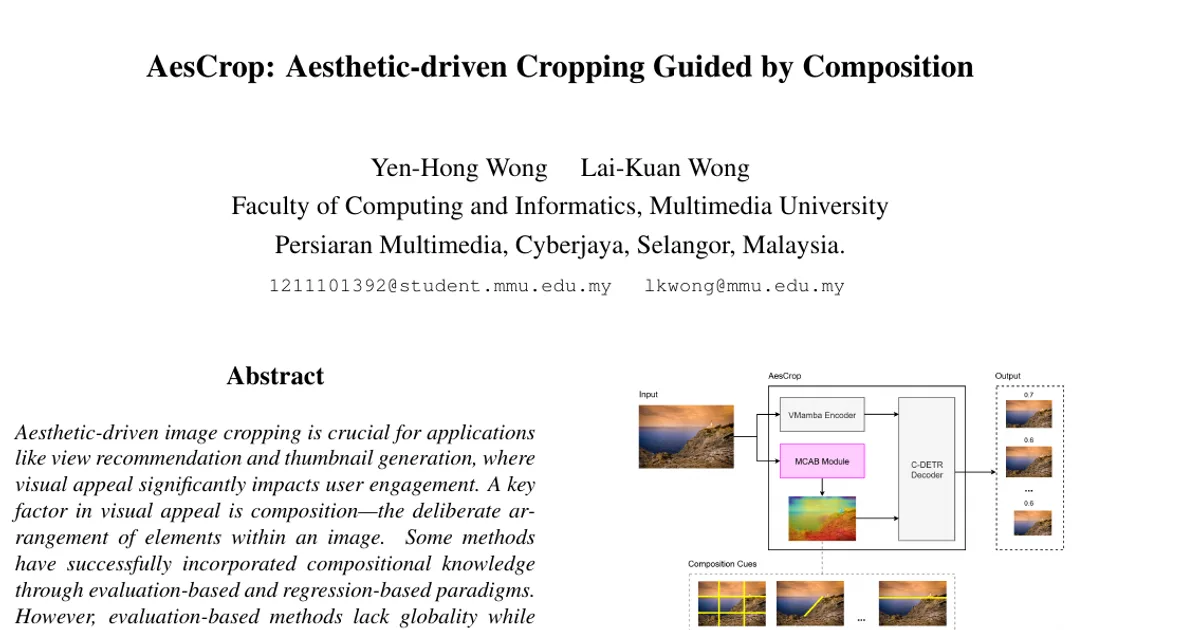
- Scope: The paper introduces AesCrop, a hybrid cropping model that injects explicit photographic-composition guidance into a VMamba-plus-Conditional-DETR pipeline and evaluates it on the GAICv2 cropping benchmark.
What This Paper Is About
Automatic cropping tools try to trim an image in a way that looks professionally composed, but existing methods tend to fall into two camps: evaluation-based methods that score a fixed, heuristically generated set of candidate crops (limited globality) and regression-based methods that predict a single crop (limited diversity). Recent "hybrid" methods do both, but none of them explicitly encode photographic composition rules. AesCrop's goal is to add that explicit compositional guidance so the model proposes multiple crops that both score well and follow composition principles.
Key Contributions
- AesCrop, a composition-aware hybrid cropping model. It combines a VMamba image encoder with a Conditional DETR-based transformer decoder to perform end-to-end rank-based cropping, outputting multiple crop boxes together with quality scores (N = 90 crops per image).
- The Mamba Composition Attention Bias (MCAB). A novel mechanism that draws composition cues from a frozen VMamba composition classifier pretrained on KU-PCP and injects them into the decoder's cross-attention weights, steering the model toward compositionally salient regions.
- A probability-weighted CAM aggregation scheme. Grad-CAM class activation maps for nine composition classes are fused by probability-weighted averaging (B = Σ pᵢ · Cᵢ) rather than selecting only the highest-probability class, which the ablation shows preserves compositional diversity.
- Comprehensive experiments and ablations. AesCrop reports state-of-the-art results on GAICv2 and validates the design choices of MCAB, object-detection pretraining, the aggregation technique, and decoder depth.
Main Findings
- Best reported results across all evaluated metrics. On the GAICv2 test set with ε = 0.90, AesCrop records Acc₁/₅ = 79.4%, Acc₂/₅ = 75.8%, Acc₃/₅ = 71.5%, Acc₄/₅ = 68.3%, average Acc̄₅ = 73.7%, and Acc₁/₁₀ = 92.2%, Acc₂/₁₀ = 90.4%, Acc₃/₁₀ = 87.1%, Acc₄/₁₀ = 84.8%, average Acc̄₁₀ = 88.6%.
- Margin over prior work. The paper reports a gain of 7.4% in Acc₁/₅ and 4.7% in Acc₁/₁₀ relative to the best competing methods. For comparison, the hybrid baseline Jia et al. reports 72.0% on Acc₁/₅ and 86.0% on Acc₁/₁₀; the evaluation-based leaders include GAIC (68.2% Acc₁/₅, 84.4% Acc₁/₁₀), TransView (69.0%, 85.4%), and CLIPCropping (70.0%, 87.5%).
- MCAB matters. Removing MCAB drops performance to 76.2% on Acc₁/₅ and 90.8% on Acc₁/₁₀ — a reduction of 3.2% and 1.4% respectively — confirming that explicit composition modeling drives the gain.
- Object detection pretraining helps substantially. Without pretraining on COCO-minitrain, the model reaches 72.8% (Acc₁/₅) and 89.6% (Acc₁/₁₀); with it, 79.4% and 92.2% — gains of 6.6% and 2.6%.
- Weighted averaging beats max-CAM selection. Max-probability aggregation yields 76.4% (Acc₁/₅) and 89.0% (Acc₁/₁₀) versus 79.4% and 92.2% for probability-weighted averaging.
- Six decoder layers is optimal. Sweeping decoder depth from 1 to 6 layers, both accuracy metrics peak at 6 layers (79.4% Acc₁/₅, 92.2% Acc₁/₁₀).
- Qualitatively stronger crops. In a six-image comparison against GAIC and a retrained Jia et al., AesCrop was the only method to preserve the negative space in front of the children in one image and the only one to remove distracting border elements around a Ferris wheel in another; it also respected the rule of thirds for a snail and preserved a framing blue arch. In a sixth case, none of the methods included the rightmost section of a building.
- MCAB heatmaps align with composition. Visualizations confirm MCAB concentrates on regionally important areas such as negative space and framing arches, matching where the successful crops came from.
- Stated limitations. Because training crops in GAIC are generated by heuristic rules, AesCrop inherits that pattern and "struggles to achieve true globality"; MCAB can also over-prioritize a composition cue when the optimal crop does not rely on it (illustrated by a case where MCAB highlights the central horizontal region).
Methodology in Plain English
AesCrop processes each input image through two parallel streams built on VMamba encoders. One stream produces standard image embeddings that describe what is in the picture. The other stream produces a composition attention bias: a frozen VMamba classifier trained on the KU-PCP dataset predicts probabilities over nine composition classes (rule of thirds, center, horizontal, vertical, symmetric, diagonal, curved, triangle, pattern), and Grad-CAM generates a class activation map for each class. These maps are fused by weighting each one according to its predicted probability into a single heatmap.
A Conditional DETR decoder with six layers then refines 90 learnable anchor queries. Each layer first runs self-attention among the queries, then cross-attention with the image embeddings. In the cross-attention step, the model adds the log of the composition heatmap to the attention weights before the softmax, which effectively up-weights compositionally salient image patches. Two output heads follow: one predicts normalized crop box coordinates (center, width, height), the other predicts a normalized quality score.
Training uses a matching strategy borrowed from hybrid cropping work: ground-truth crops with mean opinion scores of 4 or higher are treated as "good," padded with empty objects, and matched one-to-one to predictions via the Hungarian algorithm, minimizing a combined loss of L1 regression, Generalized IoU, and focal loss (with λ_focal = λ_GIoU = 0.4). Predictions matched to non-empty ground truths are supervised on boxes and scores; unmatched predictions with IoU ≥ 0.85 against a ground truth get a soft score label from that neighbor; all remaining predictions are assigned a quality score of zero. Images are resized to 512×512, normalized with ImageNet statistics, and augmented with random saturation, hue, and contrast changes. AesCrop is pretrained in two stages — the composition classifier on KU-PCP (frozen afterward) and the rest on COCO-minitrain, a 25,000-image subset of COCO — then trained with AdamW at an initial learning rate of 10⁻⁴ for 40 epochs, reduced tenfold for the final 10 epochs, on an NVIDIA RTX 4090 with batch size 16.
Why This Matters
- Research impact: The paper shows that explicit composition priors can be injected directly into attention rather than handled by a separate evaluation module, offering a concrete recipe for combining state-space encoders with DETR-style hybrid cropping. It also provides a clean set of ablations isolating the value of composition modeling versus pretraining versus aggregation strategy.
- Real-world applications:
- View recommendation and thumbnail generation, where visual appeal drives user engagement (both named directly in the abstract).
- Photo editing and automatic reframing tools for mobile and desktop software.
- Social media and content-platform pipelines that auto-generate preview images at multiple aspect ratios.
- Curating stock photography or e-commerce product imagery, where crops must follow professional composition conventions.
- Industry relevance: Aesthetic cropping is a cheap, high-leverage step in content workflows — better default crops reduce manual editing labor and improve click-through on previews. The paper's two-stage pretraining strategy also demonstrates how to work around small, sparsely annotated cropping datasets using larger detection datasets, a pattern relevant to teams with limited labeled aesthetic data.
Future Directions
- Overcoming heuristic-induced bias. Since GAICv2 crops come from heuristic generation, AesCrop inherits their pattern and "struggles to achieve true globality." Training on genuinely diverse or human-authored crop sets is a natural next step.
- Better integration of composition priors. The limitation example shows MCAB can over-prioritize a compositional feature the optimal crop does not use; making the bias adaptive or conditional on scene content could refine it.
- Extending beyond a single composition dataset. The composition classifier is trained only on KU-PCP's nine classes; whether a richer or more granular composition taxonomy improves crops is an open question.
- Generalizing across aspect ratios and conditions. The paper evaluates one IoU threshold (ε = 0.90) and one backbone variant (VMamba-T); scaling the encoder and testing varied target aspect ratios are open avenues.
Target Audience
Researchers and graduate students working on image cropping, image aesthetics assessment, or computational photography, and practitioners building automatic thumbnail, reframing, or view-recommendation systems. Readers need a working knowledge of transformer attention and DETR-style detection to follow the methodology sections, though the high-level framing and results are accessible to anyone familiar with computer vision evaluation.
Authors’ abstract
Aesthetic-driven image cropping is crucial for applications like view recommendation and thumbnail generation, where visual appeal significantly impacts user engagement. A key factor in visual appeal is composition--the deliberate arrangement of elements within an image. Some methods have successfully incorporated compositional knowledge through evaluation-based and regression-based paradigms. However, evaluation-based methods lack globality while regression-based methods lack diversity. Recently, hybrid approaches that integrate both paradigms have emerged, bridging the gap between these two to achieve better diversity and globality. Notably, existing hybrid methods do not incorporate photographic composition guidance, a key attribute that defines photographic aesthetics. In this work, we introduce AesCrop, a composition-aware hybrid image-cropping model that integrates a VMamba image encoder, augmented with a novel Mamba Composition Attention Bias (MCAB) and a transformer decoder to perform end-to-end rank-based image cropping, generating multiple crops along with the corresponding quality scores. By explicitly encoding compositional cues into the attention mechanism, MCAB directs AesCrop to focus on the most compositionally salient regions. Extensive experiments demonstrate that AesCrop outperforms current state-of-the-art methods, delivering superior quantitative metrics and qualitatively more pleasing crops.