Research
Adversarial Training for Pixel Diffusion
Adversarial Training for Pixel Diffusion Overview Research area: Generative computer vision — specifically text-to-image (T2I) diffusion models, adversarial (GAN) training, and image-frequency statist
- arXiv
- 2609.38170
- Published
- 2026-09-29
- Authors
- Xin Lin, Zhifei Zhang, Yuqian Zhou, Haitian Zheng, Zhe Lin, Ming-Hsuan Yang, Truong Nguyen
AI summary
Adversarial Training for Pixel DiffusionOverview
Research area: Generative computer vision — specifically text-to-image (T2I) diffusion models, adversarial (GAN) training, and image-frequency statistics of natural images.
Technical level: Advanced. The paper assumes familiarity with diffusion/flow-matching objectives, velocity and epsilon parameterizations, GAN discriminators, and spectral analysis of images. Its motivation and conclusions are stated plainly, but the methodology and evaluation require background in generative modeling.
Scope: The paper studies a single, narrow intervention — adding a GAN loss as a post-training step to already-converged pixel-space diffusion models — and then investigates why it works and when it fails, using two pixel backbones and two latent backbones as a mechanism-matched contrast.
What This Paper Is About
Pixel diffusion models generate images directly in RGB, skipping the compressed latent representation and separate decoder used by latent diffusion models. This removes the autoencoding bottleneck, but it also means the denoiser itself must produce every fine detail, and the authors show that converged pixel models systematically under-produce the high-frequency statistics that characterize real photographs.
The paper's goal is to test whether adversarial post-training — keeping the model's original diffusion or flow-matching objective and adding a hinge GAN loss on the predicted clean image — can correct this residual gap without sacrificing distribution fidelity, sample diversity, or prompt alignment, and to explain both why the correction works and when it does not.
Key Contributions
-
Proposal of adversarial post-training for pixel diffusion. The authors add an adversarial loss to a pretrained, converged pixel diffusion model without changing its architecture, its original training objective, or its number of sampling steps. They state this is the first systematic study of GAN-based post-training for pixel diffusion, and report joint improvements across distribution fidelity, coverage, prompt alignment, and perceptual quality on two pixel backbones (DeCo and PixelGen).
-
A mechanistic explanation grounded in image frequency statistics. Frequency-band and power-law analyses show that pixel models under-produce natural-image high-frequency content and that the GAN restores the missing spectral power. A matched perceptual-loss comparison shows perceptual supervision also adds high frequency, but via a desaturated, low-contrast domain shift that degrades FID and prompt alignment — distinguishing the GAN's effect from generic sharpening.
-
A characterization of when adversarial refinement succeeds. Through matched pixel-versus-latent comparisons (PixArt-α and SANA), the paper shows latent models do not achieve comparable joint gains and gain almost no decoded high-frequency power. A direct perturbation probe through the frozen PixArt VAE measures a 3.5–11× weaker decoded-HF response than the pixel identity map, identifying direct output access to the corrected statistics as a key factor.
-
Operating-point maps for design choices within pixel diffusion. Discriminator, noise-gate, and adversarial-weight ablations (Tables 7, 8, 9) document how these choices shift the trade-offs among fidelity, alignment, coverage, and perceptual quality, reported as operating points rather than a single optimum.
Main Findings
-
Joint metric gains on both pixel backbones. On DeCo with the DINOv2-text discriminator, FID improves from 33.27 to 28.59, recall from 0.361 to 0.406, and DPG Score from 81.6 to 83.3. pFID falls from 27.91 to 24.38, CMMD from 0.836 to 0.736, TOPIQ rises from 0.711 to 0.768, MANIQA from 0.636 to 0.712, MUSIQ from 75.5 to 76.5, and IS from 39.35 to 39.77. On PixelGen, DPG Score goes from 78.4 to 80.8, FID from 33.94 to 33.20, recall from 0.319 to 0.403, CMMD from 0.762 to 0.725, pFID from 30.81 to 30.51, TOPIQ from 0.755 to 0.799, MUSIQ from 75.7 to 77.0, MANIQA from 0.645 to 0.723, and IS from 38.58 to 38.76.
-
A measurable high-frequency deficit is corrected. The DeCo baseline's radial power-spectrum slope is α = 2.59 versus approximately 2.19 for real COCO images. Adversarial post-training moves DeCo to α = 2.24 and raises high-frequency band power by +0.34 dex, without flattening the spectrum toward white noise (which would drive α toward 0).
-
Spectral energy shifts toward mid and high bands. Averaged over 30,000 images per model, DeCo's mid-band share rises from 4.9% to 7.5% and its high-band share from 2.1% to 3.9%; PixelGen's mid-band share rises from 6.6% to 8.9% and its high-band share from 3.9% to 6.4%. Mid frequency is defined as 0.10 ≤ f ≤ 0.25 cyc/px and high frequency as 0.25 < f ≤ 0.50 cyc/px, with 0.50 cyc/px the Nyquist limit.
-
No memorization and no mode dropping. DINOv2 nearest-neighbor similarity to a ~60k-image training set changes by only +0.0001 in the mean (both variants round to 0.586), while the maximum similarity is lower with the GAN (0.929 versus 0.943). Recall rises rather than falls, and all gains are measured against matched-step no-GAN SFT controls.
-
The gain is not generic sharpening. Applying an unsharp-mask filter tuned to match the +GAN high-frequency spectrum improves FID only to 32.3 at best, versus 28.59 for the GAN, and falls short in no-reference quality.
-
Perceptual supervision is a different, worse route. On DeCo, the perceptual loss arm raises TOPIQ (0.711 to 0.749) and MANIQA (0.636 to 0.661) but worsens FID (33.3 to 34.1), pFID (27.9 to 28.6), and DPG Score (81.6 to 81.4). Its image statistics drift toward desaturation and flattening: saturation 0.532 to 0.511, contrast 0.240 to 0.210, colorfulness 0.260 to 0.221, while the GAN preserves them (0.544, 0.239, 0.256) and adds more sharpness (Laplacian variance 0.052 versus 0.022 for perceptual and 0.0076 for the original) and a higher 2-D HF spectral-energy ratio (13.9% versus 7.9% and 4.3%).
-
No-reference metrics alone are insufficient. Real photographs themselves score lowest on TOPIQ (0.57), which the authors cite as evidence that NR-IQA cannot stand alone as a quality criterion.
-
Pre-SFT trajectories agree. Starting from official pre-SFT checkpoints, DeCo moves from 81.4 to 81.2 with perceptual supervision and to 83.4 with the GAN; PixelGen moves from 79.4 to 77.8 and to 80.8, respectively.
-
Latent models do not show the same effect. SANA's self-GAN (DiT) variant moves FID from 36.58 to 36.24 but recall from 0.340 to 0.325 and DPG Score from 83.6 to 83.4; its feature-PatchGAN variant degrades FID to 38.41; its decoded-RGB PatchGAN variant degrades DPG Score to 79.7 and FID to 40.95. PixArt-α's self-GAN raises DPG Score from 73.3 to 75.5 but worsens FID from 33.70 to 35.08, and the decoded-RGB DINOv2 variant collapses several metrics (DPG 72.1, FID 34.25, TOPIQ 0.461, MANIQA 0.370). The latent GAN often falls below the 50% preference threshold in the 1,065 matched DPG-Bench pairs of Figure 6.
-
Latent models do not restore decoded high frequency. High-band share changes only from 2.2% to 2.3% for SANA and from 2.1% to 1.9% for PixArt. SANA's slope moves from 2.54 to 2.80 (+0.09 dex) and PixArt's from 2.72 to 2.86 (−0.14 dex) — neither toward the natural value of approximately 2.19.
-
The frozen VAE attenuates output access. Under matched native-output perturbations, the PixArt VAE produces 3.5–11× less decoded-HF response than the pixel identity map. Independently, VAE encoding and decoding steepens the real-image spectral slope to α = 2.48 and removes approximately 0.2 dex of HF power. Gradients are not blocked, but directions that affect decoded HF are strongly attenuated.
-
Discriminator design matters in a consistent direction. From-scratch pixel discriminators (PatchGAN, StyleGAN) stay near the no-GAN FID baseline (32.5–33.5), whereas frozen pretrained backbones (DINOv2, DINOv2-Large, DINOv3, SigLIP) tend to yield lower FID (28.6–31.0) and DPG Score up to 83.4. Individual rows favor different metrics, so no complete ordering is established.
-
Gate and weight are trade-off knobs, not one optimum. With the fixed DINOv2 discriminator and w = 0.1, t ≥ 0.35 emphasizes DPG Score and no-reference quality, t ≥ 0.53 gives higher IS and recall with competitive distribution metrics, and broader gates favor CMMD and pFID. Raising the adversarial weight monotonically increases no-reference sharpness while lower and moderate weights preserve stronger distribution and alignment metrics. A residual analysis over 1,000 prompts shows structure stabilizes by t ≈ 0.35–0.55 while detail remains incomplete, motivating the gate.
Methodology in Plain English
The authors start from models that are already fully trained. Rather than retraining from scratch or changing the architecture, they continue training an existing pixel diffusion model while keeping its original denoising (diffusion or flow-matching) loss intact. On top of that, they add a hinge adversarial loss computed on the model's predicted clean image, and they only apply this loss at timesteps where the noise level is low enough that the prediction is a meaningful image — a "signal-fraction gate" that excludes the high-noise regime where global layout is still unresolved.
The discriminator is not trained from scratch. The authors freeze a strong pretrained vision backbone (DINOv2, with DINOv3 and SigLIP tested as alternatives) and train only small per-layer heads that emit real/fake logits per patch. Critically, the image is fed at its native resolution rounded down to a multiple of 14 (512 → 504) rather than resized to a fixed 224×224 crop, so the discriminator sees a 36×36 patch grid and can score detail across the whole image. One configuration, DINOv2-text, adds a StyleGAN-T-style projection that conditions the score on pooled text embeddings.
To test whether the effect depends on having direct access to the final pixels, the authors repeat the same procedure on two latent diffusion models (PixArt-α and SANA), pairing every GAN run with its own no-GAN control that shares the same starting checkpoint, data, training horizon, prompts, and evaluation. For SANA and PixArt they try three discriminator placements: scoring the predicted latent with a copy of the generator architecture, scoring the latent with a lightweight PatchGAN, or decoding the predicted latent through the frozen VAE and scoring the RGB result. They then run a separate perturbation probe that measures how much a change in the model's native output survives decoding into high-frequency image content.
Evaluation spans four groups: prompt alignment (DPG Score on DPG-Bench), distribution fidelity and diversity on COCO-30k (FID, patch-FID, CMMD, IS, recall, CLIP score), no-reference image quality (TOPIQ, MUSIQ, MANIQA, NIQE), and naturalness of spatial statistics via the radial power spectrum and its fitted log–log slope α. For each image they take the luminance channel, apply a 2-D Hann window, compute the 2-D FFT, and azimuthally average the squared magnitude over rings of constant spatial frequency, then average across 30,000 images per model and fit the slope by least squares.
Training uses BLIP3o-60k (approximately 60k image–caption pairs) at 512². DeCo is a 1.1B-parameter pixel diffusion transformer using flow matching and 25 sampling steps; PixelGen uses a JiT backbone with roughly 1.1B parameters. Models are fine-tuned for 30k steps with generator learning rate 10⁻⁵ and discriminator learning rate 2×10⁻⁴ in a 1:1 update ratio, a global batch of 512, EMA decay 0.9999, and GAN weight λ = 0.1 at t ≥ 0.35 by default. The original flow-matching objective is retained along with a REPA feature-alignment term (weight 0.5). DiffAugment (color, translation, cutout) is applied differentiably before the discriminator.
Why This Matters
Impact on research. The paper reframes adversarial training for diffusion — usually associated with tokenizer training or few-step distillation — as a lightweight quality-correction step that leaves architecture and sampling procedure untouched. It supplies a diagnostic framework (radial power spectrum, power-law slope, band-share analysis) for measuring residual error in a converged generative model, and a falsifiable mechanism claim: adversarial refinement works when the trainable output has direct access to the image statistics being corrected. That is a testable hypothesis that could guide future work on where in a generative stack to place a discriminator.
- Text-to-image product quality. Adding fine-scale texture to generated images is directly relevant to commercial image generators, where perceived sharpness and naturalness drive user satisfaction. The finding that this can be done as a post-training step on an existing checkpoint lowers the cost of adoption
Authors’ abstract
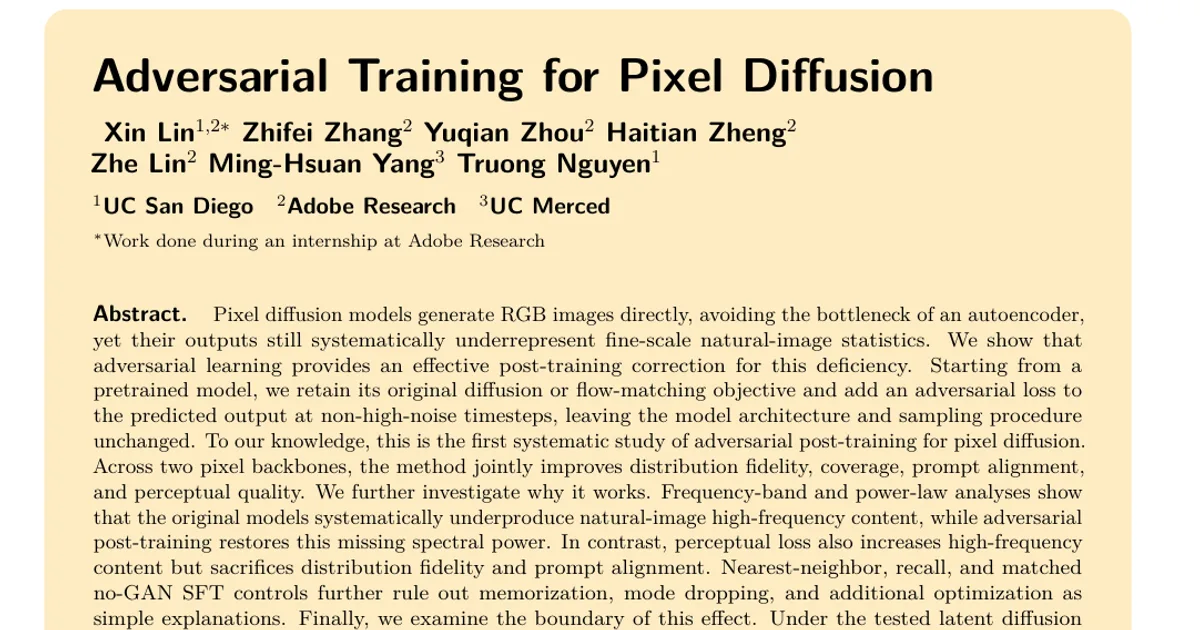
Pixel diffusion models generate RGB images directly, avoiding the bottleneck of an autoencoder, yet their outputs still systematically underrepresent fine-scale natural-image statistics. We show that adversarial learning provides an effective post-training correction for this deficiency. Starting from a pretrained model, we retain its original diffusion or flow-matching objective and add an adversarial loss to the predicted output at non-high-noise timesteps, leaving the model architecture and sampling procedure unchanged. To our knowledge, this is the first systematic study of adversarial post-training for pixel diffusion. Across two pixel backbones, the method jointly improves distribution fidelity, coverage, prompt alignment, and perceptual quality. We further investigate why it works. Frequency-band and power-law analyses show that the original models systematically underproduce natural-image high-frequency content, while adversarial post-training restores this missing spectral power. In contrast, perceptual loss also increases high-frequency content but sacrifices distribution fidelity and prompt alignment. Nearest-neighbor, recall, and matched no-GAN SFT controls further rule out memorization, mode dropping, and additional optimization as simple explanations. Finally, we examine the boundary of this effect. Under the tested latent diffusion configurations, the same procedure does not produce comparable joint gains and adds almost no decoded high-frequency power. These results identify direct output access to the image statistics being corrected as a key factor governing when adversarial post-training succeeds.