Research
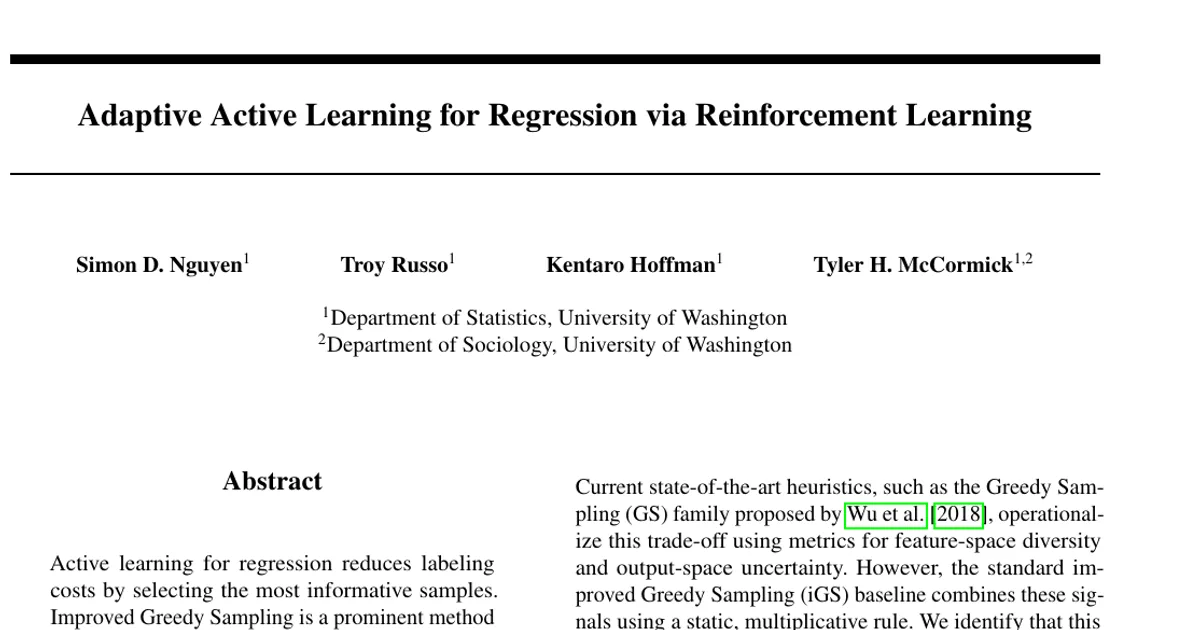
Adaptive Active Learning for Regression via Reinforcement Learning
Overview Research area: Active learning for regression, specifically pool-based sample selection, combined with reinforcement learning for adaptive control of the selection criterion. Technical level:
- arXiv
- 2603.10435
- Published
- 2026-03-11
- Authors
- Simon D. Nguyen, Troy Russo, Kentaro Hoffman, Tyler H. McCormick
AI summary
Overview
Research area: Active learning for regression, specifically pool-based sample selection, combined with reinforcement learning for adaptive control of the selection criterion.
Technical level: Intermediate. The paper assumes familiarity with active learning terminology (exploration versus uncertainty sampling), regression models such as ridge regression, cross-validation, and reinforcement learning concepts including Markov decision processes, multi-armed bandits, and actor-critic methods.
Scope in one sentence: The paper proposes Weighted improved Greedy Sampling (WiGS), which replaces the fixed multiplicative combination of feature-space diversity and output-space uncertainty used by improved Greedy Sampling (iGS) with a weighted additive combination whose weight is chosen by a reinforcement learning agent, and evaluates this on a synthetic density-veto environment plus benchmark regression datasets.
What This Paper Is About
Greedy Sampling methods for regression active learning select the next point to label by measuring how far a candidate is from the nearest labeled point, either in feature space (exploration) or in predicted-output space (investigation). The standard improved Greedy Sampling baseline multiplies these two distance terms together and selects the point with the largest minimum product, which means a candidate must score well on both criteria to be chosen.
The authors argue this fixed multiplicative rule fails when data density is uneven: in a dense feature region the diversity term approaches zero and suppresses the whole score, so high-uncertainty points are effectively "vetoed" even when they carry the most useful error information. The goal is to replace that static rule with a dynamic additive one whose balance can adapt during learning, and to learn that balance automatically rather than tuning it by hand.
Key Contributions
-
The WiGS framework. A reformulation of the Greedy Sampling selection criterion as a weighted additive combination of normalized feature-space and output-space distances, where a weight
w_x^(t)in[0, 1]controls the exploration-investigation trade-off at each iteration. -
Dynamic balancing as a continuous-control reinforcement learning problem. The agent's action is the continuous scalar weight, and its reward is the improvement in K-fold cross-validation RMSE computed only from the currently labeled set, which avoids data leakage from the unlabeled pool. Two instantiations are given: a discretized multi-armed bandit variant (WiGS-MAB, using UCB1 over a coarse weight grid) and a continuous Soft Actor-Critic variant (WiGS-SAC).
-
A theoretical characterization of the failure mode. Proposition 3.1 ("The Density Veto") proves that as the feature diversity of a high-uncertainty target approaches zero, the multiplicative selector strictly prefers a lower-uncertainty but more diverse distractor, regardless of the uncertainty gap, whereas the additive selector can always be made to prefer the high-uncertainty target by an appropriate choice of weight.
-
An empirical evaluation on a synthetic trap environment and benchmark datasets, reporting both full-pool RMSE and label efficiency, plus a released codebase for reproducibility.
Main Findings
-
The density veto is demonstrated empirically, not just proven. The synthetic data-generating process places a high-noise band at
0.8 < x < 0.9directly on top of the densest Gaussian mixture component centered atx = 0.85. The multiplicative iGS baseline fails to reduce error in this trap region, while the adaptive agent targets it. -
The learned policy is not a static weight. The authors report in Appendix C.2 that the agent never converges to a single static weight but maintains a high-variance, reactive strategy throughout learning.
-
WiGS-SAC matched or outperformed iGS on 15 of the 20 evaluated datasets, although the paper states "18 benchmark datasets" in the abstract and in Section 5, and "20 benchmark datasets" in the contributions and in the label-efficiency analysis.
-
Statistical significance. Wilcoxon signed-rank tests (Appendix C.5) indicate WiGS-SAC outperforms baselines at
p < 0.05. -
Single-objective strategies perform poorly. GSx (pure exploration) and GSy (pure investigation) frequently produce errors higher than the iGS baseline.
-
Static exploration bias rivaled the adaptive agent on the synthetic task. A static WiGS with
w_x = 0.75performed exceptionally well on the Two-Regime synthetic DGP, but the authors emphasize this value was selected ex post facto from a grid search overw_x ∈ {0, 0.25, 0.5, 0.75, 1}, whereas WiGS-SAC found comparable performance autonomously. -
Investigation-heavy static weighting performed badly on the synthetic task. Static
w_x = 0.25produced relative error1.095on Two-Regime, while WiGS-SAC achieved0.943. -
Label efficiency improves. For WiGS-MAB (
c = 2.0), median relative label efficiency is approximately0.96, implying a4%reduction in labeling costs, with the upper quartile at or below1.0, measured against milestones of70%and80%of total possible performance gain. -
Advanced baselines are volatile. QBC and EMCM reach efficiency as low as approximately
0.85on some datasets but have right whiskers extending beyond1.15. QBC and Uncertainty Sampling fail catastrophically on noisy domains, with Burbidge errors above1.40. EGAL consistently underperforms, consistent with purely density-based sampling prioritizing redundant regions. -
A warm-up period limits the RL agent in small-data regimes. On datasets such as Yacht (
N = 308) and NO2 (N = 500), the active learning loop terminates while the agent is still warming up, producing performance parity with static heuristics. On larger tasks such as Wine-White (N = 4898) and Wine-Red (N = 1599), the longer labeling horizon amortizes the initial exploration cost. -
Absolute error reductions up to 0.05 relative to iGS are reported in the synthetic performance-difference figure.
Methodology in Plain English
The setup is standard pool-based active learning: a small labeled training set (5% of samples) and a large unlabeled candidate pool (95%), with the algorithm querying one point at a time until the pool is exhausted. Ridge regression with α = 0.01 is used as the predictor to isolate the effect of the selection strategy, with Random Forest Regressor results reported in Appendix F.2.
For scoring, WiGS first normalizes the feature-space distance and the output-space distance so they are on comparable scales using a function φ(·). It then computes, for each candidate and each already-labeled point, a weighted sum of the two normalized distances. The candidate's score is the minimum of these combined values over all labeled points, and the candidate with the highest score is labeled next. Setting the weight to 1 recovers exploration, setting it to 0 recovers investigation, and intermediate values interpolate.
The weight itself is set in one of four ways. Static weights keep it fixed. Decay weights follow a fixed schedule in time, either linearly (1 − c·t/T) or exponentially (exp(−c·t/T)). The multi-armed bandit variant treats a small discrete set of weights {0.25, 0.50, 0.75} as arms and uses UCB1 to pick one per iteration based on historical reward. The Soft Actor-Critic variant treats the task as a full continuous-state Markov decision process: the state is a feature vector built only from the labeled set (current cross-validation RMSE, learning progress t/T, and distributional statistics of the labeled set), the action is the continuous weight, and the reward is the reduction in cross-validation RMSE from one iteration to the next. Soft Actor-Critic is chosen because its entropy term keeps the policy stochastic when the reward signal is ambiguous, preventing premature convergence to a fixed heuristic.
The reward is deliberately derived from 5-fold cross-validation on the labeled set rather than from test error, to avoid the "active learning validation paradox" of needing oracle labels to train the selector. Evaluation uses Full-Pool RMSE, which compares a hybrid prediction vector against ground truth across the entire domain, summarized as an Area Under the Learning Curve normalized by the iGS baseline (Relative AUC), with 100 independent replications per dataset using different random seeds.
Why This Matters
The paper targets a practical bottleneck: labeled regression data is expensive, and the most widely used heuristic for choosing what to label next embeds a balance between exploring feature space and investigating uncertain outputs that is fixed rather than fitted. Showing that a learned, adaptive control signal can match a hand-tuned optimum without access to ground truth, and can beat any fixed setting when the optimum is genuinely time-varying, changes how practitioners think about tuning active learning selectors.
Real-world applications named in the paper:
- Robotics, where labeled interaction data is costly to collect.
- Drug discovery, where experimental labeling is slow and expensive.
- Environmental science, where sensor-based ground truth requires field measurement.
- Materials science, where synthesis and characterization limit labeling throughput.
Two additional application areas the paper alludes to are generative AI and any industrial setting with unknown dataset characteristics, where the authors argue WiGS is a safer choice because of its tighter worst-case label-efficiency distribution compared with query-by-committee and expected model change maximization, which show heavy inefficiency tails.
Industry relevance: the autonomy argument is the practical one. Instead of a hyperparameter search requiring ground-truth labels, the agent converges to a good weighting policy from the evolving labeled set alone, which the authors present as automating an otherwise impossible tuning procedure.
Future Directions
-
Reducing the warm-up cost. The RL agent needs sufficient iterations to estimate its value function before it beats static heuristics. Reducing this sample complexity, or warm-starting the policy, would extend the benefit to small datasets like Yacht (
N = 308) and NO2 (N = 500), where the loop currently ends too early. -
Extending beyond ridge and random forest regressors. The main experiments use ridge regression with
α = 0.01to isolate the selection strategy, with random forest results confined to an appendix. Testing the framework against a wider range of base learners, particularly in high-dimensional settings, remains open. -
Characterizing when a static weight suffices. The authors report that on some datasets a fixed weight is adequate and the agent simply converges to it, while on others the optimal trade-off is genuinely dynamic. A clearer predictive rule for which regime a given dataset falls into would guide deployment.
-
Understanding the learned policy's structure. The policy remains high-variance and reactive rather than settling on a stable schedule, and the paper does not provide an interpretable account of what drives the weight at each step beyond the density-veto mechanism.
Target Audience
Researchers and practitioners in active learning and reinforcement learning, particularly those working on regression tasks where labeling is expensive. It is also relevant to applied scientists in robotics, drug discovery, environmental science, and materials science who use active learning pipelines and want a selector that does not require manual tuning. Readers need working familiarity with active learning baselines and with reinforcement learning algorithms such as Soft Actor-Critic and UCB1 to follow the method and appendix material; the density-veto argument and the benchmark results are accessible without that background.
Authors’ abstract
Active learning for regression reduces labeling costs by selecting the most informative samples. Improved Greedy Sampling is a prominent method that balances feature-space diversity and output-space uncertainty using a static, multiplicative rule. We propose Weighted improved Greedy Sampling (WiGS), which replaces this framework with a dynamic, additive criterion. We formulate weight selection as a reinforcement learning problem, enabling an agent to adapt the exploration-investigation balance throughout learning. Experiments on 18 benchmark datasets and a synthetic environment show WiGS outperforms iGS and other baseline methods in both accuracy and labeling efficiency, particularly in domains with irregular data density where the baseline's multiplicative rule ignores high-error samples in dense regions.