Research
Adapt-As-You-Walk Through the Clouds: Training-Free Online Test-Time Adaptation of 3D Vision-Language Foundation Models
Overview Research area: Computer vision and 3D multimodal learning — specifically test-time adaptation (TTA) of 3D vision-language foundation models (VLFMs) for point cloud recognition under distribut
- arXiv
- 2511.15311
- Published
- 2025-11-19
- Authors
- Mehran Tamjidi, Hamidreza Dastmalchi, Mohammadreza Alimoradijazi, Ali Cheraghian, Aijun An, Morteza Saberi
AI summary
Overview
Research area: Computer vision and 3D multimodal learning — specifically test-time adaptation (TTA) of 3D vision-language foundation models (VLFMs) for point cloud recognition under distribution shift.
Technical level: Advanced. The paper assumes familiarity with contrastive vision-language pretraining, softmax/entropy-based confidence, graph Laplacian regularization, and online clustering.
Scope: The paper proposes Uni-Adapter, a training-free online TTA framework that replaces confidence-based caching with class-level online clustering plus graph-based label smoothing, evaluated on corrupted and clean 3D benchmarks across three 3D VLFMs.
What This Paper Is About
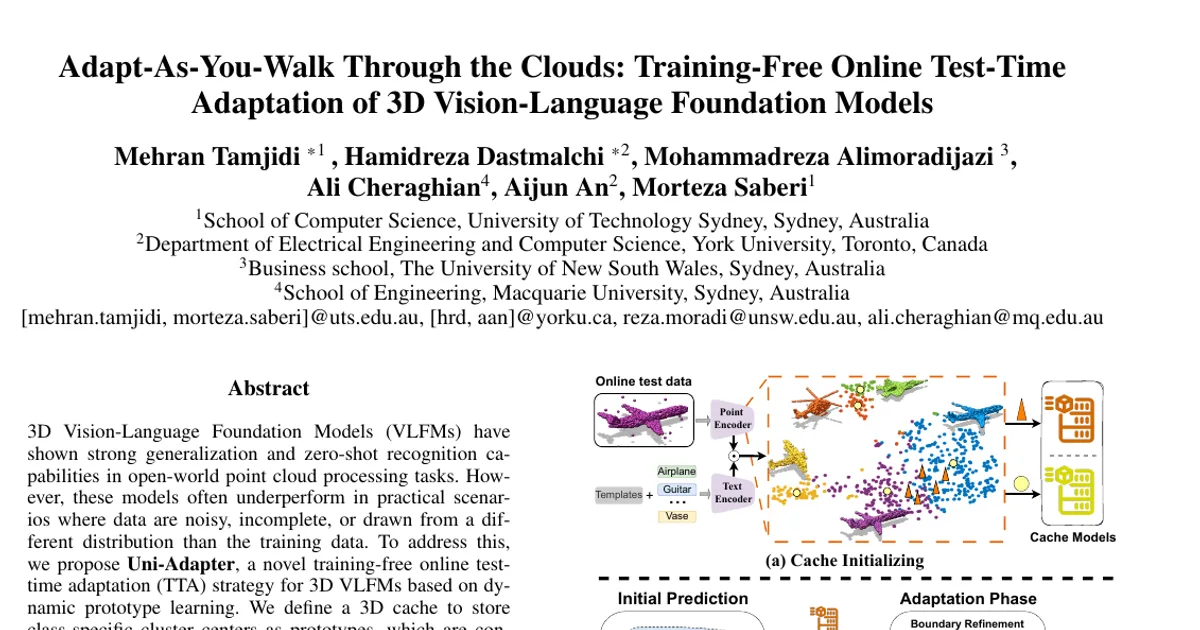
3D vision-language foundation models such as Uni3D, ULIP-2, and OpenShape can recognize point cloud categories zero-shot, but they degrade when test point clouds are noisy, sparse, incomplete, or drawn from a shifted distribution. Existing cache-based adaptation methods store only high-confidence test features as prototypes, which misses the multiple structural modes that a single 3D class typically exhibits. The goal is to adapt these models at test time without any retraining or gradient updates, while capturing the full diversity of each class.
Key Contributions
- Cluster-based caching instead of confidence-based caching. Each class maintains up to N cluster centers (prototypes) that are updated online, capturing intra-class variability rather than only the most confident samples.
- Graph-based prototype reassignment. A similarity graph over cached prototypes is used for label smoothing, propagating labels among similar prototypes to correct noisy pseudo-labels. The resulting Laplacian system is solved with the conjugate gradient method, reducing cost from O(M³) to O(ρ · nnz(L_norm)).
- Entropy-weighted fusion. Predictions from the original 3D VLFM and the cache model are combined using entropy-derived weights that favor the more confident source.
- Extensive evaluation. Twelve baselines are compared across three corrupted benchmarks and five clean datasets, on three different 3D VLFMs, all at batch size 1.
Main Findings
- Improvements over source models: Uni-Adapter improves the source 3D VLFM by 10.55% on ModelNet-40C, 8.26% on ScanObjectNN-C, and 4.49% on ShapeNet-C.
- ModelNet40-C (Uni3D-Large): Uni-Adapter reaches 69.70 average top-1 accuracy versus 59.15 for Source-Only and 66.73 for Point-Cache.
- ShapeNet-C (Uni3D-Large): Uni-Adapter reaches 62.41 average vs. 57.92 (Source-Only) and 57.70 (Point-Cache).
- ScanObjectNN-C (Uni3D-Large): Uni-Adapter reaches 46.33 average vs. 38.07 (Source-Only) and 42.13 (Point-Cache).
- Clean dataset generalization (Table 4): Gains hold across all three backbones. For example, ULIP-2 improves from 71.23 to 76.47 on ModelNet and from 52.49 to 58.84 on ScanObjectNN (SONN); OpenShape improves from 84.56 to 85.44 on ModelNet and from 55.94 to 63.12 on SONN; Uni3D improves from 78.84 to 83.96 on ModelNet and from 59.55 to 64.03 on SONN.
- Large-scale datasets: On OmniObject3D, OpenShape goes from 34.09 to 37.21; on Objaverse-LVIS, Uni3D goes from 32.06 to 35.95. Not all large-scale gains are uniform — on Objaverse-LVIS with ULIP-2, the score moves from 30.26 to 31.83 for Uni-Adapter while Point-Cache reported 32.36.
- Inference efficiency (throughput in t/s): Uni-Adapter retains 36.93 (Uni3D), 15.06 (OpenShape), and 22.67 (ULIP-2), close to zero-shot throughput of 39.19, 15.90, and 23.94 respectively, while Point-Cache drops to 9.73, 9.74, and 11.11.
- Ablation: Online Prototyping alone raises ModelNet-40C from 59.15 to 68.48, ScanObjectNN-C from 38.07 to 45.12, and ShapeNet-C from 57.92 to 61.79. Adding Prototype Reassignment raises ModelNet-40C by a further 1.22%, reaching 69.70, and ScanObjectNN-C to 46.33 and ShapeNet-C to 62.41.
- Cluster vs. confidence caches: A confidence-based cache substituted into Uni-Adapter consistently underperforms the cluster-based cache across corruption types on ShapeNet-C.
- Hyperparameter sensitivity: A cache size of 30 cluster centers balances diversity and confidence; too few clusters fail to represent the distribution, too many add noise. For label smoothing, λ_reg = 0.3 balances smoothing against label integrity, and γ = 0.5 and β = 10 are used for sparsity threshold and confidence decay.
Methodology in Plain English
The method has three stages that run as each test point cloud arrives.
First, online prototyping. A point cloud is encoded by the point encoder and matched against text embeddings to get a predicted class. Each class keeps a small set of cluster centers (prototypes). If the class still has an empty prototype slot, the new feature initializes one. Otherwise, the new feature is merged into its nearest prototype through a moving average, where both the incoming sample and the existing prototype are weighted by how confident they are (measured by how peaked their softmax over text similarities is). Confident samples therefore shift a prototype more than uncertain ones.
Second, prototype reassignment. Because the pseudo-labels come from the model itself, they can be wrong and contaminate the cache. The method builds a similarity matrix by taking the dot product of all normalized prototype vectors, thresholds weak links, forms a normalized graph Laplacian, and solves a regularized optimization that trades off staying close to original predictions against label smoothness across the graph. The closed-form solution requires inverting (I + λ_reg L_norm); instead of doing that directly, the authors use the conjugate gradient method, which converges quickly on sparse systems.
Third, cache logit computation and fusion. The test feature's cosine similarity to every prototype is computed, then class scores are averaged by dividing by the number of prototypes in each class, so classes with more prototypes are not unfairly boosted. Finally, the cache logits and the original VLFM logits are fused with weights derived from their respective prediction entropies, so the more confident source dominates.
Why This Matters
Impact on research. The paper challenges a common assumption in cache-based test-time adaptation — that high-confidence samples adequately represent the test distribution. By showing that a single 3D class forms multiple distinct clusters in feature space, it motivates diversity-aware caching as a design principle for both 3D and potentially 2D VLFMs. It also shows adaptation gains can be obtained with essentially no throughput penalty, which reframes the efficiency/accuracy tradeoff assumed by training-based TTA.
Real-world applications:
- Autonomous vehicles and robots relying on LiDAR, where scans are frequently sparse, occluded, or corrupted by weather.
- Augmented and virtual reality headsets performing 3D scene understanding from consumer-grade depth sensors.
- Industrial inspection and robotic manipulation, where objects arrive in unseen poses, lighting, or partial views.
- 3D content pipelines and asset search, where models must handle point clouds from heterogeneous capture devices.
Industry relevance. Training-free operation means no backpropagation, no labeled target data, and no access to source data — the practical requirements for deploying adaptation on edge hardware. The measured throughput of 36.93 t/s on Uni3D versus 9.73 t/s for Point-Cache on the same RTX 4090 makes streaming, real-time deployment plausible.
Future Directions
- Stabilizing the initialization phase. The authors report performance instability during the transient cache initialization, particularly under severely noisy inputs, and suggest lightweight self-supervised training with contrastive losses or prototype consistency objectives as remedies.
- Cross-task extension. The current evaluation covers recognition; segmentation, registration, object detection, and scene completion are cited as active TTA areas in 3D but are not tested here.
- Scaling and memory management. How the per-class prototype budget of N and the cache size of 30 behave on much larger class vocabularies, such as the 1,156 classes in Objaverse-LVIS, is not fully explored.
- Broader modality and backbone coverage. Only three 3D VLFMs (ULIP-2, OpenShape, Uni3D-Large) are evaluated; whether the same graph-smoothing and entropy-fusion recipe transfers to other multimodal backbones remains open.
Target Audience
Researchers and graduate students working on test-time adaptation, domain generalization, or 3D multimodal learning; practitioners deploying point cloud recognition systems under real-world sensor noise or limited compute; and engineers interested in cache-based or retrieval-augmented inference methods for foundation models. Readers should be comfortable with softmax-based confidence measures and graph regularization to get the most from the method section, though the core intuition — cache diverse prototypes, not just confident ones — is accessible without it.
Authors’ abstract
3D Vision-Language Foundation Models (VLFMs) have shown strong generalization and zero-shot recognition capabilities in open-world point cloud processing tasks. However, these models often underperform in practical scenarios where data are noisy, incomplete, or drawn from a different distribution than the training data. To address this, we propose Uni-Adapter, a novel training-free online test-time adaptation (TTA) strategy for 3D VLFMs based on dynamic prototype learning. We define a 3D cache to store class-specific cluster centers as prototypes, which are continuously updated to capture intra-class variability in heterogeneous data distributions. These dynamic prototypes serve as anchors for cache-based logit computation via similarity scoring. Simultaneously, a graph-based label smoothing module captures inter-prototype similarities to enforce label consistency among similar prototypes. Finally, we unify predictions from the original 3D VLFM and the refined 3D cache using entropy-weighted aggregation for reliable adaptation. Without retraining, Uni-Adapter effectively mitigates distribution shifts, achieving state-of-the-art performance on diverse 3D benchmarks over different 3D VLFMs, improving ModelNet-40C by 10.55%, ScanObjectNN-C by 8.26%, and ShapeNet-C by 4.49% over the source 3D VLFMs. Project page: https://mehran-tam.github.io/Uni-Adapter