Research
AcrossVAM2.0: Conflict-Aware Point Supervision for Parameter-Efficient Video Diffusion Adaptation
Overview Research area: Generative video modeling — specifically parameter-efficient fine-tuning of large text-to-video diffusion transformers using auxiliary point-correspondence (motion tracking) su
- arXiv
- 2610.14693
- Published
- 2026-10-10
- Authors
- Nan Wu, Yee Hung Hong
AI summary
Overview
Research area: Generative video modeling — specifically parameter-efficient fine-tuning of large text-to-video diffusion transformers using auxiliary point-correspondence (motion tracking) supervision.
Technical level: Advanced. The paper assumes familiarity with diffusion transformers, LoRA-style low-rank adaptation, flow-matching objectives, gradient-conflict methods (PCGrad), and point-tracking metrics (KLT cycle error, CoTracker3).
Scope (one sentence): The paper studies whether explicit point-track supervision can be added to a 5.01B-parameter pretrained text-to-video generator to improve motion correspondence without eroding the model's learned appearance prior or overall video quality.
What This Paper Is About
Large pretrained video generators already encode strong priors about how the world looks and moves. Adding explicit point correspondence as an extra training signal is attractive because tracks describe precisely how visible surfaces move between frames, but such supervision can overwrite the appearance knowledge the pretrained model already has. The authors examine this tension directly in a 5.01 billion-parameter text-to-video diffusion transformer and propose a training scheme designed to gain correspondence consistency while leaving the pretrained generator intact at the start of adaptation and protecting its main training signal throughout.
Key Contributions
-
A conflict-aware adaptation recipe (AcrossVAM2.0) for a 5.01B-parameter text-to-video diffusion transformer, combining three components: a confidence-weighted track-and-visibility head, zero-initialized residual feedback, and asymmetric PCGrad applied to shared LoRA parameters.
-
A gradient-surgery rule for auxiliary supervision. The asymmetric PCGrad variant removes only the component of the auxiliary (tracking) gradient that opposes the primary flow-matching gradient on shared LoRA parameters, rather than modifying both signals symmetrically.
-
An initialization-preserving architecture. Zero-initialized residual feedback means the generator's behavior is exactly unchanged at the start of adaptation, so pretrained capability is not perturbed before training begins.
-
A four-way ablation plus an expanded evaluation with released artifacts. The ablation is trained for 1,000 steps with three independent seeds; the expanded evaluation covers 24 prompts and 216 videos. The authors state they release equations, pseudocode, matched outputs, source tables, and artifact provenance.
Main Findings
-
Tracking consistency improves across all seeds in the ablation. The full method lowers KLT forward-backward cycle error in all three seeds relative to a matched flow-only continuation, with a mean seed-level difference of −0.00711 (SD 0.00505).
-
Sharpness does not collapse. Robust sharpness remains positive in all three seeds, which the authors treat as evidence against a degenerate blurring solution.
-
Expanded evaluation shows a tracking gain. On 24 prompts (216 videos), the method yields 9.7% lower aggregate CoTracker3 cycle error than the matched control.
-
Perceptual quality is largely preserved, not improved. Six VBench dimensions are described as near-matched to the control.
-
The generative metric moves in the wrong direction. I3D-FVD regresses from 0.1824 to 0.2022, meaning the adapted model is measurably worse on that measure.
-
The tracking effect is not uniform. The authors explicitly report that the seed-level tracking effect is heterogeneous, so the improvement should not be read as consistent across all runs.
-
The claim is deliberately bounded. The abstract concludes that conflict-aware adaptation improves correspondence consistency without broad perceptual degradation, but does not uniformly improve video quality.
Methodology in Plain English
The team starts from a large, already-trained text-to-video model and adapts it with a small set of added parameters (LoRA) rather than retraining it. Alongside the model's normal training objective — predicting how noise should be removed from video, which is what teaches it to generate plausible footage — they attach a second, auxiliary objective: an added prediction head that estimates where points on visible surfaces move between frames and whether those points are actually visible, with a confidence weighting so unreliable tracks count less.
Two design choices keep the auxiliary task from hijacking the base model. First, the auxiliary pathway is wired in through a residual connection initialized at zero, so at step zero the model is bit-for-bit the pretrained generator. Second, during training they monitor the two gradients where they share parameters; when the tracking gradient pulls in a direction that fights the main flow-matching gradient, they strip out only the conflicting part of the auxiliary gradient and leave the primary update untouched. This is an asymmetric version of a standard gradient-conflict-resolution technique.
They then compare the full method against a matched continuation trained only on the primary objective in a four-way ablation of 1,000 steps run with three independent seeds, and follow up with a larger prompt-based evaluation scored with an external point tracker and standard video-quality benchmarks.
Why This Matters
The work quantifies a real trade-off in adapting generative video models: auxiliary signals that encode motion can measurably improve motion fidelity while slightly hurting distributional realism, as the I3D-FVD regression shows. Reporting that regression alongside the gains, and releasing matched outputs and source tables, gives other researchers a calibrated baseline rather than a headline number.
Real-world applications that depend on this kind of adaptation:
- Controllable video generation and editing, where users need camera- or object motion to follow a specified trajectory rather than drift.
- Visual effects and post-production, where generated footage must line up with tracked features in existing plates.
- Synthetic training data for robotics and perception, where correspondence accuracy matters more than aesthetic appeal.
- Video restoration and frame interpolation pipelines, which lean directly on forward-backward consistency of motion.
Industry relevance: parameter-efficient adaptation of multi-billion-parameter video models is the practical route for studios and platforms that cannot pretrain from scratch, so knowing which auxiliary objectives help, and what they cost in perceptual quality, directly informs fine-tuning budgets.
Future Directions
-
Closing the I3D-FVD gap. Whether the perceptual regression from 0.1824 to 0.2022 can be removed — for instance by reweighting the auxiliary loss or scheduling it — is left open.
-
Explaining the seed-level heterogeneity. The tracking benefit varied across the three seeds; identifying what drives that variance would determine whether the effect is reliable at scale.
-
Scaling the evaluation. The reported evidence comes from 1,000-step ablations and a 24-prompt, 216-video evaluation; longer training and broader prompt coverage are natural next tests.
-
Generalizing the conflict-aware rule. Asymmetric PCGrad on shared LoRA parameters is presented as a general mechanism, but the abstract only demonstrates it for point-track supervision in one model family.
Target Audience
Researchers and engineers working on fine-tuning large video diffusion models, particularly those adding auxiliary objectives such as tracking, depth, or optical flow. It is also relevant to practitioners of parameter-efficient adaptation who need to know the cost of auxiliary supervision, and to readers interested in gradient-conflict methods applied at scale. The abstract presumes comfort with diffusion training terminology, so beginners will need background reading first.
Authors’ abstract
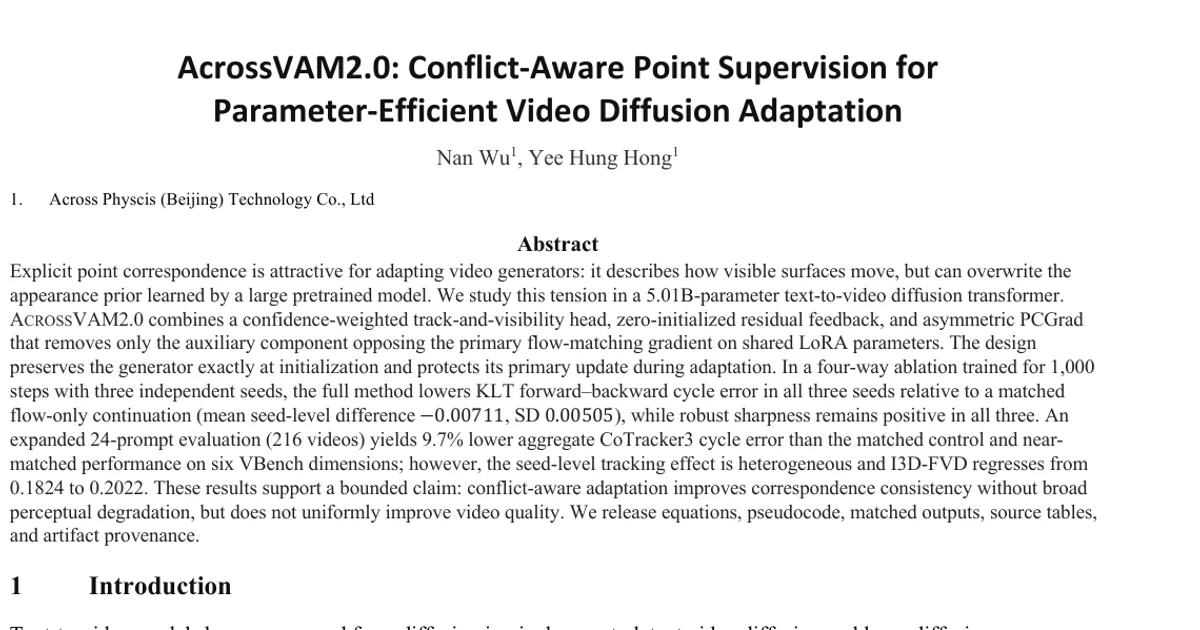
Explicit point correspondence is attractive for adapting video generators: it describes how visible surfaces move, but can overwrite the appearance prior learned by a large pretrained model. We study this tension in a 5.01B-parameter text-to-video diffusion transformer. ACROSSVAM2.0 combines a confidence-weighted track-and-visibility head, zero-initialized residual feedback, and asymmetric PCGrad that removes only the auxiliary component opposing the primary flow-matching gradient on shared LoRA parameters. The design preserves the generator exactly at initialization and protects its primary update during adaptation. In a four-way ablation trained for 1,000 steps with three independent seeds, the full method lowers KLT forward-backward cycle error in all three seeds relative to a matched flow-only continuation (mean seed-level difference -0.00711, SD 0.00505), while robust sharpness remains positive in all three. An expanded 24-prompt evaluation (216 videos) yields 9.7% lower aggregate CoTracker3 cycle error than the matched control and near-matched performance on six VBench dimensions; however, the seed-level tracking effect is heterogeneous and I3D-FVD regresses from 0.1824 to 0.2022. These results support a bounded claim: conflict-aware adaptation improves correspondence consistency without broad perceptual degradation, but does not uniformly improve video quality. We release equations, pseudocode, matched outputs, source tables, and artifact provenance.