Research
Accelerated Multiple Wasserstein Gradient Flows for Multi-objective Distributional Optimization
Overview Research area: Machine learning theory — multi-objective optimization over probability distributions (Wasserstein space), with connections to Nesterov acceleration, gradient flows, and multi-
- arXiv
- 2601.19220
- Published
- 2026-01-27
- Authors
- Dai Hai Nguyen, Duc Dung Nguyen, Atsuyoshi Nakamura, Hiroshi Mamitsuka
AI summary
Overview
Research area: Machine learning theory — multi-objective optimization over probability distributions (Wasserstein space), with connections to Nesterov acceleration, gradient flows, and multi-target sampling.
Technical level: Advanced. The paper builds on optimal transport, Wasserstein-2 geometry, geodesic convexity, and damped Hamiltonian dynamics.
One-sentence scope: The paper proposes and theoretically analyzes an accelerated version of the Multiple Wasserstein Gradient Descent algorithm, proving faster convergence rates for multi-objective distributional optimization and validating them in multi-target sampling experiments.
What This Paper Is About
The paper studies Multi-Objective Distributional Optimization (MODO), where the goal is to find a single probability distribution that simultaneously minimizes several objective functionals defined over the space of probability distributions — a setting that extends classical multi-objective optimization from Euclidean space to probability space. A motivating case is multi-target sampling, where each objective is the Kullback–Leibler divergence between the current distribution and one of several unnormalized target distributions. The authors ask whether the existing Multiple Wasserstein Gradient Descent (MWGraD) algorithm can be accelerated, in the same way that Nesterov's accelerated gradient improves on plain gradient descent in Euclidean optimization.
Key Contributions
-
A continuous-time formulation of MWGraD. The authors construct the "MWGraD flow," a probability-space gradient flow whose velocity field is built from convex combinations of the Wasserstein gradients of the objectives, and prove in Theorem 3.5 that the merit function satisfies 𝓜(ρ_t) = 𝒪(1/t).
-
An accelerated algorithm, A-MWGraD. Inspired by damped Hamiltonian dynamics for Nesterov acceleration, they define the accelerated MWGraD flow and prove in Theorem 3.7 a rate of 𝓜(ρ_t) = 𝒪(1/t²) for geodesically convex objectives and 𝓜(ρ_t) = 𝒪(e^{−√β t}) for β-strongly geodesically convex objectives. The authors state this is the first acceleration result for multi-objective optimization in probability spaces.
-
Explicit Gaussian-family characterizations. Theorems 3.1 and 3.6 reduce the infinite-dimensional MWGraD and A-MWGraD flows to finite-dimensional matrix-valued ODEs in the covariance matrix when the targets are zero-mean Gaussians and the objectives are KL divergences, and prove the covariance remains positive definite for all t ≥ 0.
-
A practical, sampling-efficient discretization. They derive a particle implementation of the accelerated flow, including strategies for efficiently estimating Wasserstein gradients in multi-target sampling tasks, aimed at fast sampling algorithms.
Main Findings
-
MWGraD flow converges at 𝒪(1/t): Theorem 3.5 shows 𝓜(ρ_t) ≤ R/(2t) for all t ≥ 0 when each objective F_k is geodesically convex and Assumption 3.2 holds, using a Lyapunov functional based on the squared Wasserstein-2 distance to a reference distribution q.
-
A-MWGraD achieves 𝒪(1/t²) in the geodesically convex case: With α_t = α/t and α ≥ 3, Theorem 3.7 gives 𝓜(ρ_t) ≤ (α − 1)R / t², improving on the 𝒪(1/t) rate of MWGraD.
-
Exponential rate under strong geodesic convexity: With β > 0 and α_t = 2√β, the bound is 𝓜(ρ_t) ≤ e^{−√β t} [ min_{l∈[K]} F_l(ρ_0) + βR/2 ], which is 𝒪(e^{−√β t}).
-
Gaussian case reduces to ODEs: Theorem 3.1 and Theorem 3.6 give explicit matrix ODEs for the covariance Σ_t (and momentum S_t), with weights w_t obtained by a simplex-constrained minimization of a weighted Wasserstein gradient norm. Positive definiteness of Σ_t is preserved for all t ≥ 0.
-
Merit function as a convergence certificate: 𝓜(ρ) = sup_q min_k {F_k(ρ) − F_k(q)} is nonnegative for all ρ, and ρ is weakly Pareto optimal if and only if 𝓜(ρ) = 0.
-
Empirical advantage over MWGraD: The abstract reports that numerical experiments on synthetic and real-world datasets show A-MWGraD consistently converges faster than MWGraD in convergence speed and sampling efficiency on multi-target sampling tasks. Figure 1 compares SVGD-based variants and Blob-based variants for GradNorm over 1000 iterations at three step sizes η = 0.001, 0.005, and 0.01. The paper content provided does not name the specific real-world datasets or report their sizes.
-
Single-objective consistency: When K = 1, the A-MWGraD flow reduces to the Wasserstein accelerated information gradient (W-AIG) flow.
Methodology in Plain English
The researchers start from the existing MWGraD algorithm, which at each step computes the Wasserstein gradient of every objective and blends them into a single descent direction by solving a small simplex-constrained minimum-norm problem. They then treat the algorithm's particles as samples from a moving distribution and take the step size to zero, which turns the iterations into a continuous-time flow of distributions with an accompanying velocity potential.
To add acceleration, they borrow the trick behind Nesterov's method: introduce a momentum variable coupled to the state through a damped Hamiltonian. In the probability-space version the "state" is the distribution and the "momentum" is a function on the sample space, so acceleration appears as an extra damping term α_t and a quadratic velocity term in the evolution equation for the potential. The aggregation step from MWGraD is preserved inside a projection onto the convex hull of the objectives' first variations.
For the theory, they prove that a carefully chosen Lyapunov functional — built from the objective gap, the transport-map discrepancy, and the velocity field — is non-increasing, which yields the claimed rates. Because the general problem is infinite-dimensional, they also verify that everything collapses to a tractable matrix ODE when all distributions are zero-mean Gaussians and the objectives are KL divergences. Finally, they convert the accelerated flow back into a discrete particle update with initial velocity zero, giving an implementable sampling procedure.
Why This Matters
Impact on research: The paper supplies the first acceleration guarantee for multi-objective optimization over probability distributions, connecting two previously separate strands — momentum methods in Euclidean multi-objective optimization and accelerated gradient flows in Wasserstein space. It also provides a continuous-time lens for understanding MWGraD, which previously had only an algorithmic description. The convergence analysis introduces a merit function and a weighted-gradient-norm formulation that may be reusable for other multi-objective sampling methods.
Real-world applications (as motivated or implied by the paper's multi-target sampling framing):
- Multi-target Bayesian inference, where posterior distributions for several models or datasets must be represented simultaneously by one set of samples.
- Multi-task posterior sampling with particle methods.
- Generative modeling tasks where a single particle population must approximate multiple target densities.
- Fast sampling across multiple target distributions, supported by the paper's emphasis on sampling efficiency.
Industry relevance: Any setting that trains or samples from several probabilistic models at once benefits from a method that reaches weakly Pareto optimal distributions faster and with fewer particles. The paper's framing around Bayesian inference and particle sampling points to data science and machine learning pipelines where sampling cost dominates.
Future Directions
- Well-posedness beyond the Gaussian family: The authors state that establishing existence, uniqueness, and well-posedness of the MWGraD flow in more general distributional settings remains an interesting direction of future work.
- Richer convergence conditions: The theory relies on Assumption 3.2 (a finite radius to the weakly Pareto set) and Assumption 3.4 (strong geodesic convexity/regularity). Extending the rates to non-geodesically convex objectives is an open question.
- Tighter acceleration regimes: The geodesically convex bound requires α ≥ 3, and the strongly convex bound uses α_t = 2√β. Investigating other damping schedules and their matching lower bounds would clarify whether these rates are optimal.
- Broader empirical validation: The abstract reports experiments on synthetic and real-world datasets but the content provided does not name the datasets, so systematically extending the empirical study — including to more objectives K and higher dimensions — remains a natural next step.
Target Audience
This paper is aimed at researchers and graduate students working on optimal transport, Wasserstein gradient flows, multi-objective optimization, and particle-based sampling methods such as Stein variational gradient descent. It is also relevant to practitioners in Bayesian inference and probabilistic machine learning who need efficient samplers for multiple target distributions and who are comfortable with the underlying mathematical machinery.
Authors’ abstract
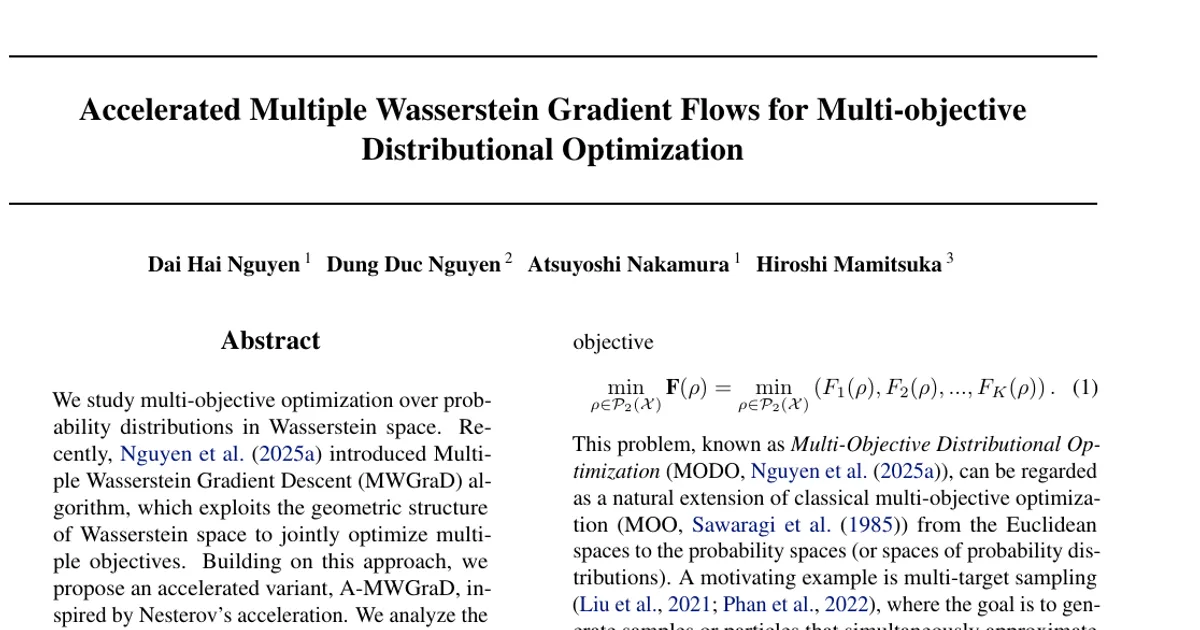
We study multi-objective optimization over probability distributions in Wasserstein space. Recently, Nguyen et al. (2025) introduced Multiple Wasserstein Gradient Descent (MWGraD) algorithm, which exploits the geometric structure of Wasserstein space to jointly optimize multiple objectives. Building on this approach, we propose an accelerated variant, A-MWGraD, inspired by Nesterov's acceleration. We analyze the continuous-time dynamics and establish convergence to weakly Pareto optimal points in probability space. Our theoretical results show that A-MWGraD achieves a convergence rate of O(1/t^2) for geodesically convex objectives and O(e^{-\sqrtβt}) for $β$-strongly geodesically convex objectives, improving upon the O(1/t) rate of MWGraD in the geodesically convex setting. We further introduce a practical kernel-based discretization for A-MWGraD and demonstrate through numerical experiments that it consistently outperforms MWGraD in convergence speed and sampling efficiency on multi-target sampling tasks.