Research
ABRA: Agent-Bound UI for Human-Agent Communication beyond Chat with Reusable Views
Overview Research area: Human–Computer Interaction, specifically human–agent communication interfaces and LLM-backed agent tool use. Technical level: Intermediate. Readers will get the most out of it
- arXiv
- 2610.30780
- Published
- 2026-10-22
- Authors
- Seon Gyeom Kim, Hannah Kim
AI summary
Overview
Research area: Human–Computer Interaction, specifically human–agent communication interfaces and LLM-backed agent tool use.
Technical level: Intermediate. Readers will get the most out of it with some familiarity with LLM agents, tool calling, and interaction-design concepts such as direct manipulation, but the core argument is stated in plain terms.
Scope (one sentence): The paper proposes Agent-Bound UI, an interaction model in which reusable interactive views carry task-specific meanings that agents bind and publish as shared state, and realizes it in the ABRA prototype, which is evaluated with four LLM-backed agents on canvas authoring, consequence resolution, and cross-agent invocation.
What This Paper Is About
Agents now produce rich, structured output such as tables, flowcharts, artifacts, and interactive canvases, but the channel for user input has stayed mostly plain chat. The authors call this mismatch the representation–interaction asymmetry: the agent-to-human direction is structured and multimodal, while the human-to-agent direction is still natural language. Their goal is to make the surfaces the agent already renders directly manipulable, and to have agents bind and publicly publish what each manipulation means for the current task, so that both humans and other agents can read those meanings and act on them.
Key Contributions
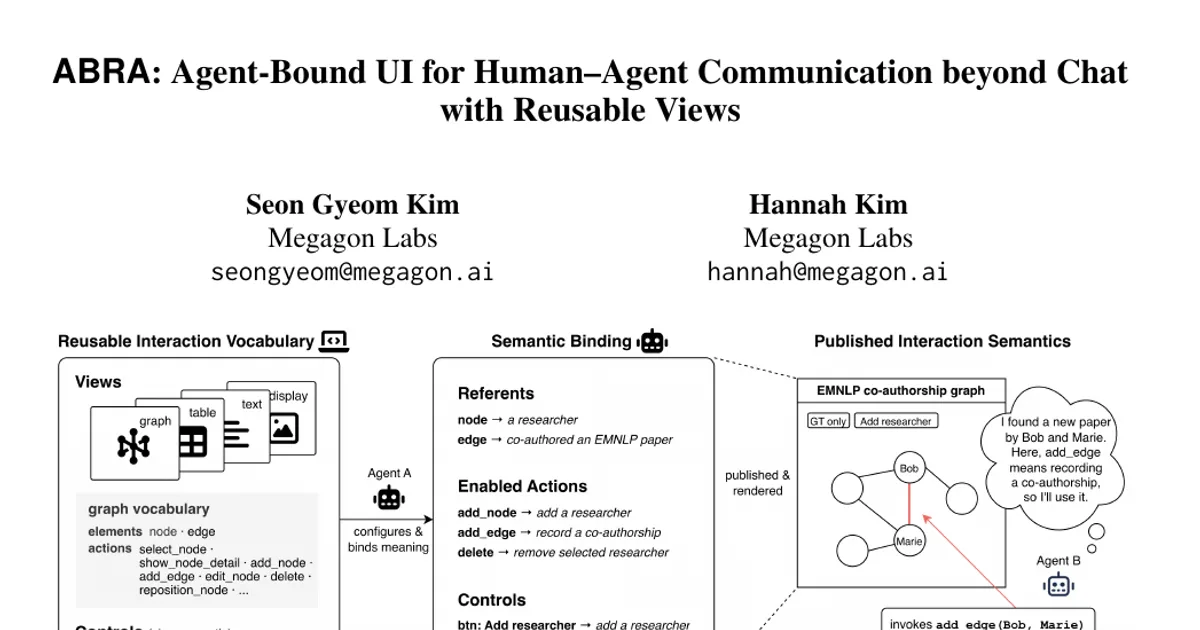
- Agent-Bound UI, an interaction model that separates a reusable interaction vocabulary (a view, defining elements and actions such as adding a node, editing a cell, or sorting a column) from task-specific semantic bindings that the agent assigns at runtime, so the same surface can mean different things across tasks.
- A published-semantics mechanism: bindings between view elements and task referents, the set of enabled actions, and each action's task-specific meaning are stored as shared canvas state rather than private agent logic, so humans and other agents can inspect them.
- ABRA (Agent-Bound Readable Interactions), an open, framework-agnostic prototype with a chat panel and a canvas panel, four view types (graph, table, text, display), and an agent tool interface of
create_canvas,read_canvas,update_canvas,fire_action, andclose_canvas; code and a demo video are released at github.com/megagonlabs/abra. - A case study and controlled experiments using a collaborative World Cup analysis scenario with three specialized agents, plus three isolated capability tasks run against four LLM-backed agents.
Main Findings
- Canvas creation is largely reliable at the structural level. For
create_canvas(n = 135), pass rates ranged from 88.9% (GPT-5.4-mini) to 97.8% (GPT-5.4), with Opus 4.8 at 91.9% and Haiku 4.5 at 93.3%; remaining failures were attributed to schema or shape errors. - Updates to owned canvases are near-perfect. For
update_canvas(n = 99), pass rates ranged from 98.0% to 100.0%. The four failures (two from Opus 4.8, two from GPT-5.4-mini) modified content beyond the expected consequence. - Cross-agent invocation exposes the largest model gap. For
fire_action(n = 99), Opus 4.8, GPT-5.4, and Haiku 4.5 passed between 91.9% and 100% of runs, while GPT-5.4-mini passed 66.7%. Of its 33 failures, 24 calledupdate_canvasinstead offire_action, eight omitted the requiredpath, and one produced no action. - View selection is partially correct, not fully correct. View recall ranged from 56% to 78% across models, while exact all-or-nothing selection ranged from 33% to 53%, indicating that multi-view requests often produced some but not all expected views.
- Element binding was perfect; specification format was not. Element binding reached 100% for every model, but spec format fell to 65% for GPT-5.4, which frequently placed the
configblock insidecontentrather than at the root. - Semantic descriptions vary in quality. Action meaning fell to 76% for Haiku 4.5, which often restated the action name rather than describing its task-specific effect.
- Cross-view referent coordination is rare. Shared
reflinking appeared in only 0/9/12/15 runs (Opus 4.8 / Haiku 4.5 / GPT-5.4 / GPT-5.4-mini); Opus 4.8 did not coordinate referents across views in any run. - Successful fires are semantically sound. Among structurally valid
fire_actionruns, judged performance was near ceiling, with action selection at 100% for all four models — agents that invoked an action generally selected the correct published binding and grounded the correct element. - The case study shows agents both accepting and rejecting manipulations. In the World Cup scenario, an agent generalized a user's abbreviation of "Forward" to "FW" across a column, while an owner agent rejected a graph edge that violated the tournament structure, illustrating that views define what users can attempt and agents determine which attempts are meaningful.
Methodology in Plain English
The authors first define an interaction model. A view is a reusable set of addressable elements (nodes, edges, rows, columns, cells, paragraphs, items) plus actions over them; a canvas instantiates one or more views with concrete content and meaning. They separate a gesture (click, drag) from an action (edit a cell, add an edge), and separate actions into two handling modes: local effects the view can finish on its own (selection, highlighting, panning, sorting, filtering) and consequences that require task-specific reasoning and are resolved by the agent that owns the canvas. The agent's bindings — element-to-referent links, which actions are enabled, and what each action means — are written into shared canvas state.
The prototype implements this with React-based views, a Node.js canvas hub that synchronizes state among participants, and Python agent adapters, wired through structured tool calls. For evaluation, the authors built three isolated task suites: canvas authoring (45 cases, 15 configurations — 4 single-view and 11 multi-view — each with three domain variations and an additional interactive variant requiring direct manipulation), consequence resolution (33 cases over 11 consequence-producing actions across three domains), and cross-agent invocation (33 cases over 11 actions across three domains). Every case was run three times per model with a fresh agent instance, and each agent got a single response turn. Outputs were checked both deterministically (schema validity, required formats, expected outcomes) and by an LLM evaluator from a separate model family (Gemini 3.1 Pro) using published rubrics covering criteria such as view selection, referent coverage, element and spec format, action meaning, target reference, and style convention. The four agents used Claude Opus 4.8, Claude Haiku 4.5, GPT-5.4, and GPT-5.4-mini.
Why This Matters
The paper reframes a design problem that most agent systems sidestep: as agents produce ever-richer artifacts, the interface for expressing intent should become the artifact itself, and the meaning of manipulations should be explicit, shared, and machine-readable rather than buried in generated code or private agent logic. It also positions this binding layer as complementary to transport protocols such as AG-UI, A2A, and MCP/MCP Apps, which move state, messages, and events but do not define what an interaction means.
Real-world applications:
- Analytic and reporting workspaces: a table, graph, and notes set that an analyst refines directly while agents maintain the underlying data and propagate conventions across a column.
- Planning and dependency modeling: dependency graphs where connecting two nodes means "these steps are ordered," and where an owner agent can reject connections that violate the underlying structure.
- Multi-agent enterprise workflows: one agent publishes a canvas with interaction semantics, and a second agent invokes those actions later without any private channel — as when a curator agent asks an analyst agent to extend a shared table rather than duplicating it.
- Document and knowledge-editing surfaces: text and display views where highlighting, collapsing, and edits carry task-specific meaning that other participants can interpret consistently.
Industry relevance: the work gives agent-platform builders a concrete alternative to "chat plus generated widgets," and a vocabulary-level contract that could be implemented over existing agent protocols.
Future Directions
- Discovering reusable vocabularies with broad coverage. The authors state that determining interaction vocabularies that cover many tasks remains challenging, and propose mining common views and actions from existing interactive systems and measuring coverage over diverse task benchmarks.
- User studies of published semantics. The paper explicitly notes it has not evaluated how well users interpret published interaction semantics or how those semantics affect the overall interaction experience, and whether agent-bound interaction improves outcomes versus chat.
- Improving semantic grounding in weaker models. The gap between near-ceiling structural validity and uneven judged criteria (spec format, action meaning, cross-view referent coordination) points to work on agents that follow open-ended specifications and link entities across views consistently.
- Generalizing beyond the prototype. Because the current prototype fixes one execution mode per action for simplicity and resolves consequences through the owner agent, the paper leaves open how richer ownership models and other deployment environments would behave.
Target Audience
HCI researchers and interaction designers working on human–agent communication; LLM agent and agent-platform engineers interested in tool interfaces, shared state, and multi-agent coordination; and practitioners building agentic products who want a principled alternative to chat-only input, especially those already working with canvas, artifact, or widget-based agent interfaces.
Authors’ abstract
Agents can create rich representations, yet these representations are rarely used as a medium for expressing user intent. We present Agent-Bound UI, an interaction model that separates reusable interaction structures from task-specific meanings. Agents bind task-specific meanings to interactions in reusable views and publish the resulting bindings as shared state, enabling humans and agents to understand and act on shared surfaces whose meanings vary across tasks. We implement ABRA, a framework-agnostic prototype of Agent-Bound UI, in which users and agents collaborate through chat and shared interactive canvases. We demonstrate ABRA through a representative use case and evaluate four LLM-backed agents on canvas authoring, owner-side consequence resolution, and cross-agent invocation. The code and demo video are available at https://github.com/megagonlabs/abra.