Research
A Review: PTSD in Pre-Existing Medical Condition on Social Media
Overview Research area: Natural Language Processing and machine learning applied to mental health, specifically the intersection of Post-Traumatic Stress Disorder (PTSD) and pre-existing medical condi
- arXiv
- 2601.08836
- Published
- 2025-12-15
- Authors
- Zaber Al Hassan Ayon, Nur Hafieza Ismail, Nur Shazwani Kamarudin
AI summary
Overview
Research area: Natural Language Processing and machine learning applied to mental health, specifically the intersection of Post-Traumatic Stress Disorder (PTSD) and pre-existing medical conditions as expressed on social media.
Technical level: Intermediate. The paper is a review rather than a new system, but it engages with NLP/ML approaches and clinical concepts, so some familiarity with both areas helps.
Scope: A critical literature review, covering work published from 2008 to 2024, on how PTSD manifests and is managed in people with chronic conditions and how that experience appears on social media platforms such as X (formerly Twitter) and Facebook.
What This Paper Is About
People who already live with a chronic illness and also develop PTSD face a combined burden that most PTSD research treats separately. This review asks what the academic literature says about that overlap, and specifically what can be learned from how these individuals talk about their experiences on social media. The goal is to establish whether social media — combined with NLP and machine learning tools — can serve as a practical way to detect, monitor, and support this population.
Key Contributions
-
A systematic review of the PTSD–chronic illness intersection on social media. The paper consolidates literature spanning 2008 to 2024 that examines how PTSD presents in individuals who also have conditions such as cancer, heart disease, and autoimmune disorders.
-
A synthesis of platform-specific evidence. It focuses on online expression on X (formerly Twitter) and Facebook, examining how these platforms surface the experiences of people with comorbid PTSD and chronic illness.
-
An assessment of NLP and ML for case identification. The review reports that these techniques can identify potential PTSD cases within these populations, with accuracy rates between 74% and 90%.
-
A case for integrating pre-existing conditions into PTSD research and care. The paper argues that chronic illness must be treated as a relevant factor in how PTSD is studied, detected, and treated, and frames social media as a monitoring and support channel for vulnerable groups.
Main Findings
-
Social media data carries signal about dual diagnoses: The abstract states that social media data offers valuable insight into the distinct challenges faced by people who have both PTSD and a chronic illness — challenges that are not visible in research that studies either condition alone.
-
NLP and ML can flag likely PTSD cases: Automated techniques applied to this kind of data can identify potential PTSD cases in these populations, with reported accuracy between 74% and 90%. The abstract does not specify which models, features, or datasets produced this range.
-
Online communities shape coping and early intervention: Support communities play a role in how members develop coping strategies and in enabling earlier intervention, according to the review.
-
Chronic illness is an under-addressed factor: The review concludes that PTSD research and treatment need to account for pre-existing medical conditions rather than treating PTSD as a uniform condition.
Methodology in Plain English
The authors conducted a review rather than a new experiment. They systematically collected and analyzed published literature from 2008 through 2024 that deals with PTSD in people who have chronic conditions, with particular attention to studies drawing on social media content from X and Facebook. From that body of work they drew out patterns about how PTSD shows up in these populations, how NLP and machine learning have been used to detect it, and what role online communities play. The abstract is the only material available here, so it does not describe the search strategy, databases queried, inclusion criteria, or how many studies were reviewed.
Why This Matters
Impact on research: The review pushes back on treating PTSD as a standalone diagnosis in text analysis and clinical study, arguing that pre-existing medical conditions change the picture. It positions social media as a data source that clinical settings alone do not capture.
Real-world applications:
- Early screening: Flagging people with chronic illness who may be developing PTSD, using language patterns from public or community posts rather than waiting for a clinical referral.
- Peer support design: Informing how online communities for cancer, heart disease, or autoimmune patients are structured, given their demonstrated role in coping and intervention.
- Clinical care planning: Encouraging providers treating chronic illness to consider co-occurring PTSD in assessment and treatment.
- Public health monitoring: Using aggregated social media signals as a population-level indicator of distress among medically vulnerable groups.
Industry relevance: The 74%–90% accuracy range reported in the abstract is the kind of performance that matters to companies building mental health screening tools, digital health platforms, and social media trust-and-safety systems, all of which need to know both what is achievable and where the ethical and clinical limits lie. The findings also support the case for integrating mental health signals into chronic disease management products.
Future Directions
-
Developing targeted interventions: The abstract states that future work should aim at interventions designed specifically for people with comorbid PTSD and chronic illness, but does not specify what those interventions would look like.
-
Standardizing detection methods: The wide 74%–90% accuracy range reported across studies points to a need for consistent datasets, definitions, and evaluation practices, though the abstract does not propose a specific standard.
-
Translating monitoring into care: If social media can identify at-risk individuals, the open question is how that signal reaches clinicians and support systems without causing harm.
-
Addressing clinical implications in detail: The abstract notes that clinical implications are discussed, but the specific recommendations are not included in the abstract itself.
Target Audience
Researchers in NLP and machine learning who work on mental health applications will find the accuracy figures and the review of detection approaches useful. Clinical psychologists, psychiatrists, and chronic illness specialists benefit from the argument that PTSD and physical illness should be assessed together. Digital health product teams and platform policy groups can use the review to understand where automated detection is feasible and where oversight is required. Patients, caregivers, and online community moderators in chronic illness spaces will find the framing of social media as a support and monitoring tool directly relevant.
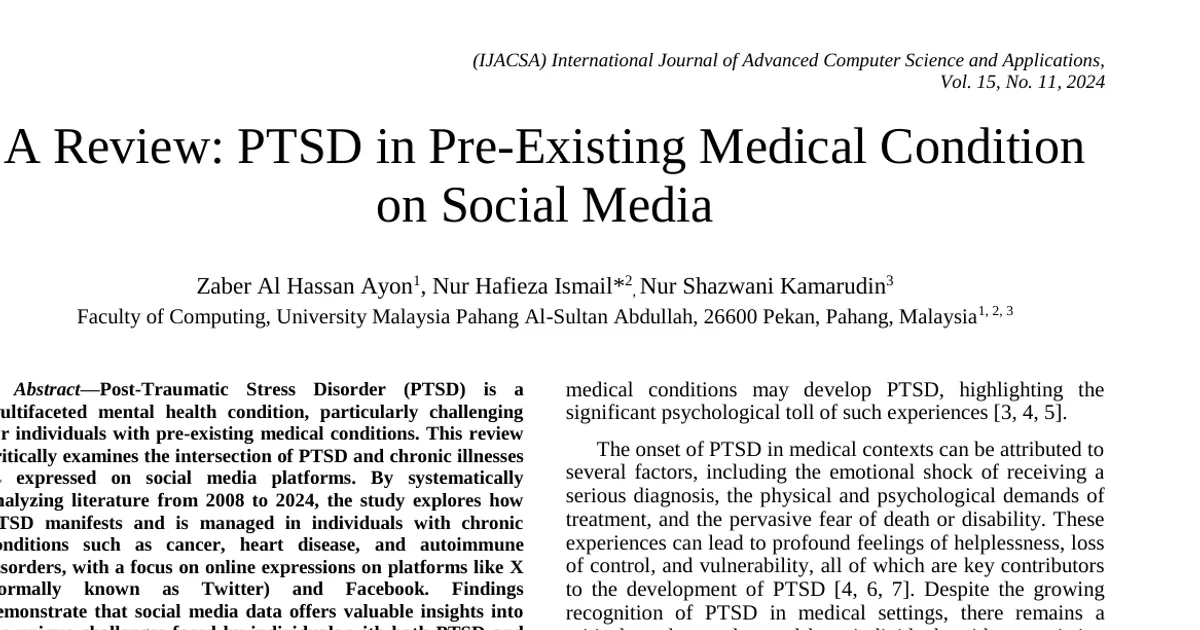
Authors’ abstract
Post-Traumatic Stress Disorder (PTSD) is a multifaceted mental health condition, particularly challenging for individuals with pre-existing medical conditions. This review critically examines the intersection of PTSD and chronic illnesses as expressed on social media platforms. By systematically analyzing literature from 2008 to 2024, the study explores how PTSD manifests and is managed in individuals with chronic conditions such as cancer, heart disease, and autoimmune disorders, with a focus on online expressions on platforms like X (formally known as Twitter) and Facebook. Findings demonstrate that social media data offers valuable insights into the unique challenges faced by individuals with both PTSD and chronic illnesses. Specifically, natural language processing (NLP) and machine learning (ML) techniques can identify potential PTSD cases among these populations, achieving accuracy rates between 74% and 90%. Furthermore, the role of online support communities in shaping coping strategies and facilitating early interventions is highlighted. This review underscores the necessity of incorporating considerations of pre-existing medical conditions in PTSD research and treatment, emphasizing social media's potential as a monitoring and support tool for vulnerable groups. Future research directions and clinical implications are also discussed, with an emphasis on developing targeted interventions.