Research
A Mind Cannot Be Smeared Across Time
Overview Research area: Machine consciousness and the formal foundations of Artificial Intelligence — specifically the architecture-level question of whether a machine could be conscious given when an
- arXiv
- 2601.11620
- Published
- 2026-01-11
- Authors
- Michael Timothy Bennett
AI summary
Overview
- Research area: Machine consciousness and the formal foundations of Artificial Intelligence — specifically the architecture-level question of whether a machine could be conscious given when and how it computes, not just what it computes.
- Technical level: Advanced. The paper is written in the language of formal definitions, lemmas, theorems and proofs (Stack Theory notation, set algebra, temporal modal operators), though the motivating question is stated in plain language.
- Scope: The paper adds a "Stack-Time Semantics" module to Stack Theory, proves that existential temporal realisation does not distribute over conjunction, and uses that result to distinguish two postulates about conscious unity (Chord and Arpeggio) whose consequences are measured by a new architectural quantity, concurrency capacity.
What This Paper Is About
The paper asks whether the timing of computation — as opposed to the content of computation — can determine whether a machine is conscious. Its core point is that most deployed artificial systems realise their functions through sequential or time-multiplexed updates, whereas a moment of conscious experience feels unified and simultaneous, and it sets out to prove that this difference is formally meaningful rather than merely intuitive. The goal is to turn the "Temporal Gap" (proposed in earlier work but not rigorously formalised) into a testable architectural question about synchrony and concurrency.
Key Contributions
-
A Stack-Time Semantics addendum to Stack Theory. The paper introduces induced layer time, window environments, temporal lifting operators, and algebraic laws relating within-window satisfaction to conjunction, so that "over time" constraints can be compiled into pointwise semantics at a new abstraction layer.
-
A compositional grounding result. It proves (Theorem 1) that any higher-layer statement can be grounded compositionally down to the base layer while preserving truth conditions exactly.
-
The core non-commutation theorem. It proves (Theorem 3) that the existential temporal lift ◇_Δ does not commute with conjunction, giving a precise formal statement of the Temporal Gap — ingredient-wise occurrence is strictly weaker than co-instantiation in general.
-
Chord and Arpeggio as competing postulates, plus a concurrency-capacity threshold. It states two postulates about what constrains phenomenality (Definitions 16 and 17) and proves (Theorem 4) that architectures with concurrency capacity below the number of required contributors can satisfy ingredient-wise occurrence while forbidding co-instantiation.
Main Findings
-
Grounding preserves truth conditions. Theorem 1 states that for any stack and any statement l^m at layer m, the truth set of the base-layer compositional grounding equals the truth set of l^m itself. The paper calls the base-layer result the grounded conjunction of the moment statement.
-
Layer time can be arbitrarily sparse. Proposition 1 shows that for any N in the natural numbers, there exist an environment, a vocabulary and a trajectory such that the induced trajectory changes at most once in the first N objective steps. Higher-layer ticks are maximal objective-time blocks of constant encoding, so subjective moments need not correspond to single objective instants.
-
Universal lift distributes over conjunction; existential lift does not. Theorem 2 shows □_Δ commutes with conjunction (because "for all" distributes over conjunction). Theorem 3 shows only the inclusion ◇_Δ T(l) ⊆ T(◇_Δ l), and that the inclusion is strict for Δ ≥ 1 and statements with two or more ingredients. The paper's counterexample uses Φ = {a, b, c}, vocabulary {p, q} with p = {a, c} and q = {b, c}, Δ = 1 and the window σ = (a, b): both ingredients occur in the window, but neither a nor b lies in p ∩ q = {c}.
-
Degenerate cases and reading the theorem back. Remark 3 notes that if Δ = 0 or |l| ≤ 1 then equality holds; strict separation requires Δ ≥ 1 and at least two ingredients. Remark 4 identifies ingredient-wise satisfaction with τ_Δ(t) ∈ T(◇_Δ l) and co-instantiation with τ_Δ(t) ∈ ◇_Δ T(l), so Theorem 3 is exactly the claim that ingredient-wise satisfaction is strictly weaker than co-instantiation.
-
Two postulates, Chord and Arpeggio. Chord (Definition 16) requires that if a moment is experienced, then within the corresponding subjective window there is at least one objective time-slice where the entire grounded conjunction holds. Arpeggio (Definition 17) requires only that each grounded ingredient occurs somewhere in the window, and explicitly permits experience without any instant realising the full conjunction.
-
A concurrency-capacity threshold. In the contributor model (Definition 18), an architecture has concurrency capacity c if at most c of the n ≥ 2 contributors are active at any objective time. Theorem 4: if c < n, no window at any horizon ever contains an element of T(l_n), so co-instantiation is impossible; but if every contributor is activated at least once within a horizon-Δ window, ingredient-wise satisfaction still holds.
-
Sequential versus synchronous architectures. Corollary 1 states that under Chord, a sequential-update architecture with capacity c < n cannot phenomenally realise a moment statement whose grounding contains an n-way conjunctive substatement; under Arpeggio the same architecture remains a candidate; and a synchronous architecture with capacity c ≥ n can host the moment under both postulates.
-
Evidence tentatively favouring Chord. In masking, conscious perception correlates with transient long-range gamma phase synchrony across cortical areas even when local activity is similar across seen versus unseen stimuli (Melloni et al., 2007). In non-REM sleep, TMS-EEG responses become strong yet local and fail to propagate, consistent with a breakdown of effective connectivity (Massimini et al., 2005). Perturbational measures such as PCI track level of consciousness across wake, sleep, anaesthesia and disorders of consciousness (Casali et al., 2013). The paper states these findings do not prove Chord but make Arpeggio's existential permissiveness less compelling, and treats Chord as the default working hypothesis, a step it calls defeasible.
-
Instrumentable metrics. The paper defines a minimal horizon for ingredient coverage, w_ing(g⁰, τ), and a minimal horizon for co-instantiation, w_co(g⁰, τ). The strict Temporal Gap pattern is w_ing < w_co, or w_co = ∞. The paper notes these are instrumentable when base-layer ingredients are defined in terms of architectural state variables, and aligns this with the view that behaviour alone may be insufficient for consciousness assessment and that concrete indicator properties should be checked against candidate theories (Butlin et al., 2023).
-
No empirical experiments are reported. The paper is a formal and conceptual contribution; it reports no datasets, no benchmarks, no model evaluations and no new measurements.
Methodology in Plain English
The author builds a formal language in which a "state" is a point of change in an environment, a "program" is a set of states, a "statement" is a bundle of programs that must all be true at once (so conjunction is set intersection), and a "stack" is a hierarchy of abstraction layers where each layer's vocabulary is generated by the policy chosen at the layer below. On top of this existing machinery, the paper adds a time module. Objective time is a discrete step counter for change; at each layer you write down which of that layer's programs are true, and consecutive objective steps with the same encoding collapse into a single higher-layer "tick".
The central move is to treat a whole window of Δ+1 consecutive states as one new state, then define two operators on that window environment: ◇_Δ ("this program is true at least once in the window") and □_Δ ("this program is true at every step in the window"). The question of whether a moment is experienced as unified then becomes a question about which operator is the right one. The paper proves that □_Δ behaves well with conjunction while ◇_Δ does not, works through a small concrete counterexample to show the gap is real, and then formalises the two competing readings as postulates. Finally, it models contributor activation directly, so that "how many things can be true together at once" becomes a single number — concurrency capacity — and proves what that number rules out.
Why This Matters
Impact on research. The Temporal Gap is converted from an informal worry into an algebraic and architectural question with a proof behind it. If Chord is even plausible, then behavioural equivalence between a synchronous system and a sequential emulation does not settle phenomenal equivalence — which undercuts a common assumption in machine consciousness research that matching input-output behaviour is sufficient. The paper also supplies a concrete experimental design: build paired systems that are behaviourally matched at a reporting layer but differ in base-layer concurrency capacity (one synchronous with c ≥ n, one sequential with small c), pick contents whose groundings include large conjunctions, and measure w_ing and w_co. Chord predicts phenomenality tracks bounded w_co; Arpeggio predicts it may track w_ing alone.
Real-world applications (as framed by the paper and its discussion):
- AI consciousness and sentience assessment protocols — checking indicator properties against candidate theories rather than relying on behavioural tests alone, as the paper links to Butlin et al. (2023).
- Hardware and architecture decisions for AI systems — concurrency capacity is presented as an implementation parameter that bounds whether large grounded conjunctions can be instantiated at any objective instant, which is relevant when choosing between sequential and synchronous substrates.
- Deployment policy under uncertainty — the paper recommends treating large Temporal-Gap regimes (w_co ≫ w_ing, or w_co = ∞) as a high-uncertainty region for attribution, motivating conservative deployment policies until the Temporal Gap is better resolved.
- Ethics and moral status — the paper argues this creates an ethically salient zone of reasonable disagreement about moral status, particularly when a system could have valenced experience, and cites a precautionary stance toward sentience under uncertainty (Birch, 2024).
Industry relevance. The paper's headline consequence is that under Chord, software consciousness on a strictly sequential substrate is impossible for any content whose grounding requires two or more simultaneous contributors. The paper notes that real machines are not perfectly sequential at the physical level, so the practical question becomes which physical concurrency scale is relevant for grounding. It also draws contrasts between a "solid brain" with persistent structure supporting synchronous broadcast and a "liquid brain" such as an ant colony that computes through movement rather than persistent structure (Solé et al., 2019), and references polycomputing — simultaneously executing multiple functions using the same parts or physical substrate (Bongard and Levin, 2023).
Future Directions
- Resolving the Temporal Gap empirically. The paper's proposed paired-system experiment — behaviourally matched synchronous and sequential systems differing in base-layer concurrency, with w_ing and w_co measured — is stated but not carried out.
- Determining the relevant physical concurrency scale. Since real machines are not perfectly sequential at the physical level, the paper leaves open which physical concurrency scale matters for grounding conscious content.
- Causal exchange between co-instantiated ingredients. The paper points to Bennett (2026) for a condition in which each co-instantiated ingredient simultaneously acts upon the others, all linked and synchronised — a condition it says is formally included in Chord and is explored there rather than here.
- Concurrency is only one aspect. The conclusion states that extreme concurrency capacity may be needed, and still concurrency is only one aspect of the picture; consciousness according to Stack Theory requires a "tapestry of valence" supported by a solid-brained polycomputing architecture. Whether that further condition is necessary remains outside this paper's scope, as do the necessary ingredients of consciousness themselves, which the introduction explicitly places beyond its remit.
Target Audience
Readers who will benefit most are researchers working on the formal foundations of machine consciousness and on Stack Theory specifically, philosophers and scientists debating whether behaviour or architecture is the right basis for consciousness attribution, and AI safety and governance researchers concerned with how hardware-level properties might affect sentience assessments and deployment policy. Because the paper is proof-driven and assumes familiarity with its prior notation (Stack Theory, causal identities, valence-first learning theory), it is best suited to readers comfortable with formal methods; those seeking empirical results or benchmarks will not find them here.
Authors’ abstract
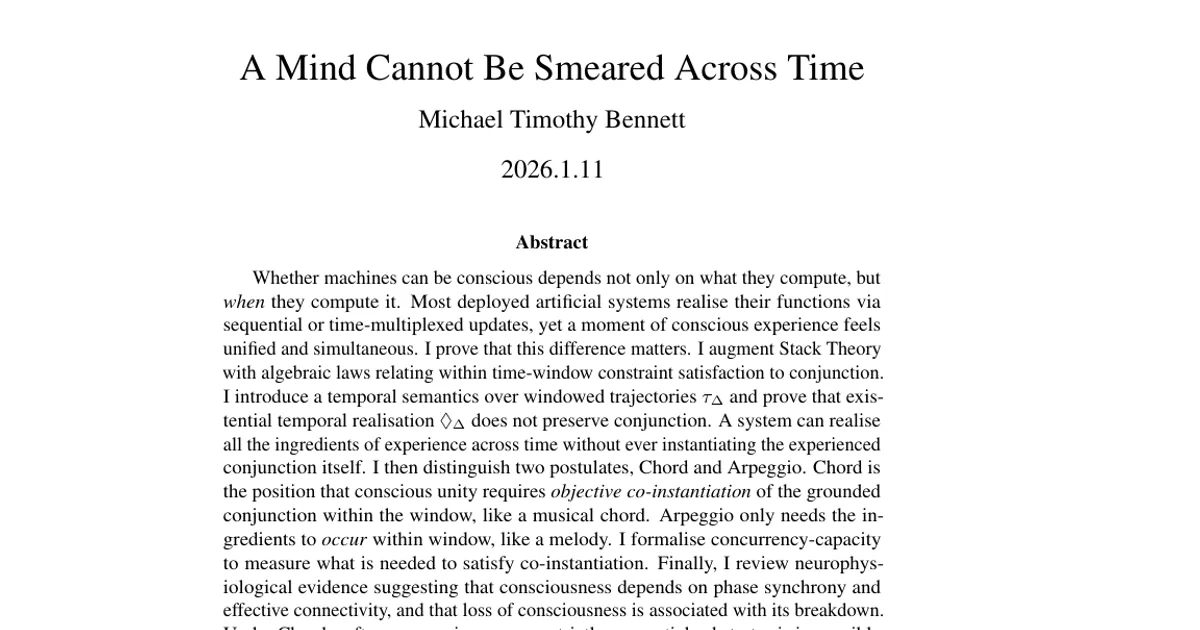
Whether machines can be conscious depends not only on what they compute, but \emph{when} they compute it. Most deployed artificial systems realise their functions via sequential or time-multiplexed updates, yet a moment of conscious experience feels unified and simultaneous. I prove that this difference matters. I augment Stack Theory with algebraic laws relating within time-window constraint satisfaction to conjunction. I introduce a temporal semantics over windowed trajectories $τ_Δ$ and prove that existential temporal realisation $\Diamond_Δ$ does not preserve conjunction. A system can realise all the ingredients of experience across time without ever instantiating the experienced conjunction itself. I then distinguish two postulates, Chord and Arpeggio. Chord is the position that conscious unity requires \textit{objective co-instantiation} of the grounded conjunction within the window, like a musical chord. Arpeggio only needs the ingredients to \textit{occur} within window, like a melody. I formalise concurrency-capacity to measure what is needed to satisfy co-instantiation. Finally, I review neurophysiological evidence suggesting that consciousness depends on phase synchrony and effective connectivity, and that loss of consciousness is associated with its breakdown. Under Chord, software consciousness on strictly sequential substrates is impossible for contents whose grounding requires two or more simultaneous contributors. The hardware matters.