Research
A Hybrid Deep Learning Model for Robust Biometric Authentication from Low-Frame-Rate PPG Signals
Overview Research area: Biometric authentication using photoplethysmography (PPG) signals and deep learning — combining biomedical signal processing with computer vision techniques (time–frequency ima
- arXiv
- 2511.04037
- Published
- 2025-11-06
- Authors
- Arfina Rahman, Mahesh Banavar
AI summary
Overview
Research area: Biometric authentication using photoplethysmography (PPG) signals and deep learning — combining biomedical signal processing with computer vision techniques (time–frequency image representations).
Technical level: Advanced. The paper assumes familiarity with convolutional neural networks, vision transformers, attention mechanisms, the Continuous Wavelet Transform, and biometric evaluation metrics such as EER and AUC.
Scope: The paper proposes and evaluates a hybrid CVT–ConvMixer–LSTM architecture for subject authentication using PPG signals extracted from low-frame-rate (14 Hz) monochrome blue-light fingertip videos from the CFISHR dataset.
What This Paper Is About
PPG signals — optical measurements of blood volume changes in the skin — carry individual physiological traits that can be used to identify people, but they are easily corrupted by motion artifacts, illumination changes, and natural differences between subjects. Most prior work relies on high-quality sensors and controlled conditions, so the authors set out to build a lightweight authentication framework that works from noisy, low-frame-rate (14 Hz) monochrome video. Their goal is a model that combines spatial, spectral, and temporal information to authenticate 46 enrolled subjects reliably under realistic deployment conditions.
Key Contributions
- A hybrid three-branch architecture (CVT–ConvMixer–LSTM) that jointly learns spatial and contextual representations from time–frequency scalograms (via the Convolutional Vision Transformer and ConvMixer branches) and temporal representations from the raw 1D signal (via the LSTM branch).
- Attention-based refinement inside the ConvMixer branch, added to emphasize user-specific physiological variation rather than generic signal structure.
- A preprocessing pipeline designed for low-frame-rate monochrome PPG, including baseline drift removal, motion artifact suppression using dynamic thresholding (PCA-based artifact suppression is cited in the abstract and contribution list), bandpass filtering (0.7–4 Hz), Fourier-based resampling to 70 Hz, and min–max normalization.
- Benchmarking on two datasets — BIDMC and the CFISHR dataset — with the paper stating that the approach outperforms the compared state-of-the-art systems.
Main Findings
- Authentication accuracy of 98% on 46 subjects: The abstract reports 98% authentication accuracy for the proposed system on the CFISHR dataset. In Table I, the CVT–ConvMixer–LSTM evaluated on CFISHR is listed at 0.98 accuracy, 0.95 sensitivity, 0.93 specificity, and 0.95 AUC.
- Strong cross-dataset result on BIDMC: The same hybrid model evaluated on the BIDMC dataset is reported in Table I with 0.98 accuracy, 0.96 sensitivity, 0.97 specificity, and 0.98 AUC.
- Ablation confirms both branches matter: On CFISHR, an LSTM-only configuration reached 89.48% accuracy, CVT+ConvMix reached 95.56%, and the combined hybrid reached 97.68% accuracy. The paper notes the hybrid outperformed both of its partial configurations.
- ROC analysis reflects the same ordering: The baseline LSTM achieved an AUC of 0.84, CvT-ConvMix reached 0.92, and the full CvT-ConvMix-LSTM reached 0.95, with the ROC curve rising steeply near the origin so most genuine attempts are detected at very low false positive rates.
- Comparison against prior systems (Table I): CorNET 0.96 accuracy / 0.90 AUC; CNN-LSTM 0.96 / 0.93; Fuzzy-Min-Max-NN 0.78 / 0.81; CVT-ConvMixer 0.95 / 0.96; the proposed hybrid 0.98 / 0.95 (CFISHR) and 0.98 / 0.98 (BIDMC). The paper states these comparison models were evaluated on the BIDMC dataset, while the final two rows were produced with separate processing pipelines on BIDMC and CFISHR.
- Signal properties captured: Scalograms of 5-second segments show dominant components below 2 Hz, consistent with the physiological heart rate range (the paper cites typical heart rate frequencies of 0.7–1.8 Hz), while analysis extends to 4 Hz to capture higher-order harmonics and transient features.
- Dataset details: Each participant recorded roughly 70 seconds of continuous right-thumb fingerprint video, sampled at 14 Hz, yielding 980 samples per recording; after resampling to 70 Hz, 4900 samples per subject and 27 segments per subject were produced.
Methodology in Plain English
The researchers started from video of a fingertip captured with a monochrome blue-light scanner at 14 frames per second, a rate far too low for clean cardiac measurements on its own. They converted each recording into a raw PPG trace, then cleaned it in stages: removing slow baseline drift, clipping extreme outliers from motion, bandpass filtering to the 0.7–4 Hz band of interest, resampling upward by a factor of five (from 14 Hz to 70 Hz) using Fourier-based interpolation for finer temporal detail, and normalizing amplitude so subjects are comparable.
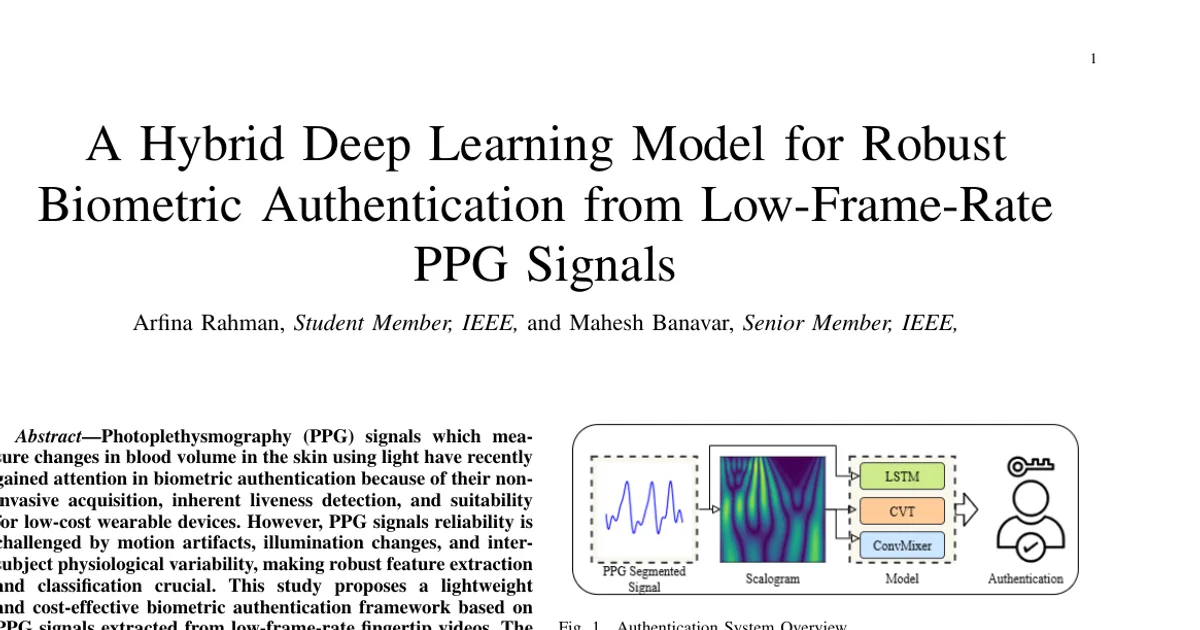
Each cleaned signal was cut into 5-second windows with 50% overlap (a 2.5-second hop), giving 27 segments per subject. Every segment was then turned into a picture: the Continuous Wavelet Transform with a Morlet wavelet converts the 1D waveform into a 2D scalogram showing how frequency content evolves over time. That image is fed to the CVT branch and the ConvMixer branch, while the original 1D segment is fed to the LSTM branch. CVT, ConvMixer, and LSTM outputs are concatenated into one feature vector, passed through a dense layer and softmax, and used for two things: building each subject's enrolled template by averaging training embeddings, and authenticating a test segment by cosine similarity against those templates with a threshold.
Training used 80% of each subject's segmented scalograms and testing used the remaining 20%, keeping subject representation balanced. Key architecture settings: CVT projects into a 64-dimensional embedding with 16 patches and four attention heads; ConvMixer uses depthwise separable convolutions with 32 filters and kernel size 5; the LSTM uses 64 hidden units; fused features are projected into a unified 64-dimensional embedding.
Why This Matters
The work argues that robust biometric authentication does not require expensive, high-frame-rate sensors — a low-frame-rate monochrome camera plus careful preprocessing and a hybrid spatial–temporal model can be sufficient. It also shows that PPG's inherent liveness requirement (a live blood-flow signal is harder to spoof than a fingerprint image) can be combined with strong accuracy in a model the authors describe as lightweight and cost-effective. For research, it adds evidence that fusing scalogram-based spatial learning with explicit temporal modeling outperforms either alone on this task.
Real-world applications:
- Wearables and smartwatches that already capture PPG for heart rate could reuse the same sensor for continuous identity verification.
- Mobile device unlock using a fingertip camera or existing phone optics rather than dedicated fingerprint hardware.
- Contactless access control where a user presents a finger to a camera-based scanner.
- Healthcare IoT and telemedicine, where confirming which patient is generating a physiological stream is a security requirement.
Industry relevance centers on device makers, embedded-security vendors, and health-monitoring platforms seeking authentication that cannot be trivially spoofed and that reuses sensors already present on the device.
Future Directions
- Multimodal fusion: The authors propose combining PPG with additional physiological modalities such as ECG or accelerometer data to build more comprehensive authentication systems.
- Lightweight and energy-efficient variants: They call for investigating reduced-complexity versions of the hybrid model so it can be deployed on wearable and mobile platforms.
- Generalization beyond controlled settings: The paper notes that most prior work — and its own evaluation — relies on signals collected under controlled conditions, leaving cross-device, cross-session, and cross-population generalization an open question.
- Privacy-aware training: The related-work section frames privacy-preserving approaches such as federated learning as a promising but computationally heavier direction, leaving room for combining lightweight architectures with decentralized training.
Target Audience
Researchers and graduate students working on biometric authentication, biomedical signal processing, or applied deep learning for wearables; engineers designing authentication for mobile, embedded, or IoT devices; and practitioners interested in converting 1D physiological signals into image-like representations for vision-based models. Readers without a background in deep learning or wavelet analysis will find the architecture sections demanding, though the motivation, preprocessing stages, and results tables are accessible.
Authors’ abstract
Photoplethysmography (PPG) signals, which measure changes in blood volume in the skin using light, have recently gained attention in biometric authentication because of their non-invasive acquisition, inherent liveness detection, and suitability for low-cost wearable devices. However, PPG signal quality is challenged by motion artifacts, illumination changes, and inter-subject physiological variability, making robust feature extraction and classification crucial. This study proposes a lightweight and cost-effective biometric authentication framework based on PPG signals extracted from low-frame-rate fingertip videos. The CFIHSR dataset, comprising PPG recordings from 46 subjects at a sampling rate of 14 Hz, is employed for evaluation. The raw PPG signals undergo a standard preprocessing pipeline involving baseline drift removal, motion artifact suppression using Principal Component Analysis (PCA), bandpass filtering, Fourier-based resampling, and amplitude normalization. To generate robust representations, each one-dimensional PPG segment is converted into a two-dimensional time-frequency scalogram via the Continuous Wavelet Transform (CWT), effectively capturing transient cardiovascular dynamics. We developed a hybrid deep learning model, termed CVT-ConvMixer-LSTM, by combining spatial features from the Convolutional Vision Transformer (CVT) and ConvMixer branches with temporal features from a Long Short-Term Memory network (LSTM). The experimental results on 46 subjects demonstrate an authentication accuracy of 98%, validating the robustness of the model to noise and variability between subjects. Due to its efficiency, scalability, and inherent liveness detection capability, the proposed system is well-suited for real-world mobile and embedded biometric security applications.