Research
A Glance Is All You Need: Single-Pass Fine-Grained Image Captioning with SimLoss
A Glance Is All You Need: Single-Pass Fine-Grained Image Captioning with SimLoss Overview Research area: Computer vision / vision-language models — specifically fine-grained (detailed) image captionin
- arXiv
- 2609.00591
- Published
- 2026-09-01
- Authors
- Suryaansh Jain, Rahasya Barkur, Vishal G, Ryan Rossi, Franck Dernoncourt, Jack Wang, Koustava Goswami, Nedim Lipka, Puneet Mathur, Samyadeep Basu, Seunghyun Yoon
AI summary
A Glance Is All You Need: Single-Pass Fine-Grained Image Captioning with SimLossOverview
- Research area: Computer vision / vision-language models — specifically fine-grained (detailed) image captioning and training objectives for VLMs.
- Technical level: Intermediate to Advanced. The paper assumes familiarity with contrastive learning (InfoNCE), LoRA fine-tuning, and reinforcement learning from preference-style rewards (GRPO, PPO).
- Scope: The paper introduces SimLoss, a reference-free embedding-space training objective that improves the visual detail and factual grounding of a single-pass image captioner without any fine-grained caption targets, evaluated on the IIW-400 benchmark against multi-stage verification, reward-optimized, and perception-aware baselines.
What This Paper Is About
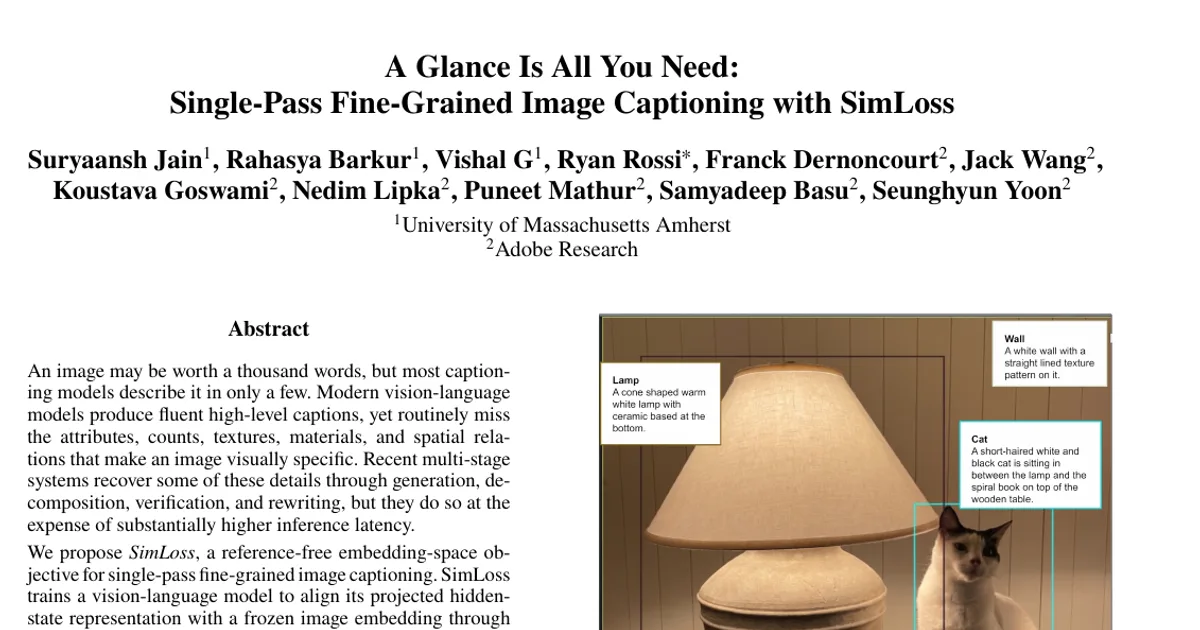
Modern vision-language models produce fluent captions like "a lamp on a table" but routinely omit the visually specific details — materials, counts, textures, object parts, spatial relations — that make an image distinctive. Prior fixes (such as the multi-stage CapMAS pipeline) recover those details by generating, decomposing, verifying, and rewriting captions at inference time, which is expensive. This paper asks whether that quality can instead be moved into training, using the image embedding itself as the only supervision signal, so that inference stays a single forward pass.
Key Contributions
- SimLoss, a reference-free contrastive objective that supervises a captioner in embedding space before decoding: the VLM's mean-pooled hidden state is projected and aligned with a frozen image embedding via an InfoNCE loss, motivated by a noisy-channel / mutual-information view of captioning (maximizing I(v; ŷ) by reducing residual uncertainty H(v | ŷ)).
- Two instantiations covering different access settings: SimLoss FFT, which backpropagates through a locally available frozen encoder (Qwen3-VL-Embed) into LoRA adapters and a two-layer MLP projector, and SimLoss GRPO, which treats the embedding model as a black-box reward (cosine similarity between image and sampled-caption embeddings) optimized with GRPO.
- An evaluation on IIW-400 against single-pass, multi-stage verification, reward-optimized, and perception-aware baselines. SimLoss FFT achieves the highest precision (0.8485) and is nearly indistinguishable from CapMAS in F1 (0.7023 vs. 0.7025) at roughly 20× lower latency (5.77 s/img vs. 115.31 s/img).
- A diagnostic finding: recall is essentially flat across all evaluated methods (0.5950–0.6015), localizing the entire F1 spread to precision differences. The paper also shows that neither human-written fine-grained captions nor pipeline-generated pseudo-captions are required as training targets.
Main Findings
- SimLoss FFT has the highest precision of all evaluated methods. It reaches 0.8485 precision, slightly exceeding CapMAS at 0.8467 and improving on the plain Qwen2.5-VL-7B baseline's 0.7884, while producing the shortest captions (114.86 ± 13.06 words).
- SimLoss FFT nearly matches CapMAS in F1. CapMAS obtains 0.7025 and SimLoss FFT obtains 0.7023 — a gap of 0.0002 — but SimLoss FFT uses single-pass inference.
- SimLoss GRPO achieves the highest recall and CLAIR. Recall 0.6015 and CLAIR 0.858, suggesting black-box embedding rewards encourage broader semantic coverage, but its precision (0.8227) and F1 (0.6949) trail SimLoss FFT.
- Recall is flat across methods. Values range only from 0.5950 (PAPO) to 0.6015 (SimLoss GRPO) and 0.6003 (CapMAS), so the entire F1 spread is attributable to precision.
- Large latency advantage. SimLoss FFT runs at 5.77 s/img against CapMAS's 115.31 s/img, a 20.0× measured speedup on A100 GPUs. Other methods: Plain Qwen2.5-VL-7B 8.66 s/img (13.3×), FeedQuill 8.97 s/img (12.9×), PAPO + YOLO 7.30 s/img (15.8×), SimLoss GRPO 6.58 s/img (17.5×), SimLoss-PAPO-YOLO 7.21 s/img (16.0×).
- Conciseness accompanies precision. SimLoss FFT cuts mean caption length from the plain baseline's 347.55 ± 46.82 words to 114.86 ± 13.06 words while raising precision, and also has the lowest length standard deviation among evaluated methods (CapMAS: 189.71 ± 49.03; FeedQuill: 164.15 ± 69.48).
- Reward-style baselines underperform. FeedQuill reaches F1 0.6823, PAPO 0.6790, PAPO + YOLO 0.6813, and SimLoss-PAPO-YOLO 0.6959 — all below both SimLoss FFT and CapMAS.
- Embedding-similarity diagnostics. In frozen Qwen3-VL-Embedding space on MS COCO, the ground-truth image aligns with the COCO human caption at only 0.4794 but with the baseline Qwen2.5-VL-7B generation at 0.6982. On IIW-400, images align with IIW human descriptions at 0.6616, with CapMAS captions at 0.7000, and with baseline generations at 0.6982; CapMAS captions align with IIW human descriptions at 0.6928 versus 0.6803 for baseline generations.
- Pseudo-caption supervision is noisy. Processed CapMAS outputs on IIW-400 average 186.0 words and 29.3 atomic propositions, of which 22.3 are judged true and 7.0 false, a mean factuality ratio of 0.766 — the paper's stated reason for avoiding caption-level distillation.
- IIW human descriptions average 171.2 words, roughly 17× longer than the COCO captions in the authors' sampled batch (10.0 words).
- Qualitative limitation: across eight IIW-400 examples, both SimLoss variants mistake an abstract driftwood moose for a deer, showing greater specificity can amplify fine-category errors. In two matched-coverage cases, SimLoss FFT answers the same questions in roughly one third as many words as plain or CapMAS captions.
- Judge supervision is a fragile signal. The paper cites work showing LLM judges have a true-positive rate near 96% but a true-negative rate below 25%, and that naive judge ensembling such as majority voting does not remove this bias — a problem CapMAS and FeedQuill inherit, but SimLoss does not.
Methodology in Plain English
The authors treat a caption as a lossy channel from image to text. A generic caption is compatible with many different images; a detailed caption should make the source image easier to identify among alternatives. Since maximizing mutual information over discrete text is intractable, they apply the same principle to continuous representations before any text is generated.
In SimLoss FFT, a frozen image encoder (Qwen3-VL-Embed) produces an embedding for each image in a training batch. Simultaneously, a trainable Qwen2.5-VL-7B processes the same image with a fixed prompt; its token hidden states are mean-pooled and pushed through a learned two-layer MLP projector into the frozen embedding space. Cosine similarities are computed between every frozen image embedding and every projected VLM representation in the batch, and an InfoNCE loss (with temperature τ) treats the matched pair as positive and all other in-batch images as negatives. Importantly, the adapters are shared between this pooling path and the generation path, so gradients reshape the representations the decoder reads from. Only LoRA adapters and the projector are updated; base weights and the encoder stay frozen. Caption targets are never used — COCO images are used, but their captions are discarded. At inference, the encoder, projector, and loss are removed, leaving ordinary single-pass generation.
In SimLoss GRPO, the embedding model is assumed to be inaccessible (closed-source or API-only), so gradients cannot flow through it. Instead, the model samples a group of captions per image, each is encoded and scored by cosine similarity to the image embedding, and GRPO estimates relative advantages within the group to update the policy.
The paper also reimplements FeedQuill with PPO using a composite reward of judge-computed F1 over decomposed atomic units, a global CLIP alignment term, and CIDEr similarity to pseudo-references, and evaluates PAPO with both random masking and object-aware masking using YOLOv13 detections. Training uses MS COCO images; all trainable methods use 7B-class Qwen VLMs with LoRA. Evaluation on IIW-400 uses CLAIR, precision (atomic-proposition factuality judged against the image and IIW reference), recall (human-verified multiple-choice questions answered from the caption alone with the image withheld), F1, caption length, and A100 latency. IIW references are used only for evaluation, never as adaptation targets.
Why This Matters
The paper reframes fine-grained captioning as a training-time problem rather than an inference-time one. Instead of paying for verification at every image, the model learns a representation that already carries the visual detail. This is notable for research on captioning, hallucination mitigation, and contrastive vision-language objectives, because it shows that a frozen embedding model can substitute for fine-grained human annotation that is expensive, slow, and scarce — and that judged-reward supervision (used by both CapMAS and FeedQuill) inherits the agreeableness bias of the judge itself.
Real-world applications the paper motivates:
- Assistive technology for blind and low-vision users, where missing attributes, counts, or spatial relations changes the meaning of a scene.
- Embodied robotics, where grounded detail about materials and object arrangement informs action.
- Clinical image interpretation, where faithful coverage of visual evidence matters and unsupported details are harmful.
- Interactive and large-scale captioning deployments, since the 20× latency reduction versus a five-stage pipeline makes detailed captioning feasible where per-image verification costs are prohibitive.
Industry relevance: the objective requires no proprietary fine-grained caption dataset and no pseudo-label generation pipeline — only a frozen embedding model that may already be available, or in the black-box variant only API access to one. The code is released at https://github.com/srynsh/SimLoss-Image-Captioning, and the work is a collaboration between the University of Massachusetts Amherst and Adobe Research.
Future Directions
- Compensating for teacher bias. SimLoss replaces dependence on caption targets with dependence on a frozen embedding teacher, whose biases and visual granularity determine which distinctions get rewarded. The authors propose comparing or ensembling teachers across domains.
- Combining FFT's precision with GRPO's recall. The two variants occupy complementary operating points (FFT: precision 0.8485, recall 0.5991; GRPO: precision 0.8227, recall 0.6015), and the paper identifies combining them as future work.
- Confidence calibration or lightweight verification. Because CapMAS still holds a marginal F1 edge (0.7025 vs. 0.7023), the authors suggest pairing SimLoss-trained single-pass captioners with lightweight factuality checks to preserve single-pass latency while improving factual consistency.
- Open question: whether explicit verification can be eliminated entirely. The residual gap to CapMAS suggests inference-time verification remains useful for precision–recall balancing, leaving unresolved how much of that benefit a training-time signal can ultimately absorb.
Target Audience
Researchers and practitioners working on vision-language models, image captioning, hallucination mitigation, and contrastive representation learning will get the most from this paper. It is also relevant to engineers deploying detailed captioning at scale, who care less about the theoretical framing and more about the 5.77 s/img versus 115.31 s/img latency comparison. Readers wanting to reproduce or extend the work should be comfortable with LoRA fine-tuning, InfoNCE, and GRPO/PPO-style optimization; those unfamiliar with reinforcement learning can still follow the FFT variant and the main results.
Note: the provided paper content is truncated partway through Appendix A. Quantitative details that would appear in Appendices B (qualitative examples) and C (per-theme comparisons) are summarized in the main text as "eight IIW-400 examples" and "two matched-coverage cases," but the appendix sections themselves are not included in the source content.
Authors’ abstract
An image may be worth a thousand words, but most captioning models describe it in only a few. Modern vision-language models produce fluent high-level captions, yet routinely miss the attributes, counts, textures, materials, and spatial relations that make an image visually specific. Recent multi-stage systems recover some of these details through generation, decomposition, verification, and rewriting, but they do so at the expense of substantially higher inference latency. We propose SimLoss, a reference-free embedding-space objective for single-pass fine-grained image captioning. SimLoss trains a vision-language model to align its projected hidden-state representation with a frozen image embedding through an InfoNCE contrastive loss, supplying a dense visual supervision signal before any text is decoded, and requiring neither human-written fine-grained captions nor pseudo-captions from a multi-stage pipeline. We instantiate it as SimLoss FFT, which backpropagates through a locally available embedding model, and SimLoss GRPO, which treats that model as a black-box reward. Compared with single-pass, multi-stage verification, reward-optimized, and perception-aware baselines, the fully differentiable fine-tuning variant, SimLoss FFT, achieves the highest precision while nearly matching the F1 score of the multi-stage method, all while retaining single-pass inference and running roughly 20 times faster than the multi-stage pipeline. The reward-based variant SimLoss GRPO attains the strongest recall. Together, these results show that embedding-space supervision can recover the quality of multi-stage verification at the latency of a single-pass captioner.