Research
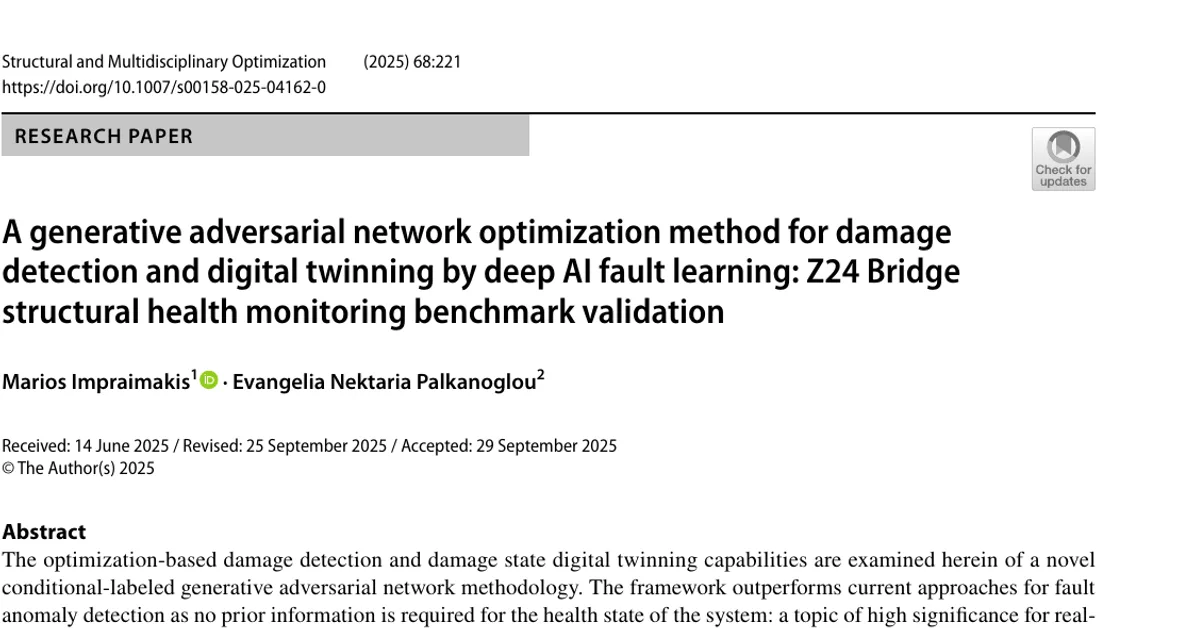
A generative adversarial network optimization method for damage detection and digital twinning by deep AI fault learning: Z24 Bridge structural health monitoring benchmark validation
Overview Research area: Structural health monitoring (SHM) using machine learning — specifically generative adversarial networks applied to damage detection and damage-state digital twinning for civil
- arXiv
- 2511.00099
- Published
- 2025-10-30
- Authors
- Marios Impraimakis, Evangelia Nektaria Palkanoglou
AI summary
Overview
Research area: Structural health monitoring (SHM) using machine learning — specifically generative adversarial networks applied to damage detection and damage-state digital twinning for civil infrastructure.
Technical level: Advanced. The paper assumes familiarity with unsupervised learning, generative adversarial networks, conditional labeling, support vector machines, principal component analysis, and vibration-based structural monitoring.
Scope: The paper examines whether a novel conditional-labeled generative adversarial network can detect structural damage and generate digital-twin measurements of damage states without any prior knowledge of the system's health condition, validated on the Z24 Bridge benchmark dataset.
What This Paper Is About
Existing AI-based digital twinning methods for structures struggle when only a few measurements are available, when physics knowledge is absent, or when the damage state is unknown — all common conditions in real infrastructure monitoring. The authors propose and test an unsupervised framework that requires no prior information about the structure's health, and they validate it on the Z24 Bridge, a post-tensioned concrete highway bridge in Switzerland that serves as a standard SHM benchmark. The goal is both to detect damage and to generate synthetic measurements representing different damage states for digital twinning purposes.
Key Contributions
-
A conditional-labeled GAN framework for damage detection that needs no prior health-state information. The methodology is presented as unsupervised with respect to the system's condition, which the authors position as a significant advantage for real-world deployment where baseline data may not exist.
-
A convergence-score comparison procedure for identifying damage states. The framework forces the model to converge conditionally to two different damage states, repeats this with a different measurement group, and then compares the convergence scores to determine which group belongs to a distinct damage state.
-
Simultaneous generation of digital-twin measurements at multiple damage states. Using both healthy-to-healthy and damage-to-healthy input pairings, the process produces synthetic measurements useful for pattern recognition and machine learning data generation, not just detection.
-
A secondary validation pathway combining SVM and PCA. A support vector machine classifier and a principal component analysis procedure are developed to assess the generated and real measurements per damage category, acting as a new dynamics-learning indicator in damage scenarios.
Main Findings
-
No prior health-state information required: The framework is reported to perform fault anomaly detection without any advance knowledge of the system's healthy condition, which the authors describe as a key departure from current approaches.
-
Convergence scores discriminate damage states: Comparing convergence scores across measurement groups is claimed to identify which group belongs to a different damage state, forming the basis of the detection logic.
-
Damage is captured over healthy measurements: The abstract states the approach "is shown to capture accurately damage over healthy measurements" — the specific quantitative evidence behind this claim is not given in the abstract.
-
Z24 Bridge benchmark validation: The approach was validated on the benchmark SHM measurements of the Z24 Bridge, a real post-tensioned concrete highway bridge. Details of the validation setup, data volume, and comparative baselines are not specified in the abstract.
-
Generative output supports digital twinning: The same process that detects damage also generates measurements at different damage states, giving the framework a dual detection-and-synthesis role.
-
Auxiliary assessment via SVM and PCA: The classifier and analysis procedure serve as an independent indicator for judging generated versus real measurements, adding a second layer of dynamics learning on top of the GAN.
Methodology in Plain English
The approach rests on a conditional-labeled generative adversarial network — a type of model where two networks compete: one generates data, the other judges it, and here the generation is conditioned on a label indicating a damage state. The procedure runs in three stages. First, different measurements that all share the same damage level are fed in as inputs, and the model is pushed to converge toward two different damage states. Second, the same process is repeated using a different group of measurements. Third, the convergence scores from these runs are compared — if one group converges differently, it indicates that group belongs to a different damage state. Running this with healthy-to-healthy and damage-to-healthy input pairings simultaneously produces synthetic measurements for digital twinning at various damage states. Separately, the authors build a support vector machine classifier and a principal component analysis procedure to check how well the generated measurements match the real ones for each damage category, providing an independent signal about damage.
Why This Matters
Impact on research: The paper targets a well-known weakness in AI-driven SHM and digital twinning — dependence on known healthy baselines, physics models, or large measurement volumes. If the no-prior-information claim holds up, it shifts the field toward unsupervised, label-free damage detection and offers a generative route to synthetic damage-state data for training and simulation. Anchoring the work to the Z24 Bridge gives it a common reference point against which other SHM methods can be compared.
Real-world applications (implied by the vibration-based, infrastructure-scale framing):
- Continuous monitoring of bridges and highway structures, where baseline "healthy" data may be missing or unreliable.
- Digital twin platforms for asset management, using generated damage-state measurements to populate simulations where real damaged-state data cannot ethically or practically be collected.
- Post-event or post-earthquake inspection of large civil structures, where measurement counts are low and the damage state is initially unknown.
- Scalable monitoring across portfolios of infrastructure, such as dams, tunnels, or wind turbine foundations, where per-asset physics knowledge is incomplete.
Industry relevance: Infrastructure owners and operators face aging assets and limited sensor budgets. A method that works with few measurements and no known baseline lowers the barrier to deploying monitoring systems, and digital-twin measurement generation can support predictive maintenance planning and resilience assessment without waiting for real damage to occur. The abstract explicitly frames the approach as "a powerful tool for vibration-based system-level monitoring and scalable infrastructure resilience."
Future Directions
-
Generalization beyond Z24: The framework is validated on one benchmark bridge. Whether it transfers to other bridge types, materials, and sensor configurations is an open question the abstract does not address.
-
Scaling to more damage states: The procedure as described compares two damage states at a time. Extending it to graded or multi-class damage severity, and defining how convergence scores should be thresholded, remains unresolved in what the abstract presents.
-
Robustness under genuinely sparse data: The paper motivates itself by the problem of a "low number of measurements," but the abstract does not report how the method behaves across different measurement quantities or sensor counts.
-
Independence and rigor of the validation layer: The SVM and PCA components are described as a secondary indicator built by the authors themselves; whether they could be replaced by or cross-checked against external validation schemes is a natural next question.
-
Bridging to physics-informed twins: Since the framework is explicitly motivated by cases where physics knowledge is missing, an open question is how it might combine with partial physical models to improve digital twin fidelity.
Target Audience
This paper is most useful to researchers and graduate students in structural health monitoring, machine learning for civil engineering, and digital twin development, particularly those working on unsupervised or label-free damage detection. It also suits practicing engineers and asset managers evaluating AI-based monitoring for bridges and large infrastructure, and machine learning researchers interested in applied GAN methods with a real-world benchmark. A working understanding of generative models and vibration-based monitoring is needed to follow the technical content.
Authors’ abstract
The optimization-based damage detection and damage state digital twinning capabilities are examined here of a novel conditional-labeled generative adversarial network methodology. The framework outperforms current approaches for fault anomaly detection as no prior information is required for the health state of the system: a topic of high significance for real-world applications. Specifically, current artificial intelligence-based digital twinning approaches suffer from the uncertainty related to obtaining poor predictions when a low number of measurements is available, physics knowledge is missing, or when the damage state is unknown. To this end, an unsupervised framework is examined and validated rigorously on the benchmark structural health monitoring measurements of Z24 Bridge: a post-tensioned concrete highway bridge in Switzerland. In implementing the approach, firstly, different same damage-level measurements are used as inputs, while the model is forced to converge conditionally to two different damage states. Secondly, the process is repeated for a different group of measurements. Finally, the convergence scores are compared to identify which one belongs to a different damage state. The process for both healthy-to-healthy and damage-to-healthy input data creates, simultaneously, measurements for digital twinning purposes at different damage states, capable of pattern recognition and machine learning data generation. Further to this process, a support vector machine classifier and a principal component analysis procedure is developed to assess the generated and real measurements of each damage category, serving as a secondary new dynamics learning indicator in damage scenarios. Importantly, the approach is shown to capture accurately damage over healthy measurements, providing a powerful tool for vibration-based system-level monitoring and scalable infrastructure resilience.