Research
A Framework for the Systematic Evaluation of Obstacle Avoidance and Object-Aware Controllers
Overview Research area: Robotics — real-time robot control, specifically obstacle avoidance and object-aware controllers (OACs) for robot manipulators. Technical level: Advanced (the paper uses quadra
- arXiv
- 2510.24683
- Published
- 2025-10-28
- Authors
- Caleb Escobedo, Nataliya Nechyporenko, Shreyas Kadekodi, Alessandro Roncone
AI summary
Overview
Research area: Robotics — real-time robot control, specifically obstacle avoidance and object-aware controllers (OACs) for robot manipulators.
Technical level: Advanced (the paper uses quadratic programming formulations, Jacobian-based manipulability analysis, and jerk estimation from real robot velocity data).
Scope: The paper proposes a three-part evaluation framework (kinematics, motion profiles, virtual constraints) and uses it to compare three existing object-aware controllers on a real 7-DoF Franka Emika Panda arm across two obstacle-avoidance experiments.
What This Paper Is About
Robots working around people need controllers that can react on-line to obstacles that a motion planner did not anticipate — for example due to perception errors, occlusions, dynamic obstacles, or clutter. These "object-aware controllers" (OACs) exist, but the paper argues that limited analysis has been done on their strengths and limitations, making it hard to compare them or extract actionable research directions. The goal is a systematic evaluation framework — a set of design considerations and metrics — that can be used to compare OACs and to guide future controller design.
Key Contributions
- A structured evaluation framework for OACs. The authors define three design considerations — kinematics, motion profiles, and virtual constraints — as the basis for robust analysis of object-aware controllers across varied contexts.
- A comparison of three representative OACs. Flacco [7], Ding [4], and Escobedo [5] are formalized in a shared quadratic programming notation, implemented on real hardware, and compared against the framework's criteria.
- A pair of fundamental robot-obstacle experiments plus four metrics. Two scenarios (Static Robot, Dynamic Obstacle and Dynamic Robot, Dynamic Obstacle) and four metrics (manipulability scalar, projection of the repulsive vector onto the minimum-operability ellipsoid axis, jerk profiles, and repulsive-force/distance profiles) are used, with additional analysis and real-time operation detailed in an accompanying video.
- Concrete design recommendations and future research directions. Based on the findings, the authors propose that manipulability should scale repulsive forces, that constraints should not be placed near the manipulator's base, and that the framework be expanded by the community into a library of controller comparison benchmarks.
Main Findings
- Control point continuity differs sharply between controllers. Flacco's control point manipulability values are smooth in both experimental scenarios, whereas Ding and Escobedo show sudden changes in manipulability as the obstacle moves closer to the robot's body. This is attributed to a rapid change of the control point position and a consequent change of the movement restriction to a new part of the robot's body.
- Discontinuous control points produce undesirable motion. The discontinuity in Ding is described as sudden and as a transition between two points with drastically different manipulability measures; the authors state that control points with higher manipulability can likely avoid an obstacle without affecting the main task, so these points should not be treated equally.
- Movement along the axis of least manipulability is a failure mode. When the majority of the movement required to avoid a collision is along the axis of minimum manipulability, the projection metric approaches one, indicating the control point is being commanded in the direction of lowest manipulability.
- Proximal control points are kinematically problematic. Control points near the base of the manipulator always have low manipulability because they are kinematically more constrained. Imposing constraints on proximal links causes a mismatch between desired and achievable velocity, and a lack of motion at those control points can inhibit the main objective function and lead to an unsolvable optimization formulation.
- Motion profiles are not smooth for all controllers. In the dynamic robot experiment, Ding ran for 8 seconds until the joints contorted into an undesirable configuration and the robot entered a self-collision state. Escobedo showed low jerk after 4 seconds because it slowed to a stop by design as the obstacle approached the end-effector. Flacco successfully avoided the obstacle despite slight increases in jerk during avoidance behavior. The no-obstacle condition incurs non-zero jerk, described as likely the baseline jerk of the executed trajectory. Escobedo's joint q6 jerk is less pronounced than both Flacco's and Ding's.
- Jerk is tied to motor current and safety standards. Low jerk is described as synonymous with low motor current, which the authors say must be required to meet ISO safety standards for robot operation.
- Repulsive force shapes differ and serve different purposes. In the static robot scenario, Flacco sees a sharp rise in repulsive force at 0.3 meters distance, quickly reaching its maximum value and causing the robot to move quickly away from an obstacle. For Escobedo, when an obstacle approaches the end-effector, the repulsive force is mitigated by the end-effector velocity scaling term, a behavior designed to avoid high velocities when a human is interacting with a robot.
- Three identified shortcomings of the evaluated OACs. The authors conclude that OACs fail to effectively incorporate kinematic information about the specific robot embodiment; set discontinuous virtual constraints that lead to unsteady motion profiles; and specify unweighted constraints that fail to prioritize behaviors when multiple objectives must be achieved.
Methodology in Plain English
The authors start by defining a general obstacle representation: the robot's perception system reduces sensor data to a finite set of rigid obstacles, each carrying the information a particular controller needs. Every evaluated controller is then written in a common quadratic programming (QP) form with a shared first task term — minimizing the error between the desired Cartesian velocity and the robot's actual velocity, expressed through the Jacobian. The three controllers are distinguished by the extra terms and constraints they add. Flacco uses repulsive vectors to alter the end-effector trajectory plus joint velocity constraints derived from a collision risk factor, along with a Pivot Algorithm for moving obstacles. Ding adds a manipulability-based regularization term and two avoidance constraints: a limit on the approach velocity of the closest control point, and a weighted gradient of distance to all obstacles in a region of surveillance. Escobedo adds both of those plus a term that favors joint velocities toward the middle of joint limits, a stepwise maximum approach velocity function with notice, repulse, and critical distances, and a scaling term that reduces end-effector velocity near obstacles.
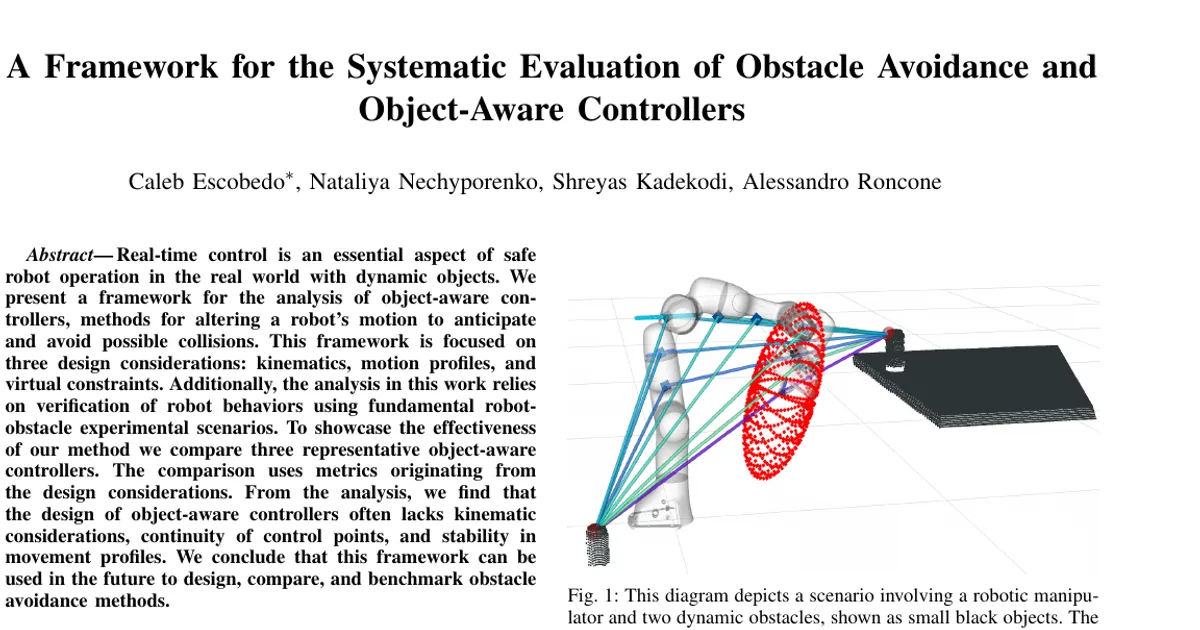
Evaluation then proceeds on a real 7-DoF Franka Emika Panda arm, with controllers written in C++ and ROS and obstacles introduced virtually through ROS topics so every controller receives exactly the same information. Two experiments are run. In the static robot, dynamic obstacle scenario, the end-effector is commanded to hold position at (0.4, 0.0, 0.45) m from the base while an obstacle travels at 0.15 m/s from (0, -0.5, 0.6) to (0, 0.1, 0.6). In the dynamic robot, dynamic obstacle scenario, the robot moves in a Cartesian circle of radius 0.25 m centered at (0.5, 0, 0.25), moving counter-clockwise in x and y at a maximum of 0.3 m/s when no obstacles are nearby, while an obstacle moves from (0.45, -0.5, 0.45) to (0.45, 0.1, 0.45) at 0.15 m/s. Data collected during these runs is turned into the four metrics: a manipulability scalar computed from the determinant of the Jacobian product, the scalar projection of the repulsive vector onto the minimum-operability eigenvector, joint jerk estimated by smoothing the Franka Panda API velocity with a Savitzky-Golay filter and taking second-order accurate central-difference gradients twice, and plots of repulsive force against minimum obstacle distance.
Why This Matters
The paper argues that without analysis it is difficult to compare existing OACs or propose actionable insights, and that matching measurable OAC properties to robot behavior builds confidence in adopting these methods for robot safety. Because complex planners and prediction models cannot satisfy real-time safety requirements due to computational complexity, controllers that react on-line are the practical layer of protection, so understanding their failure modes matters.
Real-world applications:
- Robots operating in hospitals, homes, and schools, the dynamic, human-occupied environments the paper names as the motivation for this work.
- Collaborative robot (cobot) deployments, where the paper ties low jerk to low motor current and to ISO restrictions on allowable power and force.
- Human-robot interaction scenarios where an object or person approaches the end-effector, which the Escobedo velocity-scaling behavior was specifically designed for.
- Manufacturing or manipulation settings where occlusions, sensing errors, high clutter, or dynamic obstacles cause collisions not accounted for by the trajectory planner.
Industry relevance: The framework offers a way to benchmark and compare candidate avoidance controllers before deployment, and the finding that some controllers drive the robot into self-collision states or unsolvable optimization formulations is a directly relevant risk signal for anyone integrating these methods into a product.
Future Directions
- Build a community benchmark library. The authors explicitly envision expansion of the framework by the research community to build a library of controller comparison benchmarks.
- Scale repulsive forces by manipulability. The analysis concludes that information about the current control point's manipulability measure should be used to ensure a repulsive force is scaled accordingly.
- Retune the applied force functions. The jerk results indicate that adjusting the forces in Ding's and Escobedo's constraint equations is required to smooth the robot motion profile.
- Avoid restricting proximal links. Because control points near the base are always kinematically constrained, the authors recommend that control points and restrictions not be placed near the base of the manipulator, and that discontinuous switching of control points be addressed.
Target Audience
Robotics researchers and graduate students working on real-time control, obstacle avoidance, and safe manipulation; engineers integrating avoidance controllers into collaborative robot systems; and human-robot interaction researchers who need to reason about how a controller's repulsive behavior will feel and perform around people. Readers benefit most if they have some background in robot kinematics, Jacobians, and optimization-based control, since the framework is built on a quadratic programming formulation shared across the compared controllers.
Authors’ abstract
Real-time control is an essential aspect of safe robot operation in the real world with dynamic objects. We present a framework for the analysis of object-aware controllers, methods for altering a robot's motion to anticipate and avoid possible collisions. This framework is focused on three design considerations: kinematics, motion profiles, and virtual constraints. Additionally, the analysis in this work relies on verification of robot behaviors using fundamental robot-obstacle experimental scenarios. To showcase the effectiveness of our method we compare three representative object-aware controllers. The comparison uses metrics originating from the design considerations. From the analysis, we find that the design of object-aware controllers often lacks kinematic considerations, continuity of control points, and stability in movement profiles. We conclude that this framework can be used in the future to design, compare, and benchmark obstacle avoidance methods.