Research
A Comprehensive Evaluation of Graph Neural Networks and Physics Informed Learning for Surrogate Modelling of Finite Element Analysis
Overview Research area: Scientific machine learning / surrogate modelling — replacing expensive Finite Element Analysis (FEA) simulations with deep learning models. Technical level: Intermediate to Ad
- arXiv
- 2510.15750
- Published
- 2025-10-16
- Authors
- Nayan Kumar Singh
AI summary
Overview
Research area: Scientific machine learning / surrogate modelling — replacing expensive Finite Element Analysis (FEA) simulations with deep learning models.
Technical level: Intermediate to Advanced. The paper assumes familiarity with graph neural networks, convolutional architectures, physics-informed training, and error metrics such as relative L2 error.
One-sentence scope: The paper benchmarks graph neural networks against 3D U-Nets as FEA surrogates for parametric I-beams, and tests whether physics-informed training and a curriculum learning schedule improve accuracy, generalization, and practical usability.
What This Paper Is About
FEA is a cornerstone of product design, but it is computationally expensive, which makes it impractical to run repeatedly inside design optimization loops. Deep learning surrogates could stand in for FEA and return predictions far faster, but it is unclear which architecture actually emulates FEA accurately. This paper systematically compares graph-based and image/grid-based (3D U-Net) surrogates on parametric I-beams, and adds a physics-informed component to see whether embedding physical laws improves the models.
Key Contributions
- A comprehensive comparative evaluation of graph neural networks (GNNs) and 3D U-Nets as surrogates for FEA of parametric I-beams.
- A Physics-Informed Neural Network (PINN) framework governed by the Navier–Cauchy equations, used to enforce physical laws during surrogate training.
- A curriculum learning strategy — pretraining on data first, then physics-informed fine-tuning — which the authors identify as essential for stabilizing training.
- A practical architecture recommendation balancing predictive accuracy, model size, and inference speed, rather than selecting purely on accuracy.
Main Findings
- GNNs fundamentally outperform the U-Net. The authors state this as a general conclusion across the architectures compared.
- Worst GNN still beats best U-Net. The GCN framework — the weakest graph-based model — reached a relative L2 error of 8.7%, while the best U-Net configuration, a U-Net with an attention mechanism trained on high-resolution data, reached 13.0%.
- MPNN and Graph Transformers are the most accurate graph architectures. Message Passing Neural Networks reached a relative L2 error of 3.5%, and Graph Transformers reached 2.6%.
- Physics-informed training improves generalization. Adding fundamental physical laws reduced error by up to 11.3% on high-signal tasks, according to the abstract.
- Curriculum learning is necessary for stable training. Data pretraining followed by physics-informed fine-tuning is described as essential, not optional.
- The most accurate model is not the most practical. The Graph Transformer was reported as 37.5% slower at inference than the second-best model, MPNN PINN.
- MPNN PINN is the recommended practical choice. It offers what the authors call a good compromise between predictive performance, model size, and inference speed.
Methodology in Plain English
The author took a well-defined structural engineering problem — parametric I-beams, where the beam geometry is varied according to parameters — and treated FEA results as the ground truth to be imitated. Two families of deep learning models were trained to reproduce those results: graph neural networks, which represent the geometry as nodes and connections, and 3D U-Nets, which are grid- or voxel-based convolutional models. Variants within each family were compared, including graph convolutional networks, message passing neural networks, graph transformers, and U-Nets with and without attention mechanisms, with at least one U-Net trained on higher-resolution data.
Beyond plain data-driven training, the author introduced a physics-informed framework in which the model is constrained by the Navier–Cauchy equations, the governing equations of continuum mechanics. Because training with physical constraints directly can be unstable, the models were trained in two stages: first learning from data alone, then being fine-tuned with the physics constraints imposed. Models were then compared using relative L2 error against the FEA reference, along with practical considerations of inference speed and model size. The abstract does not report dataset sizes, training durations, hardware, or specific network dimensions.
Why This Matters
Impact on research: The paper argues that architecture choice matters more than a generic "deep learning for FEA" framing, and it backs this with a direct head-to-head comparison. Its claim that a two-stage curriculum — data pretraining followed by physics fine-tuning — is essential for stability is a methodological lesson that applies beyond this specific problem, and its finding that the most accurate model is not the most deployable one pushes the field to report efficiency alongside accuracy.
Real-world applications:
- Design optimization loops, where thousands of candidate geometries must be screened and full FEA on each is too slow.
- Structural engineering of beams and frames, since I-beams are a standard load-bearing profile in construction and machinery.
- Interactive or real-time design tools, where engineers need fast approximate feedback before committing to a full simulation.
- Early-stage product development, where rapid iteration matters more than final-certification accuracy.
Industry relevance: The recommended model, MPNN PINN, is framed as a practical compromise between accuracy, model size, and inference speed — the trade-off that matters in deployment, not just in a benchmark table. The finding that a graph-based surrogate beats an image-based one at this task gives practitioners a concrete starting point for similar mesh-based physics problems.
Future Directions
- Extending beyond I-beams. The evaluation covers parametric I-beams; whether the ranking of GNNs over U-Nets and the benefit of physics-informed fine-tuning holds for other geometries and load cases is not established by the abstract.
- Closing the accuracy gap. Even the best model, the Graph Transformer at 2.6% relative L2 error, is not exact; reducing residual error further remains open.
- Making physics-informed training cheaper and more stable. The abstract identifies curriculum learning as essential for stability, implying that direct physics-informed training is fragile and that better training schemes could be developed.
- Broadening the accuracy-efficiency trade-off study. The Graph Transformer is more accurate but 37.5% slower than MPNN PINN; the abstract does not explore intermediate designs or further optimization of the MPNN PINN configuration.
Target Audience
Researchers and graduate students in scientific machine learning, computational mechanics, and surrogate modelling; engineers working on simulation acceleration or design optimization for structural components; and practitioners choosing among graph-based, convolutional, and physics-informed architectures for mesh-based physical simulation. Readers looking for a strictly data-driven benchmark without physics constraints, or for full hyperparameter and dataset details, will need the full paper, since the abstract does not provide them.
Authors’ abstract
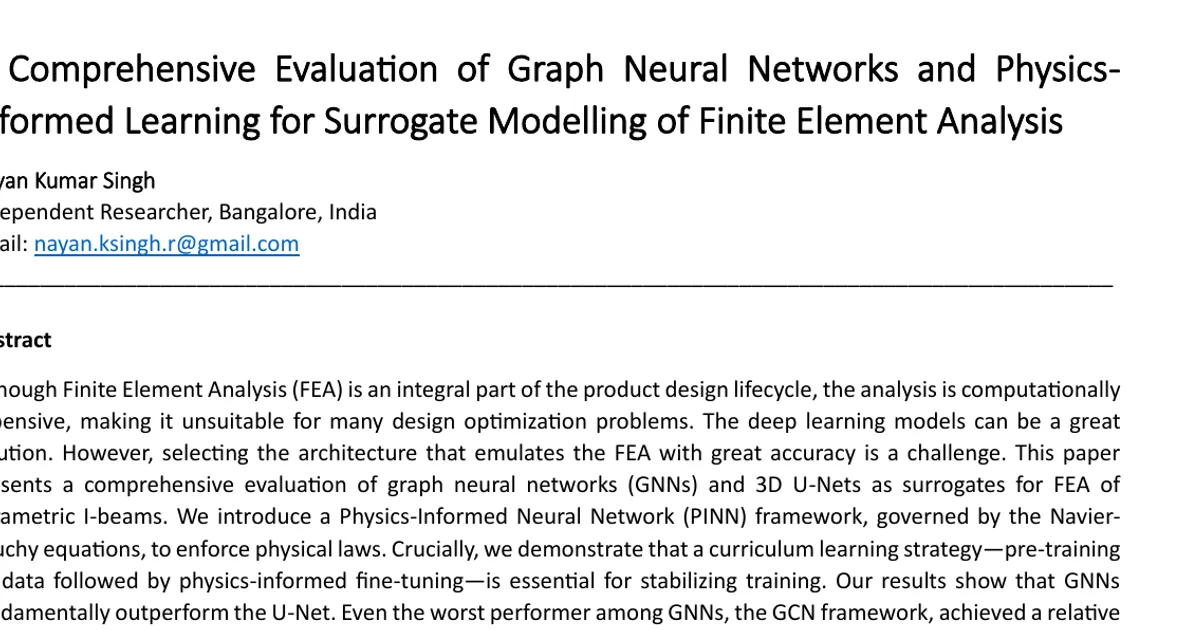
Although Finite Element Analysis (FEA) is an integral part of the product design lifecycle, the analysis is computationally expensive, making it unsuitable for many design optimization problems. The deep learning models can be a great solution. However, selecting the architecture that emulates the FEA with great accuracy is a challenge. This paper presents a comprehensive evaluation of graph neural networks (GNNs) and 3D U-Nets as surrogates for FEA of parametric I-beams. We introduce a Physics-Informed Neural Network (PINN) framework, governed by the Navier Cauchy equations, to enforce physical laws. Crucially, we demonstrate that a curriculum learning strategy, pretraining on data followed by physics informed fine tuning, is essential for stabilizing training. Our results show that GNNs fundamentally outperform the U-Net. Even the worst performer among GNNs, the GCN framework, achieved a relative L2 error of 8.7% while the best framework among U Net, U Net with attention mechanism trained on high resolution data, achieved 13.0% score. Among the graph-based architectures, the Message Passing Neural Networks (MPNN) and Graph Transformers achieved the highest accuracy, achieving a relative L2 score of 3.5% and 2.6% respectively. The inclusion of physics fundamental laws (PINN) significantly improved the generalization, reducing error by up to 11.3% on high-signal tasks. While the Graph Transformer is the most accurate model, it is more 37.5% slower during inference when compared to second best model, MPNN PINN. The PINN enhanced MPNN (MPNN PINN) provides the most practical solution. It offers a good compromise between predictive performance, model size, and inference speed.