Research
3DGesPolicy: Phoneme-Aware Holistic Co-Speech Gesture Generation Based on Action Control
3DGesPolicy: Phoneme-Aware Holistic Co-Speech Gesture Generation Based on Action Control Overview Research area: Computer vision and 3D human animation, specifically holistic co-speech gesture generat
- arXiv
- 2601.18451
- Published
- 2026-01-26
- Authors
- Xuanmeng Sha, Liyun Zhang, Tomohiro Mashita, Naoya Chiba, Yuki Uranishi
AI summary
3DGesPolicy: Phoneme-Aware Holistic Co-Speech Gesture Generation Based on Action ControlOverview
Research area: Computer vision and 3D human animation, specifically holistic co-speech gesture generation — synthesizing full-body motion, facial expressions, and lip movement together from speech.
Technical level: Advanced. The paper assumes familiarity with diffusion models, robot learning policy frameworks, transformer architectures, multimodal fusion, and motion-capture representations.
Scope: The paper proposes and evaluates a single framework, 3DGesPolicy, that recasts holistic gesture generation as a continuous trajectory control problem solved with a diffusion policy, evaluated on the BEAT2 dataset.
What This Paper Is About
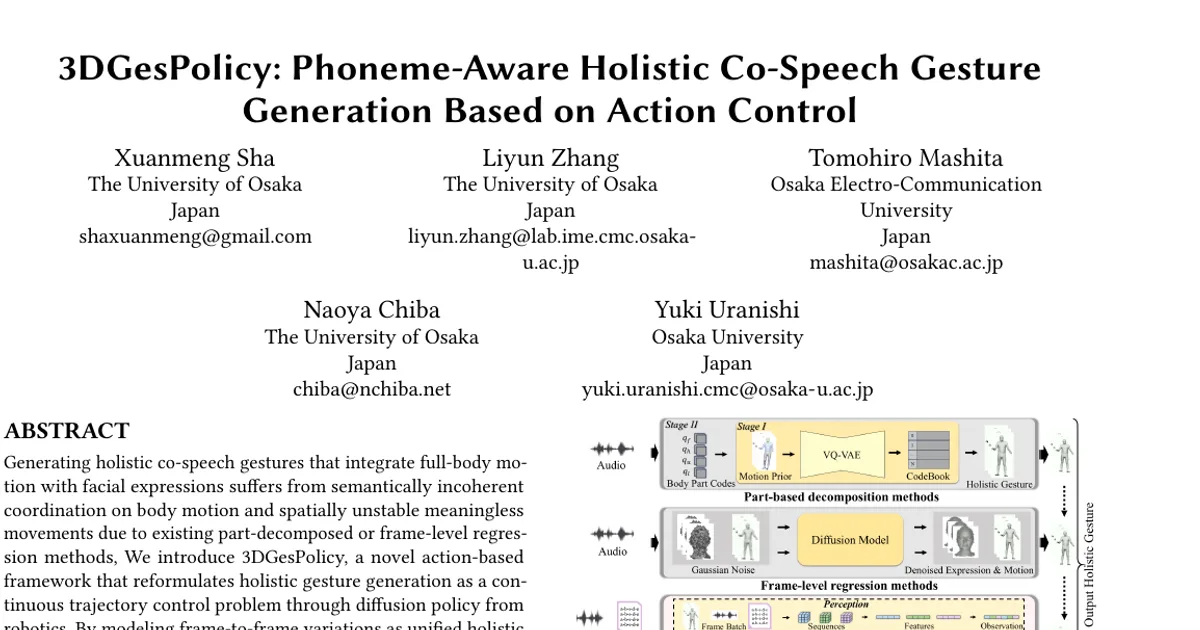
Existing holistic co-speech gesture systems fall into two camps: part-based methods that quantize body parts into discrete codebooks, and frame-level methods that regress absolute poses with diffusion models. The authors argue the first weakens coordination between body parts and loses motion detail, while the second is noise-sensitive and prone to producing semantically meaningless or spatially unstable movement. The paper's goal is to replace absolute pose prediction with prediction of frame-to-frame motion ("actions"), so the model learns smooth, physically grounded movement trajectories that follow speech semantics and synchronize the face at the level of individual phonemes.
Key Contributions
- 3DGesPolicy, a trajectory-control framework. The paper reformulates holistic gesture generation as an action-based diffusion policy problem, modeling frame-to-frame variations as unified actions that span body and face, rather than regressing absolute poses or discrete body codes.
- The Gesture-Audio-Phoneme (GAP) fusion module. A hierarchical fusion design that combines gesture features with audio features (HuBERT) and phoneme features (XPhoneBERT) through adaptive gating and cross-modal attention to establish fine-grained phoneme-level alignment.
- A closed-loop three-module architecture. Environment, Perception, and Decision modules mirror a robotics policy-learning loop, with the Environment constructing the action space, the Perception module encoding multimodal observations, and the Decision module refining noise into clean action sequences.
- Extensive validation on BEAT2. Quantitative metrics, qualitative comparison, a 30-participant user study, and ablations over the action formulation, the GAP fusion module, and phoneme input.
Main Findings
- Best FGD among all compared methods. 3DGesPolicy reports FGD of 3.190 (units of 10⁻¹), compared with 5.366 for MambaTalk, 5.512 for EMAGE, 6.209 for TalkSHOW, 6.644 for CaMN, 8.811 for DSG, 8.986 for DiffSHEG, 9.040 for Habibie et al., and 9.417 for DisCo. Lower is better.
- Best LVD. 3DGesPolicy reports LVD of 2.200 (units of 10⁻⁵), against 6.897 for MambaTalk, 7.556 for EMAGE, 7.593 for FaceFormer, 7.766 for CodeTalker, and 8.673 for DiffSHEG. Lower is better.
- Highest diversity. DIV of 14.03 (no unit scaling), higher than TalkSHOW (13.47), EMAGE (13.06), MambaTalk (13.05), DiffSHEG (11.91), DSG (11.49), CaMN (10.86), DisCo (9.912), and Habibie et al. (8.213). Higher is better.
- MSE is not the lowest reported. 3DGesPolicy reports MSE of 7.020 (units of 10⁻⁸), while MambaTalk reports 6.289, EMAGE 7.680, DiffSHEG 7.665, TalkSHOW 7.791, Habibie et al. 8.614, CodeTalker 8.026, and FaceFormer 7.787. The Table 1 caption states the method achieves superior performance on all metrics; on the numeric MSE column, MambaTalk's value is lower.
- User study favors the proposed method over baselines. Against DiffSHEG, preference for 3DGesPolicy was 91.67% for naturalness, 58.33% for synchrony, and 66.67% for emotion (competitor: 8.33%, 41.67%, 33.33%). Against EMAGE: 83.33%, 83.33%, 58.33% (competitor: 16.67%, 16.67%, 41.67%). Against MambaTalk: 91.67%, 50.00%, 50.00% (competitor: 8.33%, 50.00%, 50.00%).
- Ground truth still wins overall. In the A/B test against ground truth, 3DGesPolicy scored 25.00% versus 75.00% on naturalness, 25.00% versus 75.00% on synchrony, and 0.00% versus 100.00% on emotion.
- Ablation: removing the action formulation causes a drastic collapse. Without action-based formulation (direct absolute-pose regression), FGD rises to 23.563 ± 0.481, MSE to 82.530 ± 0.269, and LVD to 18.030 ± 0.405.
- Ablation: simplified fusion degrades facial quality. Replacing adaptive gating and cross-modal attention with simple concatenation (Sim-GAP) yields FGD 3.713 ± 0.138, MSE 12.847 ± 0.177, and LVD 2.500 ± 0.098.
- Ablation: phonemes matter. Removing phoneme features gives FGD 4.009 ± 0.125, MSE 16.698 ± 0.242, and LVD 2.400 ± 0.076, all degraded relative to the full model's FGD 3.190 ± 0.119, MSE 7.020 ± 0.164, and LVD 2.200 ± 0.088.
- Qualitative strengths. The paper reports that the method produces appropriate pointing gestures for words like "went" and "find," expresses intensity for "…very surprised to…," and reproduces phonetic detail such as full lip closure for the "m" phoneme, labiodental articulation for "f," the "s" in "fantastic," the "w" in "watching," and the "in" sound in "kind," where baselines produce incomplete or overly smoothed articulation.
- Motion stability. The paper attributes reduced sliding artifacts and more spatially grounded 3D motion to the trajectory-control reformulation.
Methodology in Plain English
The authors borrow an idea from robot learning: instead of asking a network to output where a body should be in space, ask it to output how the body should move.
Representing motion as actions. The system takes in a gesture representation made of 55 pose joints in Rot6D, 100 FLAME facial parameters, 4 foot contact labels, and 3 global translation values. Instead of predicting these values directly, it computes the difference between consecutive frames to get a motion vector, then rescales it with an adaptive factor that gives more weight to subtle movements so large motions do not dominate. These scaled differences are the "actions."
Three modules. An Environment module builds the action space and slices variable-length inputs into fixed-length windows. The sequence sampler uses a horizon H = 16, with an observation window of N_obs = 8 frames and an action prediction window of N_act = 8 frames. A Perception module turns history, audio, and phonemes into a single conditional representation. A Decision module performs conditional denoising diffusion over the action sequence.
The GAP fusion module. Gesture features (pose 55×3, expression 100, translation 3) go through separate modality encoders, each a two-layer MLP plus a transformer block. Audio is encoded with a pretrained HuBERT model into 1024-dimensional features, then split into content and rhythm pathways (the rhythm path uses 1D convolutions with kernel sizes 5 and 3) that recombine via Content-Rhythm Attention. Phonemes are encoded with a pretrained XPhoneBERT model into 768-dimensional representations and passed through temporal projection, 1D convolutions with kernel sizes 3 and 5, and a transformer block. Audio and phoneme features are merged by an adaptive gate computed with a sigmoid-activated two-layer MLP, producing α·audio + (1−α)·phoneme. Pose, expression, and translation features are summed into a motion feature, and cross-modal attention then uses speech features as queries and motion features as keys and values. All encoders project to a shared latent dimension of 256.
Training. Diffusion starts from Gaussian noise and refines it into a clean action sequence over K steps, using a DDIM scheduler with 100 training steps and 10 inference steps. The final gesture is reconstructed by accumulating the predicted actions onto a model template. Three losses are combined: a diffusion loss predicting the added noise (λ₁ = 10), a reconstruction loss penalizing drift between predicted and ground truth gestures (λ₂ = 1), and a velocity loss matching frame-to-frame changes (λ₃ = 1). Training ran for 200 epochs with batch size 32 using AdamW at an initial learning rate of 1×10⁻⁵, on a single NVIDIA RTX 6000 Ada Generation GPU, taking 28 hours, 1 minute, and 20 seconds.
Evaluation. Training and testing use BEAT2, which extends the original BEAT dataset with 76 hours of motion capture from 30 speakers, standardized into mesh representation with synchronized audio, text, and frame-level semantic annotations. Following the protocol of prior work, the BEAT2-standard subset is split 85% / 7.5% / 7.5% for training, validation, and testing. Metrics are Fréchet Gesture Distance (FGD), L1 Diversity (DIV), Mean Squared Error (MSE), and Lip Vertex Distance (LVD).
Why This Matters
Impact on research. The paper introduces a different framing for a crowded problem: rather than improving quantization codebooks or pose regressors, it treats gesture synthesis as a control problem and imports a diffusion policy from robotics. This reframing gives other researchers a template for applying trajectory control to animation, and the ablation showing that removing the action formulation inflates FGD from 3.190 to 23.563 argues that the formulation itself, not just model capacity, drives the result.
Real-world applications (as named in the paper):
- Virtual assistants with expressive 3D avatars that gesture in time with speech.
- Social robots whose motion quality affects user engagement and communication effectiveness.
- AR/VR telepresence, where a remote participant's captured speech drives a realistic animated body and face.
- 3D human animation more broadly, the paper's own keyword, where speech-aligned lip and body motion must be generated without manual keyframing.
Industry relevance. The measurable gains on lip synchronization and gesture naturalness matter for any product where a talking digital human is the interface. The paper's claim of stable, grounded motion without sliding artifacts targets a common failure mode in deployed avatar systems. The 28-hour training time on a single RTX 6000 Ada Generation GPU is also relevant for practitioners judging reproducibility costs.
Future Directions
- Fine-grained hands. The conclusion states that trajectory control of keypoints on 3D human body gestures may improve fine-grained hand details and finger articulation, and names this as the focus of future work to raise hand motion fidelity while maintaining holistic coordination.
- Closing the gap to ground truth. The user study's ground truth comparison — 0.00% versus 100.00% on emotion, 25.00% versus 75.00% on naturalness — marks human motion as an unresolved ceiling.
- Reconciling the MSE result. Since MSE (7.020) is not the lowest reported among holistic methods (MambaTalk: 6.289) despite the caption's claim, further work could clarify which aspect of facial vertex accuracy lags and whether the metric weighting favors it.
- Generalization beyond BEAT2. All reported quantitative, qualitative, ablation, and user-study results come from BEAT2; robustness across other speakers, languages, and capture setups is not reported.
Target Audience
This paper is most useful to researchers and graduate students working on speech-driven 3D human animation, multimodal generation, and diffusion-based motion synthesis, particularly those already familiar with holistic gesture benchmarks such as BEAT2. It also suits robotics-adjacent researchers interested in whether diffusion policy and action-space formulations transfer from manipulation to expressive human motion. Practitioners building avatars for virtual assistants, telepresence, or social robotics will find the evaluation protocol and user-study design directly relevant, though the diffusion-policy machinery makes the paper less accessible to readers without prior exposure to diffusion models and transformer fusion architectures.
Authors’ abstract
Generating holistic co-speech gestures that integrate full-body motion with facial expressions suffers from semantically incoherent coordination on body motion and spatially unstable meaningless movements due to existing part-decomposed or frame-level regression methods, We introduce 3DGesPolicy, a novel action-based framework that reformulates holistic gesture generation as a continuous trajectory control problem through diffusion policy from robotics. By modeling frame-to-frame variations as unified holistic actions, our method effectively learns inter-frame holistic gesture motion patterns and ensures both spatially and semantically coherent movement trajectories that adhere to realistic motion manifolds. To further bridge the gap in expressive alignment, we propose a Gesture-Audio-Phoneme (GAP) fusion module that can deeply integrate and refine multi-modal signals, ensuring structured and fine-grained alignment between speech semantics, body motion, and facial expressions. Extensive quantitative and qualitative experiments on the BEAT2 dataset demonstrate the effectiveness of our 3DGesPolicy across other state-of-the-art methods in generating natural, expressive, and highly speech-aligned holistic gestures.