The Pulse
WISE Raises Robot Planning Success by Selecting Among Four Futures
WISE evaluates multiple imagined robot actions before execution, combining action validity, consistency with predicted motion and task progress. In the paper’s tests, four candidates raised success from 6% to 24% on RoboLab and from 75.1% t
AI.info Team · Written with AI · fact-checked ·
“Visual plausibility alone does not guarantee that an action will realize the predicted transition.”
Cheikh Ahmed, Mahdi Mostajabdaveh, Milad Yazdani and Zirui Zhou, authors of “Seeing Through the Illusion: Test-Time Scaling for World Action Models”
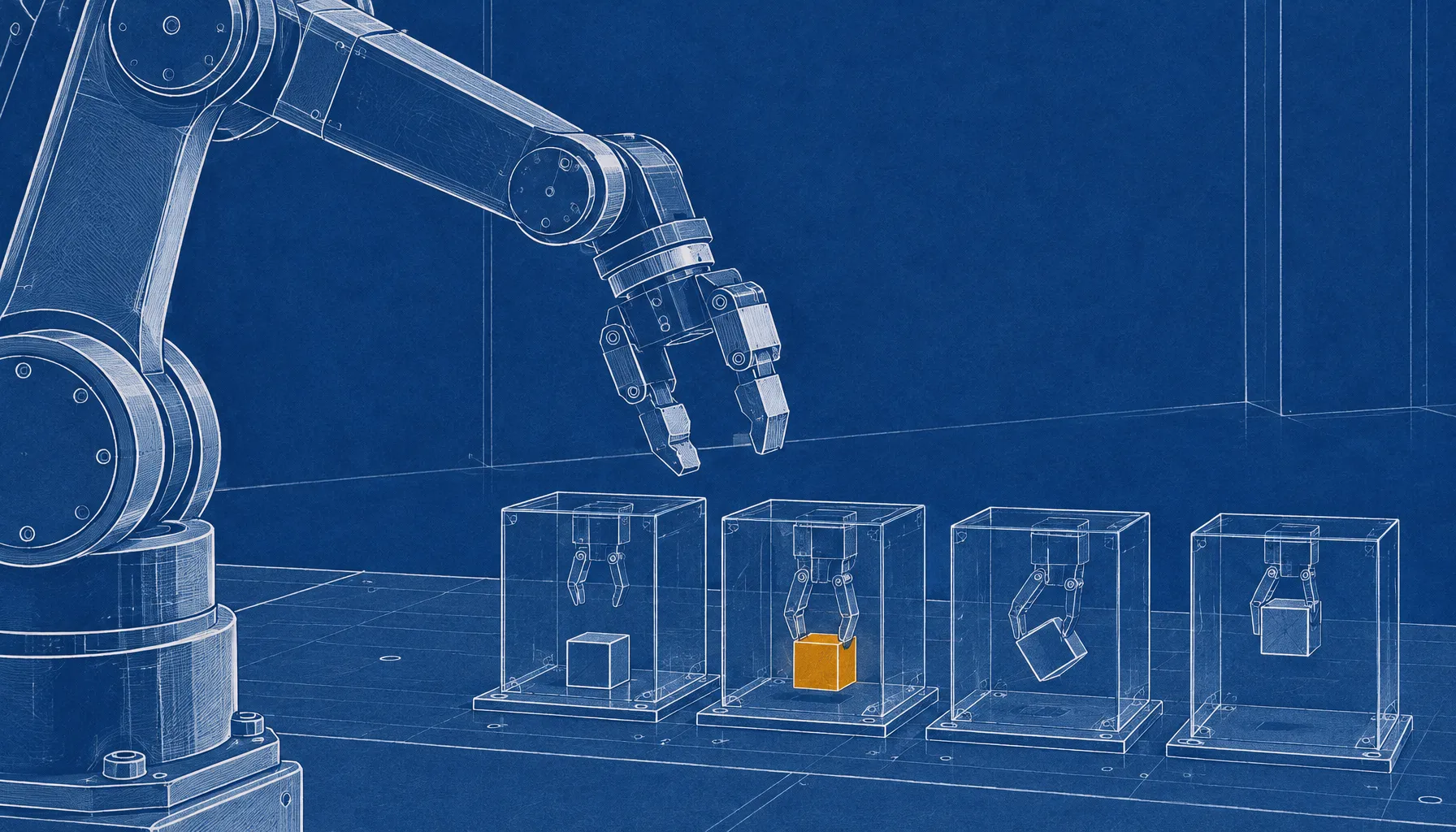
A robot model can imagine a convincing future and still issue an action that fails to produce it. A paper posted on arXiv on November 2, 2026, proposes a way to check that mismatch before the robot moves: generate several action-and-future candidates, score them, and execute the highest-ranked one.
WISE checks whether an imagined action fits its future
The method, called WISE, evaluates each rollout on three properties. It checks whether the proposed action is valid and temporally regular, whether an inverse-dynamics model can recover an action consistent with the imagined motion, and how much progress the future appears to make toward the instruction.
The selector sums those scores and chooses the top candidate. The underlying world action model stays frozen; the paper says its inverse-dynamics model is trained once for each robot embodiment. After executing the chosen action chunk, the robot observes the result and replans.
The authors focus on a specific failure in world action models, which produce both robot actions and predictions of how the scene will change. Their paper’s example describes an imagined banana grasp in which the object remains near the gripper, while the real execution moves it away from the predicted interaction. The scoring system aims to distinguish a plausible-looking imagined scene from one whose paired action supports the predicted motion.
Four candidates lift RoboLab success from 6% to 24%
In tests with Cosmos 3 Edge on RoboLab, WISE raised closed-loop success from 6.0% for single-rollout execution to 24.0% with four candidates per decision. The RoboLab evaluation covered 10 manipulation tasks and 50 episodes per method. At the same four-candidate budget, Future Consensus reached 18.0%, while GeoBoN and Robometer each reached 20.0%.
The paper says WISE’s advantage over the strongest competing selector on RoboLab amounted to two additional successful episodes out of 50. That is a narrower margin than its improvement over executing a single rollout, and the authors caution that differences of a few points between selectors fall within sampling variation at that evaluation size.
LIBERO gains are smaller, and inference takes longer
On LIBERO, WISE raised DreamZero’s mean success rate from 75.1% to 78.3% across four benchmark suites. The paper reports 2,000 episodes per method and an aggregate lead of 0.9 points over Robometer. WISE did not lead every suite: GeoBoN performed best on LIBERO-Goal, and Robometer on LIBERO-Long.
The added selection work carries a runtime cost. Compared with executing a single rollout, WISE increased average episode runtime by 3.4 times on RoboLab and 3.5 times on LIBERO. Among selectors using four candidates, WISE had the highest runtime on RoboLab; on LIBERO, its cost was comparable to Robometer and lower than GeoBoN.
Task progress changes the most selections
Ablations suggest that the three scoring signals often favor different candidates. All three independently selected the same candidate in 7.8% of RoboLab decisions and 7.0% of LIBERO decisions. Task progress agreed most often with WISE’s final choice, at 67.2% on RoboLab and 65.5% on LIBERO, but it did not determine the selection by itself.
Removing the task-progress score changed WISE’s choice in 47.1% of RoboLab decisions and 48.5% of LIBERO decisions, the largest effect of any component in both settings. The authors also identify limits: an inverse-dynamics model can misread actions implied by an imagined trajectory, and a progress model can misjudge futures that look plausible. The paper’s results therefore show a measurable benefit from evaluating multiple imagined rollouts, alongside extra inference time and dependence on the auxiliary evaluators.