The Pulse
UCLA Team Tests Optical Deepfake Detection on 15 Video Streams
A UCLA study reports a hybrid optical-neural system that classified 15 video streams in parallel, reaching 97.79% average accuracy on the Celeb-DF deepfake dataset. The laboratory prototype uses digital processing alongside an optical stage
AI.info Team · Written with AI ·
Published September 22, 2026, a UCLA study reports an optical-neural system that classified 15 video streams in parallel, reaching 97.79% average accuracy on the Celeb-DF deepfake dataset. Rather than sending each video through a digital decoding network one at a time, the researchers encoded video features electronically, then used light traveling through a physical optical setup to produce authenticity scores.
The result is a laboratory demonstration, not a finished detector ready to screen online video feeds. Its optical stage works alongside conventional digital processing, and its performance varies across datasets and system configurations.
Light handles the parallel decoding
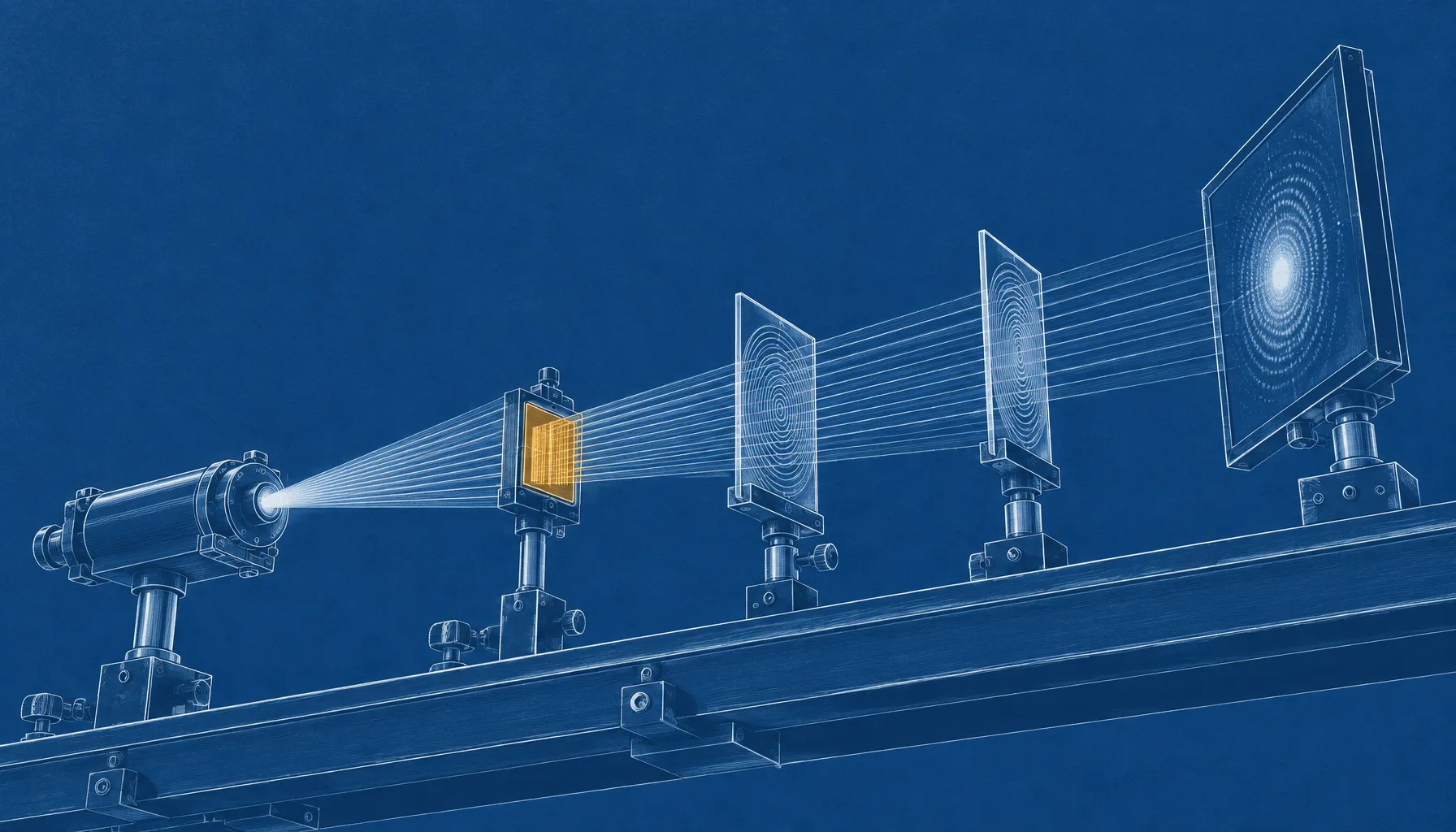
The team’s design combines a digital front end with a spatially multiplexed optical decoder. A programmable spatial light modulator encodes information from each video into patterns of light; the patterns propagate through the optical setup, and paired detectors register outputs used to classify each video. Because the streams occupy separate spatial channels, one optical pass can process many at once.
“The presented spatially multiplexed optical deepfake detection framework is designed to serve as an energy-efficient and highly sensitive first-stage screening module for large-scale deepfake detection.” The paper’s authors, Parnian Ghapandar Kashani, Shiqi Chen and Aydogan Ozcan, write that their design aims to flag suspicious clips for a more detailed digital review, rather than replace that review.
Accuracy changes with the dataset and channel count
In a visible-light experiment, the system processed 15 Celeb-DF videos per optical pass and recorded 97.79% average accuracy, 99.86% sensitivity and 95.72% specificity. Sensitivity measures how often manipulated videos are correctly flagged; specificity measures how often authentic videos are correctly identified. The two measures describe different error risks, so the high sensitivity does not mean that every flagged video is fake.
When the researchers raised the parallel count to 18 videos, average accuracy fell to 96.13%. They attribute the drop in part to increased optical crosstalk between channels. That trade-off matters: packing more streams into a single pass raises throughput, but the tested system did not preserve the same measured accuracy at the higher count.
The team also tested videos generated with Google’s Veo 3 through Gemini. After fine-tuning the digital encoder with 50 generated videos, the experimental system reached 94.80% accuracy, 97.61% sensitivity and 92.00% specificity on a held-out test set. Five fine-tuning videos yielded 85.1% accuracy in numerical testing, while the 50-video setting produced the reported experimental result.
The energy comparison covers the decoder
The paper compares its optical decoder with digital alternatives and estimates energy use per video. In one comparison, the 15-channel optical decoder with two passive diffractive layers used an estimated 1.38 to 4.11 millijoules per video; a digital deep convolutional decoder with similar detection performance used 30.44 millijoules. Those figures apply to the decoder, not the entire pipeline: digital video preprocessing and encoding remain part of the system.
That boundary is important because the optical hardware does not eliminate conventional computation. The researchers describe face detection, landmark localization and feature encoding as digital steps before optical decoding. Their energy comparison also depends on the selected configurations and experimental assumptions, rather than a direct test of a complete deployed moderation service.
A screening stage, not a verdict
The researchers position the system as an initial filter for high-volume video screening. Clips that receive suspicious scores could then go to more computationally demanding digital detectors for further examination. That setup could help where many streams need an early check, but the paper does not establish performance across all video generators, platforms or real-world operating conditions.
The results instead show what the prototype has demonstrated: visible-light hardware classifies 15 Celeb-DF streams in one pass, with lower accuracy at 18 streams and a separate 94.80% result on held-out Veo 3-generated video after fine-tuning. The optical decoder supplies the parallel stage; digital processing still prepares the videos and produces the features it needs.