The Pulse
Toyota Trains Workers to Teach 400,000 Factory Robots
Toyota workers are training ELEY humanoid robots for factory tasks as the automaker plans to deploy 400,000 machines across its production network. Toyota says the program will support human workers rather than replace them, with annual fac
AI.info Team ·
Toyota plans to invest $6.42 billion a year from 2028 to upgrade its factories for a robotic workforce of 400,000 machines, while asking workers to help teach the humanoid systems that will operate alongside them. The plan covers 150,000 robots for Toyota’s own automotive plants and another 250,000 for group companies producing components and materials, according to Ars Technica.
The scale of the proposal places Toyota among the largest industrial users of humanoid robots, even though the company has not said how many of the 400,000 machines will use a humanlike form. Toyota has already started deploying its ELEY robots on assembly lines, where workers provide demonstrations and help the machines learn tasks involving precise hand movements.
Workers teach ELEY through physical demonstrations
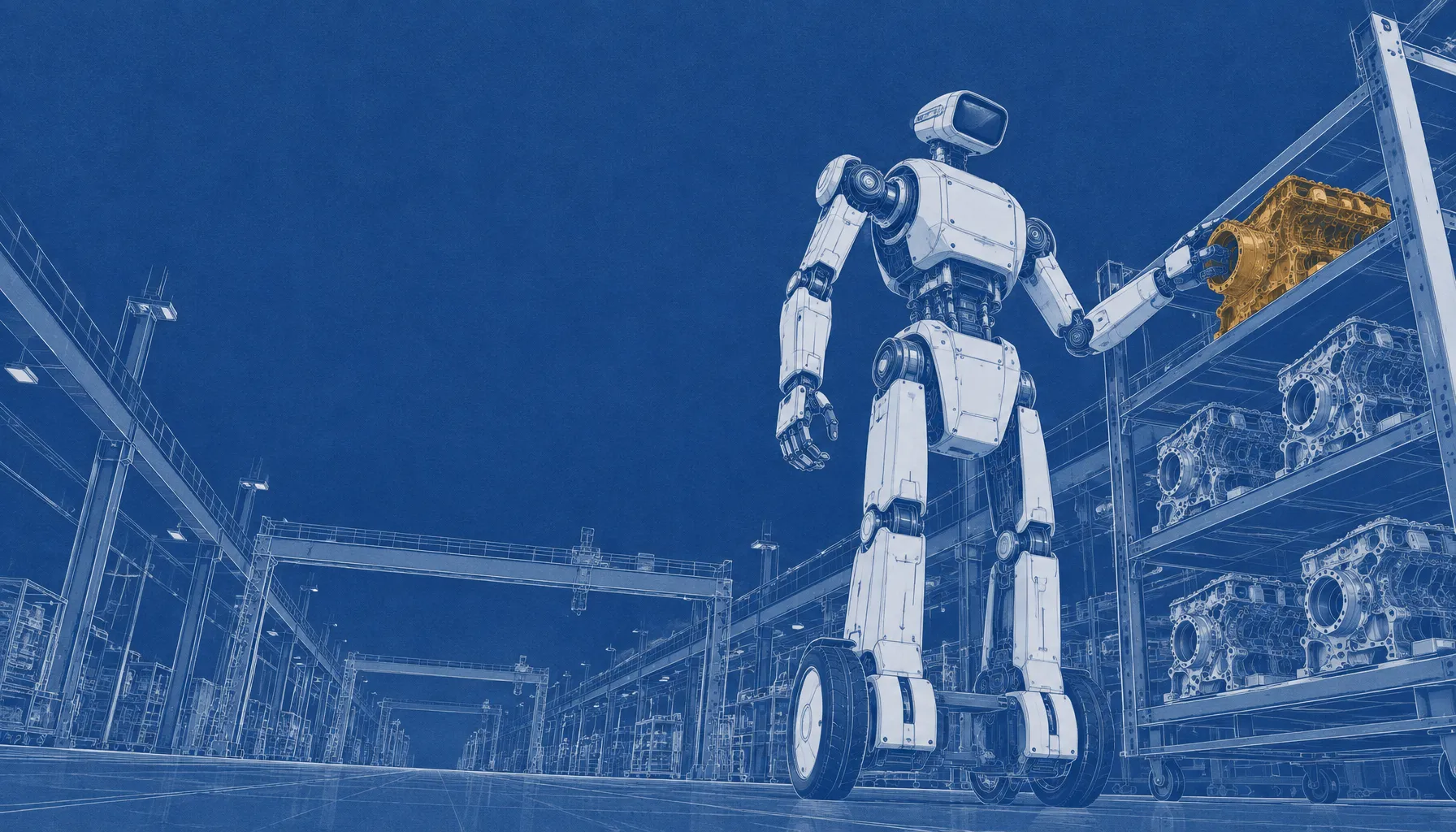
ELEY robots roll on wheels and use two hands for manipulation. Toyota workers reportedly wear finger-like jigs based on the robot’s design, allowing them to demonstrate how a task should be performed. The approach shifts part of the training process from conventional programming toward collecting examples from people working in the factory.
Toyota’s own research describes ELEY as an “Embodied Learning robot for Enhanced Yield.” The company says the machine was designed to interact gently with its surroundings and to learn from operations carried out in conditions closer to a real production site. Toyota researcher Toshihide Yamada identifies long-duration reliability, repeatable positioning and the data infrastructure needed for robot learning as outstanding technical problems.
$6.42 billion a year for Toyota’s factory upgrade
The investment plan is scheduled to begin in 2028. Toyota intends to place 150,000 robots in its automotive factories and 250,000 in facilities operated by companies within the wider Toyota group. Ars Technica reports that Toyota has not disclosed how many robots it has deployed so far or how many of the planned machines will be humanoid.
The company’s manufacturing network already relies heavily on conventional automation, including fixed robotic arms and mobile machines that transport parts and materials. Humanoid systems are being pursued for a different reason: their shape could allow them to work in facilities built for people without requiring every station to be redesigned.
The stated deployment: 150,000 robots for Toyota automotive plants and 250,000 for group companies, with annual factory investment planned at $6.42 billion from 2028.
“Robots coexist with humans”
The plan raises an immediate question about Toyota’s 18,000 veteran workers across 60 factories worldwide, including 11 US manufacturing plants. Hiroki Nakajima, a Toyota executive vice president, told Nikkei Asia that the company wants “a world where robots coexist with humans, rather than replacing them.”
That promise places Toyota’s robotics strategy in the same difficult territory facing other automakers: companies want machines to handle repetitive, physically demanding or difficult tasks, but workers and unions are concerned that productivity programs can eventually reduce headcount or weaken bargaining power.
Toyota’s official description of ELEY presents the robot as a partner for production-site workers. The company says the machine is intended to learn from both successful and failed attempts, creating a cycle in which factory operations generate more training data. The description does not establish how the planned deployment would affect staffing levels, wages or job classifications.
Humanoids move from demonstrations to factories
Toyota’s program arrives as other automakers begin building dedicated facilities for humanoid-robot training. On September 21, Boston Dynamics opened a robotics application center at Hyundai Motor Group Metaplant America in Georgia. The center is training Atlas robots on tasks including sequencing automotive parts and placing them in the correct order for assembly.
Hyundai Motor Group plans to deploy up to 25,000 Atlas robots across Hyundai and Kia plants over the next several years, while Boston Dynamics says a new US facility will eventually be capable of producing 30,000 robots annually. Toyota’s target is far larger, but its plan also leaves open basic questions about the machines’ final configuration, cost and production timetable.
Industrial robots are already widespread in automotive manufacturing. The International Federation of Robotics counted about 2 million industrial robots in China in 2024 and 450,500 in Japan. Those figures largely cover established systems such as robotic arms and mobile platforms, not the newer class of general-purpose humanoids now being tested in vehicle plants.
The unresolved test is factory performance
Toyota’s ELEY research points to the gap between a robot performing a demonstration and a machine operating reliably for an entire production shift. The company says ELEY still needs better long-hour reliability, more precise repeatability and a stronger data foundation for learning.
Safety around human colleagues and the economics of deployment also remain unsettled. Toyota’s announcement sets a numerical target for its robotic workforce, but it does not say how many employees will be retrained, which jobs the robots will take on first, or how the company will measure whether the systems complement rather than displace workers.
For now, Toyota’s first operational step is clear: factory workers are being asked to teach the robots. Whether that training expands human capability or prepares the production line for fewer people will depend on what Toyota does with the 400,000 machines after they leave the research floor.