The Pulse
Scaleout Drones Pick Battlefield Targets Without Live Commands
Swedish startup Scaleout Systems is adapting small AI models for drones that can identify, rank and attack battlefield targets without continuous operator commands. Its work with NATO DIANA and BAE Systems Bofors shows how federated learnin
AI.info Team ·
“With the war in Ukraine and a shifting world, we realized that this technology can be very important to operationalize edge data and sensor data for machine learning to make sure that NATO allies have found that strategic advantage.”
Andreas Hellander, cofounder and CEO of Scaleout Systems
Scaleout Systems is developing military drone software that can detect, identify and prioritize battlefield targets on the aircraft itself, allowing an attack mission to continue without a live link to a human operator.
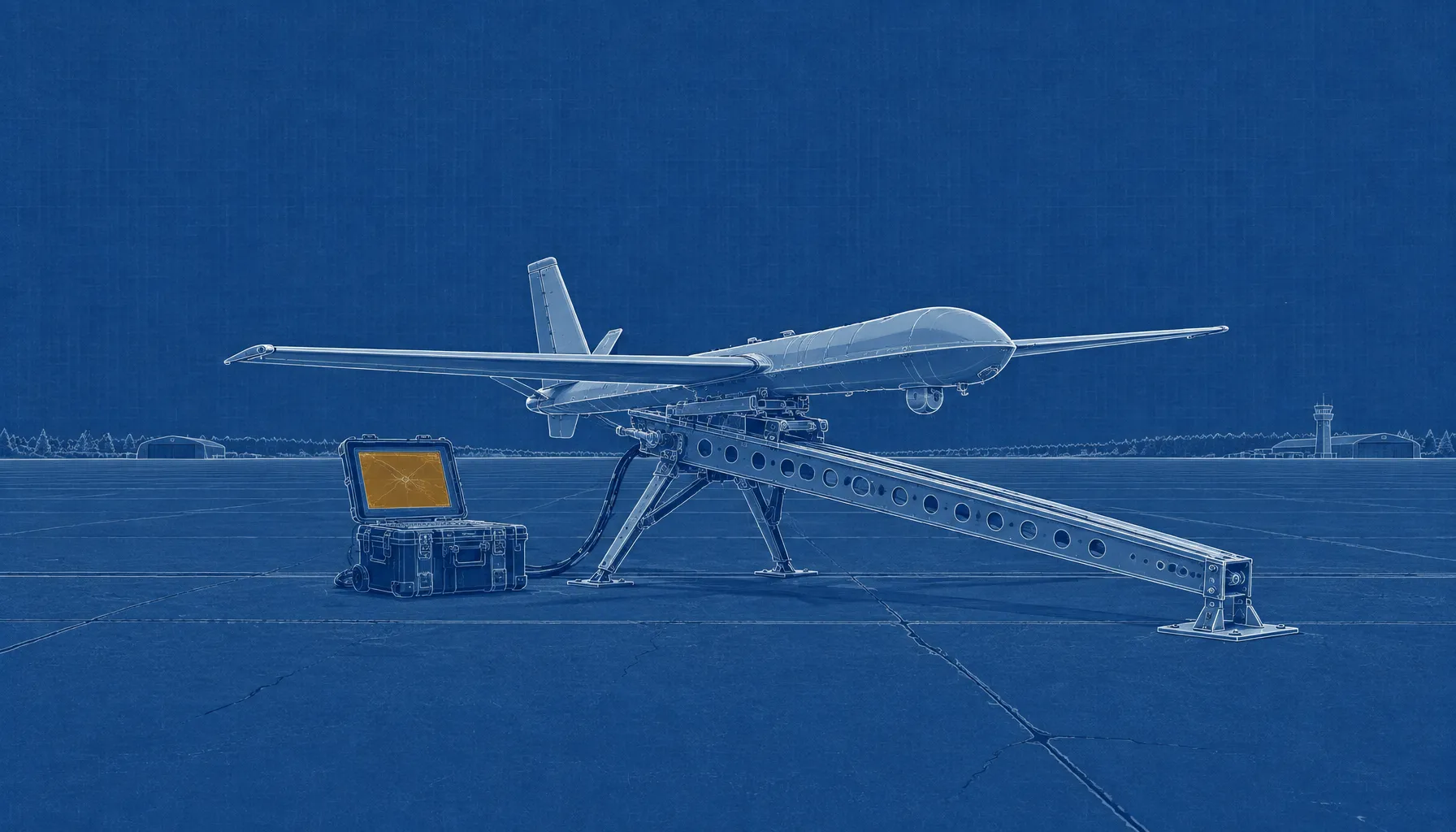
The Swedish startup’s systems have been demonstrated on an autonomous attack drone under the Affordable Loitering Modular Ammunition, or ALMA, project led by BAE Systems Bofors. In a January demonstration in Sweden, the drone identified potential threats, selected an armored engineering vehicle as the highest-value target defined by its mission and flew toward it to release an explosive.
A human operator could still control or redirect the aircraft. The distinction is that the drone completed the target-selection and engagement sequence without receiving direct commands during the mission.
Small models move from the cloud to the drone
Scaleout’s approach does not depend on a large general-purpose model running in a distant data center. The company adapts smaller computer-vision models to the processors available on drones, pilot tablets and forward command posts.
Those models can identify objects from the drone’s onboard cameras and sensors, then send selected model updates to computing nodes at platoon or company headquarters. The system does not need to transmit all raw video, reducing the amount of sensitive data moving across a battlefield.
“They need to fit on forward-deployed hardware and edge hardware, which can vary quite a bit from small embedded devices to quite powerful edge workstations,” Hellander told Ars Technica.
Federated learning for disconnected battlefields
Scaleout joined NATO’s Defence Innovation Accelerator for the North Atlantic, known as DIANA, in 2025. Its Federated Aerial Intelligence for Recon project focuses on updating models across distributed devices while keeping the underlying sensor data at the point where it was collected.
Federated learning allows each local node to train or refine a model using its own data. The nodes can later share model updates rather than raw footage, allowing a central system to combine information from several locations and distribute an updated model back to the field.
Scaleout’s own description of the FEDAIR project says the method is intended for environments where communications are unreliable and sensitive data cannot be centralized. NATO lists the company among its 2025 DIANA innovators.
“Models might have been trained in a desert environment, and if we try to deploy them in an urban environment, they’re not going to perform well,” Hellander said. “If we can release several new versions of this model that—during the course of a single day or certainly an operation—keep learning and keep improving from this massive amount of sensor data that is generated at a practical edge, that is the sustainable advantage.”
The Swedish Air Force test focused on a severed link
In June, Scaleout tested the system at a Swedish Air Force base in Uppsala. The demonstration used a forward computing node at the base and a separate development node in Scaleout’s lab.
When the connection between the nodes was disrupted, the forward system continued running local AI inference and active-learning processes. It recorded detections and continued operating until the connection returned, at which point the local updates were synchronized with the other node.
Scaleout’s account of the demonstration describes a three-level setup: a control system for managing models, ground nodes that run inference and local training, and onboard software that performs last-mile analysis on drones. The Swedish Air Force already licenses Scaleout’s main software platform, according to the company.
ALMA puts target selection into the flight mission
The ALMA project is aimed at producing a low-cost loitering munition that can operate with onboard computing. In the public demonstration described by Scaleout, the drone’s AI detected, identified and located potential threats before ranking them according to the mission objective.
That capability goes beyond navigation. A drone that follows a preprogrammed route is still executing a fixed flight plan; the ALMA demonstration showed a system that interpreted what its sensors saw, chose among possible targets and altered its flight path toward the selected vehicle.
Other military drone programs are pursuing narrower forms of autonomy. Ukraine has deployed strike drones that can track a target after an operator designates it, including systems designed to continue operating when radio links are blocked by terrain or electronic interference. Scaleout’s demonstration takes the human operator out of the immediate target-selection loop after the mission is initiated, though the operator remains able to direct the system.
Autonomy expands faster than the safeguards around it
The technical attraction is clear: a drone that can process sensor data locally is less vulnerable to lost communications, GPS disruption or a damaged command network. Local model updates could also help military systems adapt to new vehicles, camouflage and operating conditions without waiting for a full software release.
The same design raises a harder question about responsibility. If a system identifies a target, ranks it and attacks after a mission-level command, the human decision happens earlier and at a higher level than the final engagement. That may improve reaction time, but it also makes model errors, stale training data and misidentification more consequential.
Scaleout’s work does not establish that autonomous target selection is being used broadly in combat. The company and its partners have described demonstrations and development programs, including the ALMA project and the Swedish Air Force test. The concrete result is a drone that can continue sensing, learning and carrying out a defined attack sequence even after the network connecting it to the rest of the system goes down.