The Pulse
Qualcomm details Hexagon NPU architecture for on-device agentic AI
A September 10, 2026 Qualcomm OnQ post by Vinesh Sukumar describes a next-generation Hexagon NPU built for on-device agentic AI, including Mixture-of-Experts models and a 50% larger shared-memory system. The source contains no separately at
AI.info Team ·
Qualcomm has outlined a next-generation mobile architecture designed to run more agentic artificial intelligence directly on smartphones. In a September 10, 2026 OnQ post, Vinesh Sukumar, Qualcomm Technologies’ vice president of product management for AI and generative AI, described a new Hexagon NPU focused on persistent, multimodal and low-latency AI workloads.
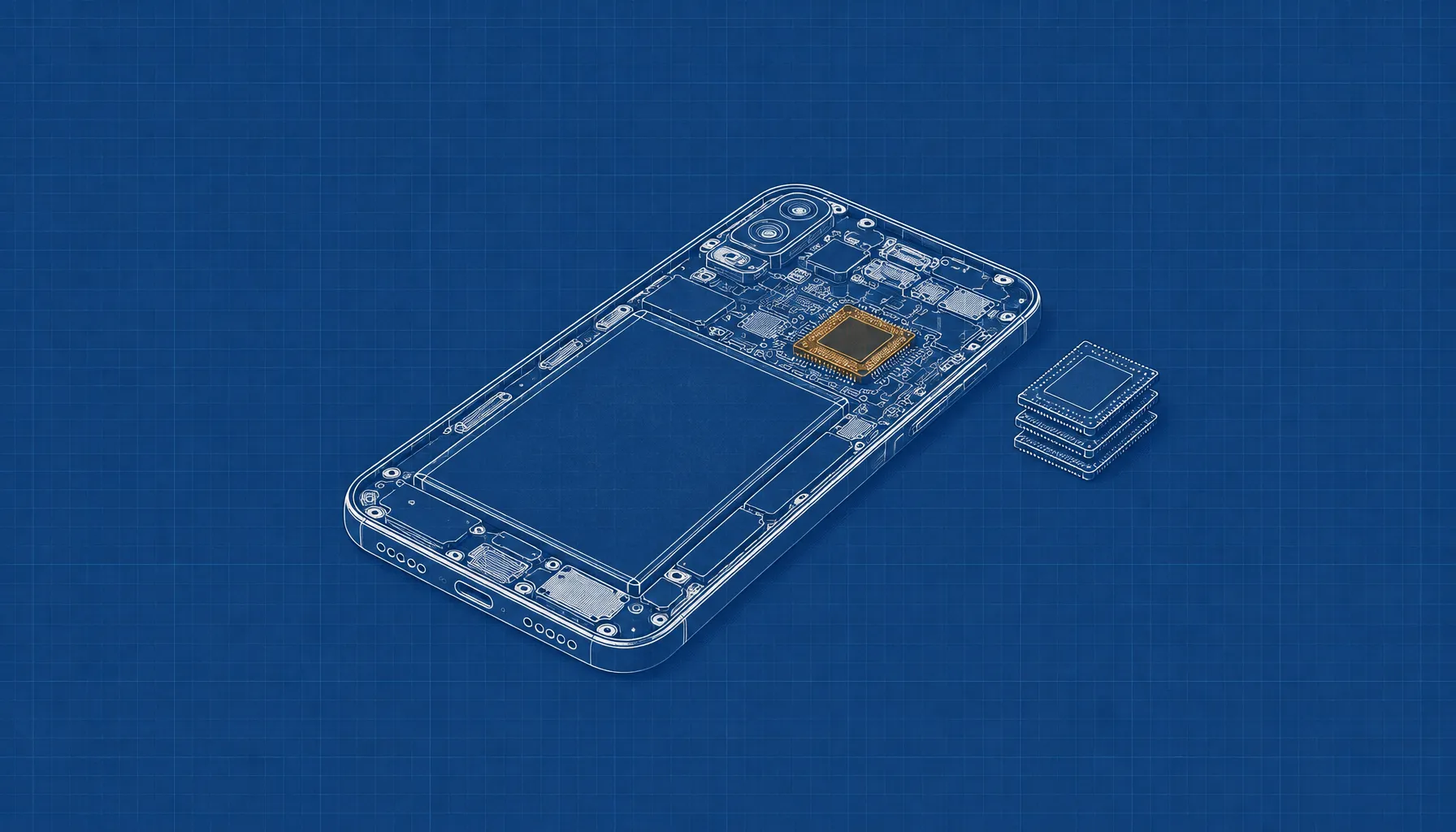
The post does not announce specific Snapdragon phone chips. Instead, it presents the Hexagon NPU as part of Qualcomm’s next-generation premium mobile platform and highlights two architectural features: a transformer-focused Element Accelerator and a larger shared-memory system.
Why Qualcomm is focusing on mixture-of-experts models
Qualcomm’s discussion centers on model architecture as well as raw processor speed. The company says it is working with memory and model providers on on-device systems built around Mixture-of-Experts, or MoE, models. In these systems, specialized expert networks are selected according to the input rather than running the entire network for every inference step.
A 30-billion-parameter MoE model can keep tens of billions of parameters available while activating only about 3 billion routed parameters for each token-generation step on the NPU, Qualcomm says. The company also points to flash-to-memory expert management and caching techniques as ways to reduce memory-bandwidth demands while keeping larger-model-class experiences available on a phone.
That distinction is important because a dense model would require a much larger portion of its network to participate in every inference step. MoE routing can reduce the active computation and memory movement required for each response, although the practical result will depend on the model, quantization, memory configuration and software implementation.
A larger Hexagon NPU memory system
The Hexagon NPU includes a shared-memory subsystem that is 50% larger than the previous generation, according to Qualcomm. The additional capacity is intended to keep more model state, activations and intermediate tensors close to the processor, reducing trips to external device memory.
The architecture also includes an Element Accelerator designed for transformer workloads. Qualcomm describes the NPU as combining that accelerator with scalar, vector and matrix extensions. The scalar extensions support decision logic, routing and orchestration, while the vector and matrix capabilities help process the mathematical operations used by generative AI models.
Support for INT2, INT4, INT8, FP8 and FP16 precision gives developers options for balancing model quality, memory use, power consumption and performance. For INT4-based models, Qualcomm says the platform provides up to 50% higher prefill performance, faster decoding throughput, enhanced speculative decoding and higher overall tokens per second.
From assistants to persistent phone agents
Qualcomm is designing the architecture for AI systems that operate across applications rather than responding only to isolated chatbot prompts. The company describes agents that maintain context, use tools, select specialized models and handle concurrent tasks.
The CPU and NPU have complementary roles in that design. Qualcomm says the CPU can orchestrate multi-step workloads and keep data ready, while the Hexagon NPU accelerates transformer operations and keeps frequently used context close to compute. That division is intended to support repeated cycles in which an agent interprets context, chooses an action, uses a tool and returns to the model for the next decision.
The company links local execution with privacy and reduced dependence on remote servers. Qualcomm’s post also emphasizes that more model data, activations and intermediate tensors can remain local to the processor, helping reduce delays as agents move between tasks.
A platform architecture rather than a phone launch
Qualcomm’s September 10 post describes the Hexagon NPU as a foundation for on-device agentic AI, not as the launch announcement for two named smartphone platforms. The source does not identify Snapdragon 8 Elite Gen 6 or Snapdragon 8 Elite Extreme Gen 6, and it does not establish a standard-versus-Extreme product split.
The company’s immediate focus is the underlying architecture: specialized hardware, expanded local memory, flexible precision support and model-loading techniques aimed at making larger AI systems practical on mobile devices. The actual experience will depend on handset memory, thermal design, model compression and access to optimized runtimes.