The Pulse
Pathway Trains Brain-Inspired BDH on AWS H200 Clusters
Pathway says its BDH-CQ reasoning system reached 29.2% pass@2 on ARC-AGI-1 at a cost of $0.0007 per task. AWS details how the company used SageMaker HyperPod, H200 GPUs and Elastic Fabric Adapter to scale development of the post-transformer
AI.info Team ·
Pathway is asking a direct question of the transformer architectures that dominate modern AI: must a reasoning system generate long chains of text to think through a problem? The Polish company says no. Its brain-inspired Dragon Hatchling, or BDH, performs iterative reasoning inside a latent state, while AWS says SageMaker HyperPod supplied the distributed infrastructure needed to train and test the approach at scale.
The claims arrive with a specific benchmark result. AWS says Pathway’s BDH-CQ system reached 29.2% pass@2 on ARC-AGI-1 at an estimated cost of $0.0007 per task, with the result measured as of August 2026. The result comes from an AWS customer story rather than an independent evaluation, so the most immediate significance is not that BDH has displaced transformers, but that an alternative architecture is being tested on large GPU clusters and tied to a concrete cost figure.
Pathway’s latent-state argument against chain-of-thought
Transformer-based systems usually expose reasoning as a sequence of generated tokens. Each intermediate step consumes context, adds latency and increases inference cost. BDH-CQ takes a different route: it updates an internal recurrent state while processing examples and decodes candidate answers without producing a long verbal reasoning trace.
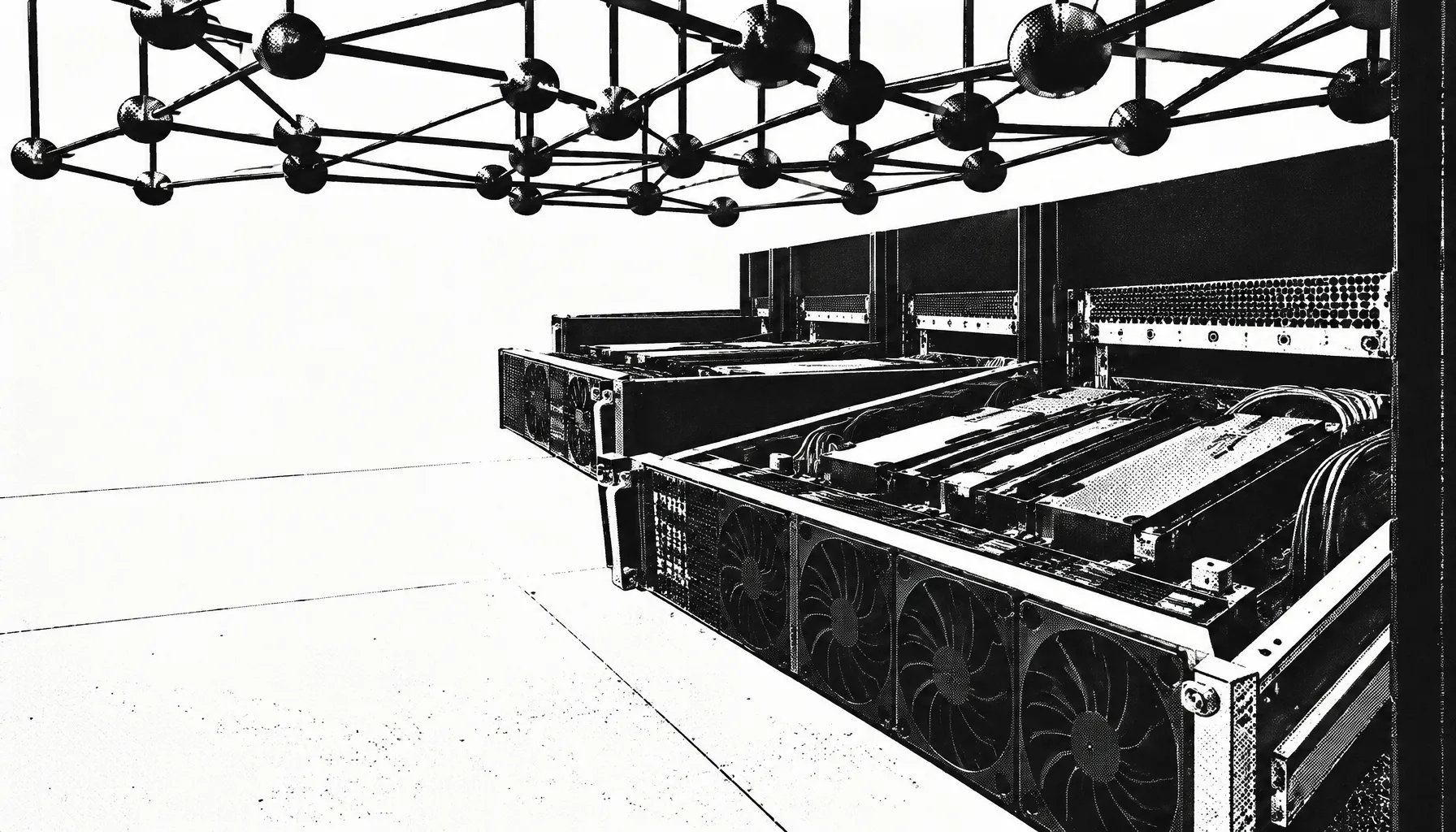
AWS describes the underlying BDH model as a graph of neuron-like units connected through sparse, local interactions. State is maintained in synapse-like connections, allowing the model to adapt during inference without test-time weight updates. The design also aims to avoid tying the length of a reasoning process to a fixed context window.
“Today’s AI pays a steep token cost for reasoning, but that cost is imposed by architecture, not by any law of intelligence,” Zuzanna Stamirowska, CEO and co-founder of Pathway, says in the AWS post. “A 150M-parameter model, built on Pathway’s BDH architecture, reasons recurrently in latent space, and sets a new state of the art in cost efficiency on ARC-AGI-1.”
Pathway’s 2025 technical paper describes BDH as a state-space architecture built from locally interacting neuron particles. The paper reports results across models ranging from 10 million to 1 billion parameters, claiming that BDH can rival GPT-2-style transformers on language and translation tasks using the same parameter counts and training data. It also presents a GPU-oriented version called BDH-GPU.
H200 hardware turns the architecture into a scaling test
Pathway developed BDH with Amazon SageMaker HyperPod, AWS’s managed environment for distributed training and inference across large accelerator clusters. The company used Amazon EC2 p5en.48xlarge instances equipped with NVIDIA H200 GPUs. AWS says each instance offers up to 3,200 Gbps of network performance.
The instances were connected through Amazon Elastic Fabric Adapter, which works with NVIDIA CUDA and the NVIDIA Collective Communications Library to move data, model weights and activations between GPUs. Pathway also ran the workload on an Amazon EC2 UltraCluster, reducing the network distance between accelerators and lowering communication latency.
That infrastructure choice matters because BDH is not merely a small laboratory experiment in an unusual model format. AWS presents the HyperPod deployment as a test of whether a non-transformer architecture can use the same distributed GPU machinery that supports large language model training. The company says BDH integrates with PyTorch, allowing Pathway to use familiar training tools while changing the model’s internal computation.
Monitoring becomes part of the architecture experiment
AWS says Pathway paired HyperPod with Amazon Managed Service for Prometheus and Amazon Managed Grafana. The monitoring stack tracked GPU utilization, memory behavior and communication between nodes during distributed training.
For a team changing the basic structure of a model, those measurements are more than operational dashboards. They help distinguish a problem in the architecture from a problem in scheduling, networking or accelerator utilization. AWS says the setup helped Pathway shorten development cycles, compare cost and performance, and reproduce results across training runs.
HyperPod also provides automated cluster provisioning, customizable software environments and infrastructure designed for distributed workloads. AWS describes the service as a way to reduce the infrastructure work required to train foundation models, while Pathway’s use of H200 instances shows the practical level of hardware involved in its experiments.
ARC-AGI supplies the sharpest test so far
ARC-AGI-1 asks a system to infer an unknown visual rule from a small set of before-and-after grid examples and apply that rule to a new grid. The task is designed to test generalization from limited demonstrations rather than simple recall from a large training corpus.
BDH-CQ uses in-context learning and repeated computation over a latent state to explore possible solutions. AWS says the model can process an arbitrary number of demonstrations at fixed memory cost, because the examples update its internal state instead of expanding a chain of generated reasoning tokens.
The reported score of 29.2% pass@2 and cost of $0.0007 per task place the system on a cost-versus-accuracy comparison rather than a general claim of superiority over every transformer model. AWS says the result changed the cost-accuracy frontier on ARC-AGI-1 as of August 2026. The post does not present a broader set of independent benchmark results establishing that BDH is generally more capable than leading transformer systems.
AWS sees a production case, Pathway is betting on a new model family
Nicolas Tarducci, head of solution architecture for startups in EMEA at Amazon Web Services, frames the work as an infrastructure and deployment question as much as a research result.
“Customers are increasingly exploring how to move advanced reasoning from experimentation into production, where performance, efficiency, and scalability all matter. Pathway’s work training BDH-CQ on Amazon SageMaker HyperPod points to a promising path toward deploying high-performing systems more cost-effectively at scale.”
Nicolas Tarducci, head of solution architecture for startups EMEA, Amazon Web Services
Pathway’s claim depends on whether the measured efficiency survives broader testing: larger models, more tasks, different hardware and comparisons against carefully matched transformer baselines. The company has made the technical paper and sample implementations available through its repositories, giving researchers a way to inspect the architecture rather than treating the AWS benchmark figure as a standalone product announcement.
For now, the concrete result is narrower and more useful. A 150-million-parameter BDH-CQ model, according to AWS and Pathway, achieves 29.2% pass@2 on ARC-AGI-1 at $0.0007 per task, while its developers use H200 GPU clusters, EFA networking and SageMaker HyperPod to train and monitor the system.