The Pulse
NVIDIA Unveils GR00T 2 Robot Model and Isaac Lab 3.0 at CoRL
At the Conference on Robot Learning in Austin, NVIDIA introduced GR00T 2, an open world action model built on Cosmos, and version 3.0 of its Isaac Lab robot-learning framework. It also presented new benchmarks for industrial robot tasks wit
AI.info Team · Written with AI · fact-checked ·
NVIDIA used this week’s Conference on Robot Learning (CoRL) in Austin, Texas, to introduce GR00T 2, a world action model for robots, alongside Isaac Lab 3.0 and new open benchmarks for industrial tasks.
GR00T 2 learns from demonstrations
At CoRL, NVIDIA is introducing GR00T 2, an open frontier world action model built on NVIDIA Cosmos. The model was trained on diverse robot and human data, including 100,000 hours of NVIDIA open source human egocentric data. According to NVIDIA, without task-specific demonstrations it completed 40 of 50 evaluated tasks at least once; with just one demonstration per task, it achieved 71% average success across 50 tasks, increasing to 95% with five. GR00T 2 learns from human demonstrations and transfers skills between different robot bodies without robot demonstrations.
AI agents can use GR00T 2’s application programming interface and supporting tools to run skills in sequence and recover from errors. NVIDIA says the model currently ranks among the top three models across all vision language action and world action model categories for the RoboCasa365, RoboLab, RoboDojo and MolmoSpaces benchmarks, with multiple leaderboard wins. Nexuni is testing GR00T 2 for robotic laundry handling, Foxconn is applying it to factory automation for server manufacturing, and Siemens is evaluating it across industrial use cases.
One policy for 20 assembly tasks
Built in Isaac Lab, AlphaNIST trains a single policy across all 20 tasks on the NIST Assembly Task Board, manipulating millimeter-scale parts using only a yes-or-no success signal. NVIDIA says it reaches more than 98% training success, against 81% for separate per-task policies, with roughly 39x less GPU time. Success-Guided Sampling, or SGS, from the University of Washington and NVIDIA is behind those results. SGS focuses practice on tasks a policy succeeds at about half the time; with SGS, robot training can scale beyond a million parallel environments.
Isaac Lab 3.0 has tighter integration with Newton
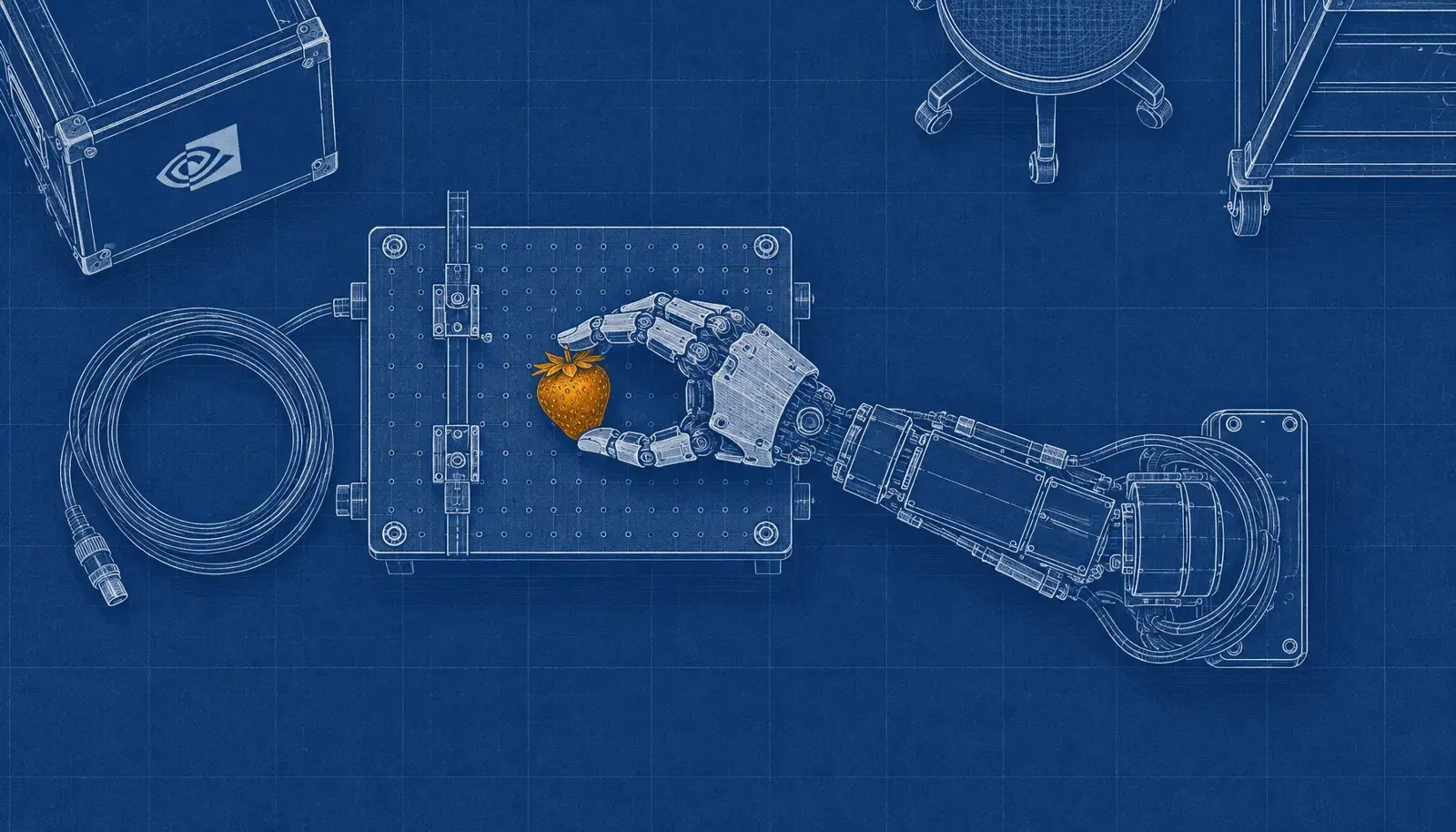
Isaac Lab 3.0, NVIDIA’s open source robot-learning framework, allows researchers to use agents to quickly set up training environments with simulation-ready assets, switch between NVIDIA PhysX and Newton physics solvers, choose renderers for perception-based training and apply a new reinforcement post-training library to foundation models like GR00T. Tighter integration with Newton now allows Isaac Lab to model deformable objects such as cables and cloth, along with complex articulated systems such as robotic hands with many interacting joints. In a vision-based dexterous manipulation benchmark, Isaac Lab 3.0 with Newton achieved up to 2.5x the training throughput of Isaac Lab 2.3 with PhysX. Integration with Newton simulates how a strawberry deforms under a robot’s grip.
New DexBench and VABAR evaluate industrial tasks
Isaac Lab-Arena’s developer preview of its latest version, 0.4, is arriving at CoRL; the framework lets developers compose diverse and repeatable evaluations and run policies across thousands of variations in parallel. DexBench, developed by RLWRLD in collaboration with NVIDIA, features 15 tasks across four scenes spanning retail, logistics, manufacturing and hospitality, testing generalization across object, spatial and physics variations. VABAR, from UC Berkeley and NVIDIA, evaluates robots across six industrial tasks with standardized variations, difficulty tiers and success metrics.
UC Berkeley’s new Graph-as-Policy (GaP) framework uses agents to connect individual skills into robot programs. Agents test these programs using NVIDIA Isaac open simulation technologies and refine them based on failures.
“To me, agentic robotics is the most exciting technological development since the internet in 1995,”
Ken Goldberg, professor of robotics at UC Berkeley and a lead on the VABAR and GaP projects
Ambi Robotics, Bosch Research and Siemens are all exploring GaP for its agentic robotics workflows across diverse industrial scenarios.