The Pulse
NVIDIA and Cisco Plan 400Gb/s-Lane USFP Optics
NVIDIA and Cisco announced plans for USFP, a pluggable optical form factor designed for 400Gb/s-per-lane AI networking. The companies plan to develop an open industry specification with a community-led project, working with TE Connectivity
AI.info Team · Written with AI ·
At the Open Compute Project Global Summit on October 12, NVIDIA and Cisco announced plans for a pluggable optical module built around electrical signals running at 400 gigabits per second per lane. The design, called Ultra-Dense Small Form Factor Pluggable (USFP), targets AI Ethernet networks that need more bandwidth without adding switch layers or replacing the operating model of removable transceivers. The companies also plan to develop an open industry specification for USFP through a community-led project, so the announcement is a proposal for a shared design—not a published or adopted standard.
USFP aims to add capacity without another network tier
NVIDIA says the first planned modules will fit an OSFP-sized footprint and contain 16 full-duplex lanes, with support for switches and SuperNICs. The company describes a path to 12.8 terabits per second of overall capacity and says the design could connect more 1.6Tb/s endpoints without adding network tiers. Cisco’s account describes the 16-lane configuration as 6.4Tb/s of aggregate capacity, with a path to 12.8Tb/s by expanding to 32 lanes. Those figures are presented differently by the companies; the releases do not provide a shared accounting convention that reconciles them.
Both companies compare USFP with pluggable optics operating at 200Gb/s per lane. NVIDIA says USFP is designed to deliver four times the bandwidth density and about 1.3 times the power efficiency in a comparable module footprint. Cisco describes those improvements as expected results, not measured performance from a shipping product. The stated aim is to fit more network capacity into existing front-panel space and reduce the network’s share of an AI facility’s power budget.
A connector designed for 400Gb/s lanes
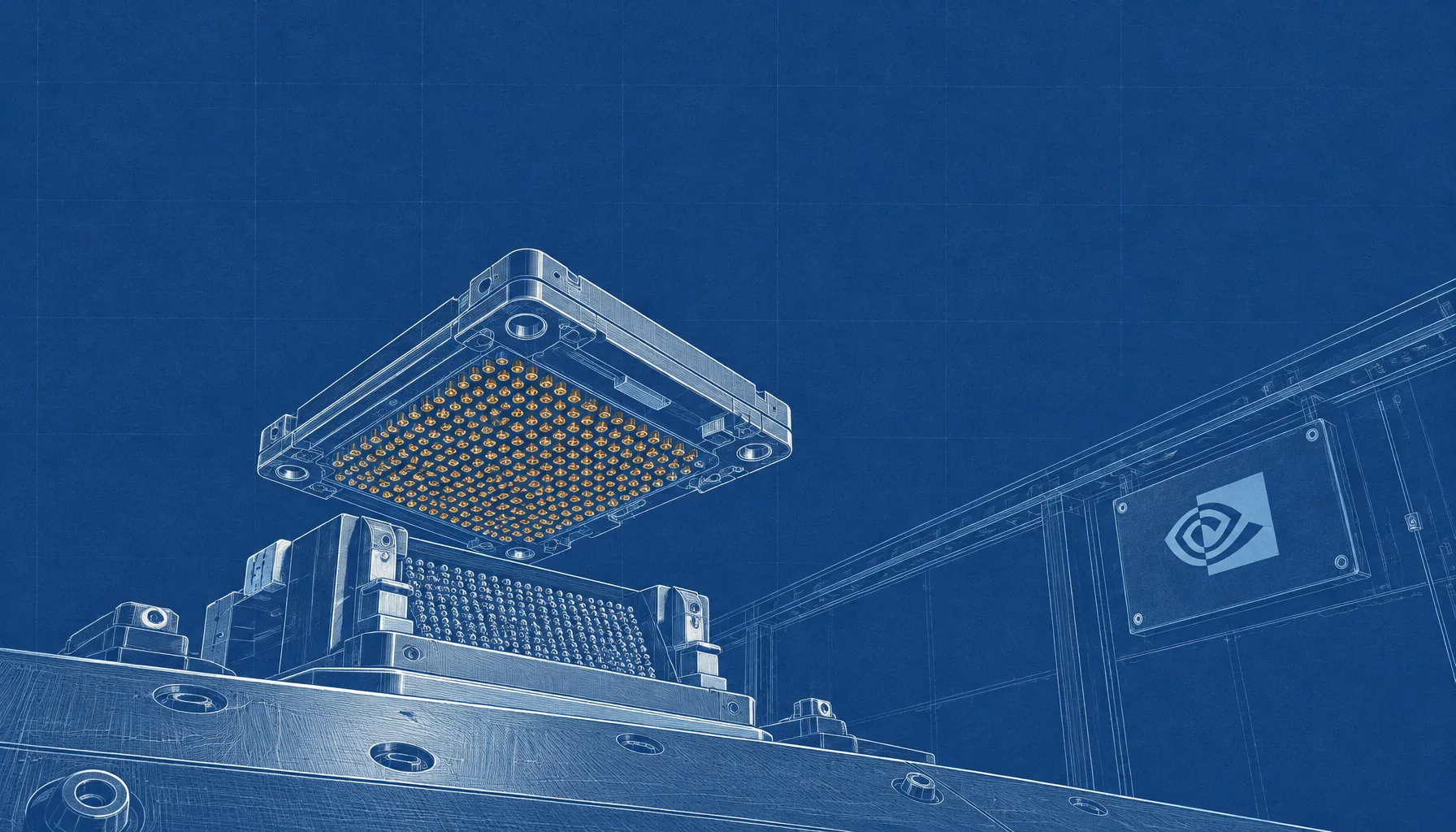
The proposed module uses a two-dimensional array connector with a two-step insertion mechanism. According to NVIDIA, the high-speed contacts engage after the module is inserted, a design intended to reduce contact wear, improve signal integrity and make insertion force more predictable. The connector is also designed to support future expansion beyond 16 full-duplex lanes.
NVIDIA says USFP can dissipate up to 100 watts without a separate embedded cooling circuit inside the transceiver. The company says that could simplify switch design while preserving the replaceability and serviceability associated with pluggable optics. The announcement also points to optical designs that simplify signal processing to reduce latency and power use, though it does not identify specific module products or delivery dates.
Four companies are working on the hardware
NVIDIA and Cisco say they are collaborating with TE Connectivity and Amphenol on cages, connectors and modules, and expect additional partners to join. Cisco says it intends to create the open specification through an upcoming multi-source project, a structure meant to bring multiple suppliers into the design. The companies have not yet named a project launch date or set out a finished specification in their announcements.
NVIDIA senior vice president Gilad Shainer framed the proposal around the connection between optical hardware and larger AI systems:
“Building the world’s largest AI factories starts with rethinking the smallest of connections,”
Gilad Shainer, senior vice president, NVIDIA
The proposal keeps pluggable optics in the mix
USFP is positioned as an extension of pluggable optics rather than a move to replace them with a different optical architecture. Cisco says operators value field-replaceable modules, established supply chains and familiar maintenance practices; the proposed form factor seeks higher lane speeds while keeping those features. That approach matters for large AI networks, where replacing modules and maintaining equipment across many systems can shape operating costs as much as peak link speed.
The next concrete milestone is the open specification: it will determine how other manufacturers can build compatible cages, connectors and transceivers. Until that work appears, USFP remains a joint design plan backed by NVIDIA, Cisco, TE Connectivity and Amphenol—not an available product or an industry-wide standard.