The Pulse
NVIDIA Post Shows Factory Manager Agent Coordinating Specialized Agents on Suspected Defects and Rework
The NVIDIA Factory Operations Blueprint (FOX) reference example explains how a factory manager agent coordinates specialized agents to inspect suspected defects, arrange rework and investigate likely causes. Its SMT reference example follow
AI.info Team · Written with AI · fact-checked ·
NVIDIA’s Nov 04, 2026 post presents a FOX reference example for adding a factory manager agent to existing factory systems. Developers connect factory data and tools, configure specialized agents and define which decisions require operator review. These agents can monitor operations, investigate defects and orchestrate robot fleets.
Factory Manager Agent components
The Factory Manager Agent brings together an LLM, an agent harness and NVIDIA OpenShell. The LLM interprets tasks, connects data across factory systems, develops plans and assesses results. Developers can choose a frontier model such as GPT-6 Astra or an open model such as NVIDIA Nemotron, depending on deployment requirements.
NemoClaw is the default agent harness, with support for alternatives; it connects the manager to tools, skills, persistent memory and specialist agents. NVIDIA OpenShell isolates the execution environment and enforces access policies for files, commands and network destinations. Factory policies define permitted actions and when operator review is required.
Developers connect machine databases, manufacturing execution systems and enterprise resource planning systems through adapters and mappings. Manuals and operating procedures help the manager interpret the data, while an Elasticsearch database stores information for retrieval and retains the investigation context. Specialist agents use their own instructions, context, skills and tools, and can call models such as NVIDIA Cosmos for visual inspection or Kumo for time-series anomaly detection.
The SMT reference example follows an AOI alert through inspection, rework and root cause analysis
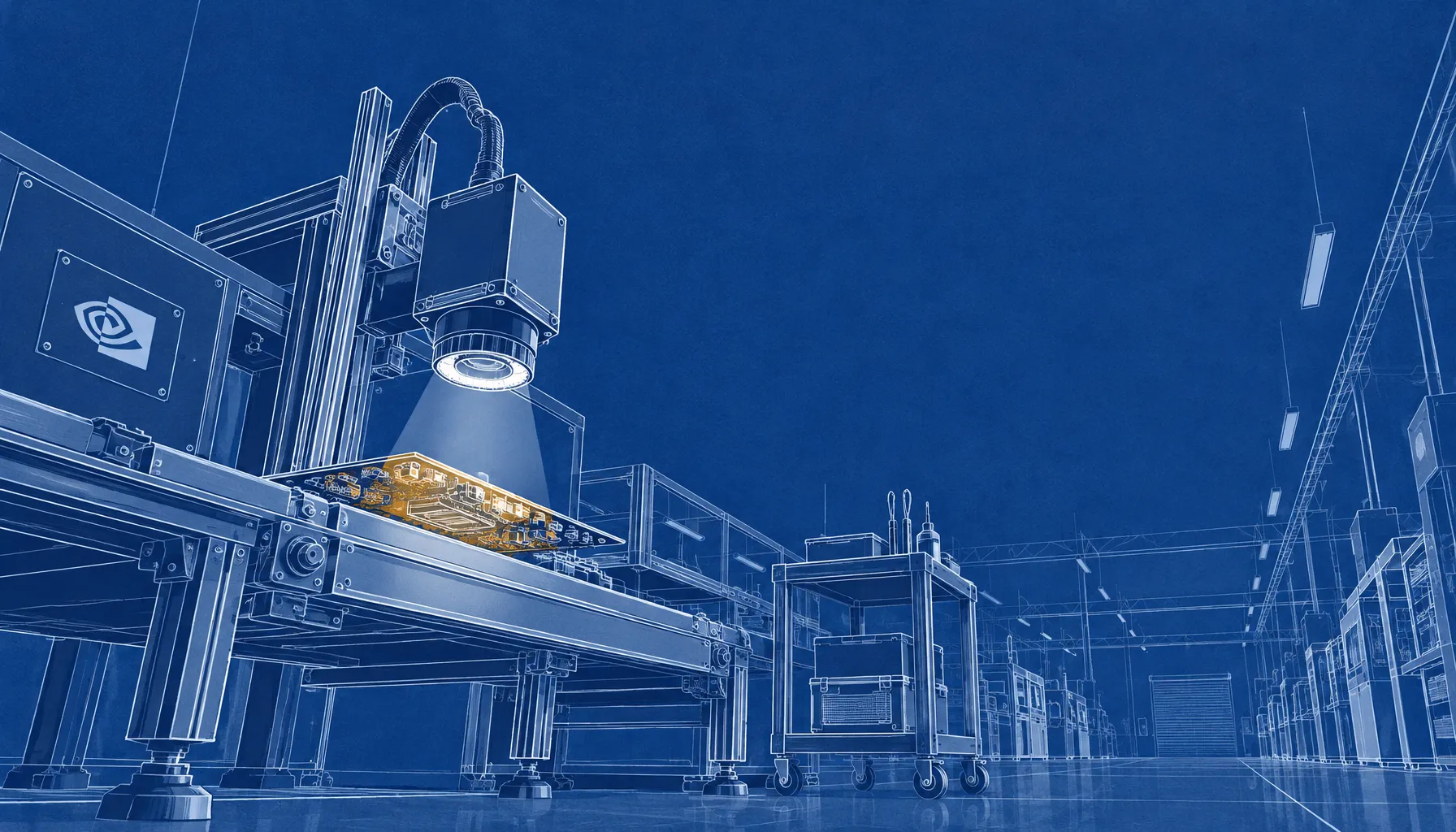
The reference workflow follows an AOI alert on a surface-mount technology (SMT) assembly line producing printed circuit boards. When the AOI station flags a board, the manager retrieves its identifier, affected component and inspection image, then requests a secondary assessment. Adapters preserve identifiers, timestamps, units and source references so agents can retrieve the board’s production history and machine conditions.
The Visual Inspection Agent receives the board image, reference examples and approved criteria, then calls NVIDIA Cosmos to compare the suspected component against the factory handbook. It returns findings, supporting evidence and uncertainty; an inconclusive assessment goes to human review. If the defect is confirmed, the manager asks the Fleet Management Agent to move the board to rework.
The reference workflow demonstrates this transport in a digital twin using NVIDIA Isaac Sim and ROS 2. Physical deployment requires factory-specific equipment integrations for robot handling and autonomous mobile robot (AMR) transport. Initial deployments should require operator approval before handling. Operators repair and retest the board before packaging.
The Root Cause Analysis Agent retrieves inspection findings, placement records, electrical test results and machine measurements using the board identifier and processing history. For a suspected solder defect, the board’s reflow entry and exit times identify the oven readings to examine; Kumo Anomaly analyzes those readings for unusual patterns. The agent compares findings with other production runs, inspection results and machine manuals, then returns a PDF report with source records, suspect measurements, the likely cause and recommended corrective action for a line manager to review.
On-premises deployment and the Siemens production-planning implementation
FOX can run on an NVIDIA DGX Station with its agent environment, required AI models and data stores hosted locally. A fully on-premises deployment requires every model and service endpoint to remain within the factory network, keeping production records, images, prompts and investigation results local. Developers using an externally hosted model must assess what data goes to that endpoint.
The SMT workflow is separate from the Siemens production-planning implementation. At the Siemens Electronics Factory in Erlangen, which produces more than a thousand products a year, for rush orders, agents built with FOX and powered by NVIDIA Nemotron run simulations through Siemens Intelligence Center X. The simulations balance costs, existing orders, supply levels and line setups; the end-to-end agentic system can enable cost savings of up to 20%.
For new product designs, Siemens is combining its product lifecycle management software and Process Preparation X with NVIDIA Cosmos and NVIDIA Omniverse to generate a virtual prototype and synthetic training data. This virtual production preparation can reduce time to market by up to 40%. In the SMT example, the investigation report collects evidence and recommended corrective action for review by the line manager.