The Pulse
Meta and Oxford Researchers Introduce OverSeer World Model
Researchers affiliated with Meta AI and the University of Oxford introduced OverSeer, a multi-agent video world model, in a paper submitted October 20. The system adds fixed auxiliary camera views to help agents maintain a shared, consisten
AI.info Team · Written with AI · fact-checked ·
“We show that these fixed views substantially help the model to maintain consistency.”
Runjia Li et al., “OverSeer: Multi-Agent World Models Beyond What Agents See”
Researchers affiliated with Meta AI and the University of Oxford describe OverSeer, a video world model designed to keep multiple agents’ views of a shared environment aligned. The paper was submitted to arXiv on October 20. Rather than giving each agent a separate model of the world, OverSeer generates their first-person video streams alongside views from cameras fixed in place.
That stable perspective targets a specific weakness in multi-agent simulations: an agent may leave an area, while another changes something there, and the first agent’s later view may fail to reflect what happened. The researchers tested the system in Minecraft and Doom, with additional qualitative examples from real-world multi-camera video. Their results suggest fixed views can help preserve shared scene details, though performance depends on what those cameras cover.
Fixed cameras give OverSeer a shared reference
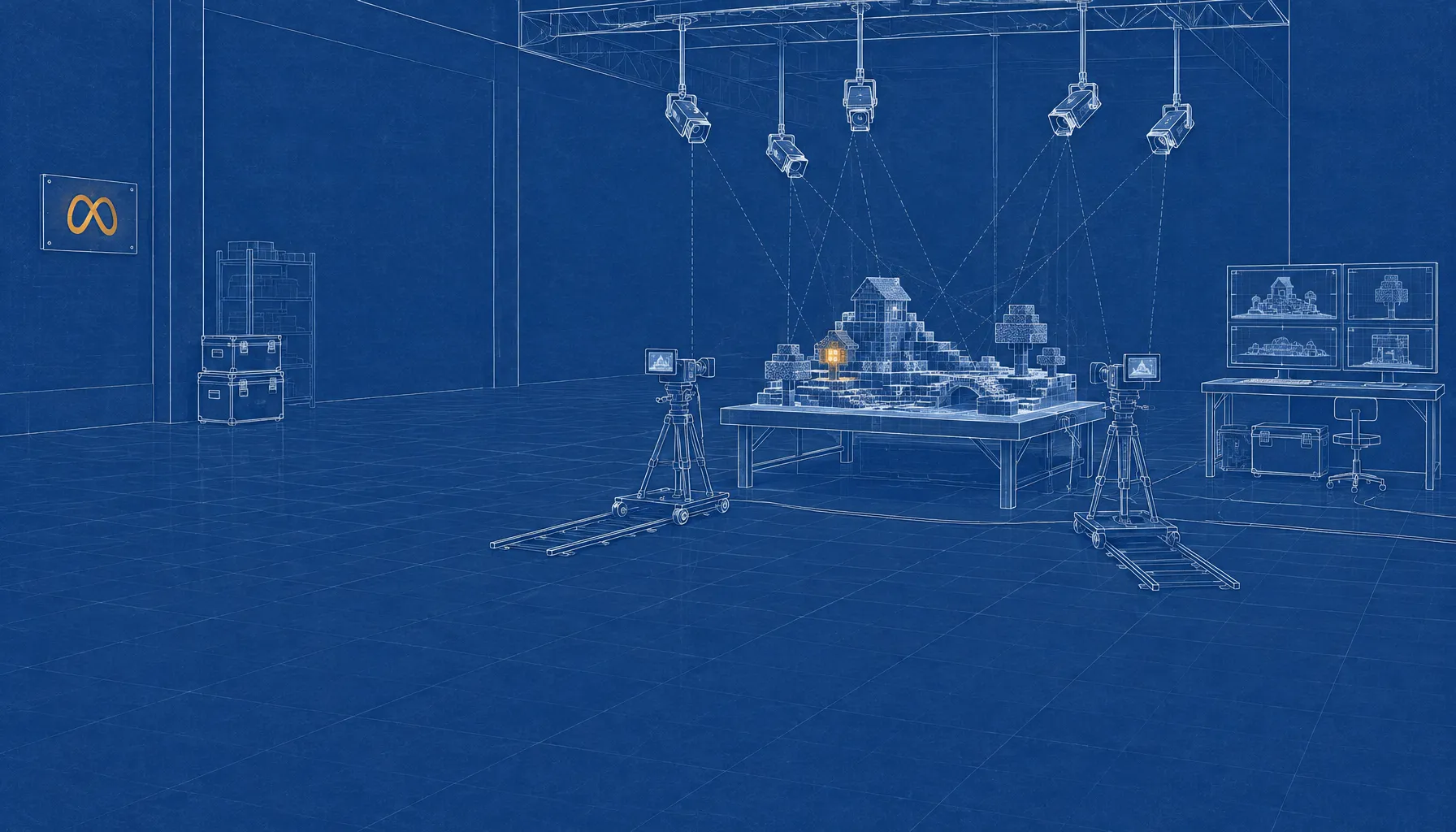
In OverSeer, agents’ cameras move with the agents, so their images change even when the environment does not. Auxiliary cameras stay at fixed positions. The model generates those views jointly with the agents’ video, using them as a persistent reference for changes in the environment and for events outside an agent’s immediate field of view.
The researchers built the system on the Wan2.2-TI2V-5B video model. To reduce the cost of adding auxiliary views, they developed a delta-VAE that stores an initial reference image and encodes later changes relative to it. The paper says six auxiliary views require 37.5% of the token overhead of the two agents’ video streams.
Reunions expose the consistency gap
The team’s Multi-Agent Consistency Benchmark tests whether separated agents can reunite in the right place and whether scenes retain changes that occurred off-screen. In Minecraft, OverSeer reached 60.2% accuracy on “Reunite at Start,” 37.9% on “Reunite Far” and 40.5% on a dynamic-event task. The two comparison systems scored 0% or 6.2% on those tasks, depending on the baseline and task.
The results were not uniformly better. On the Solaris benchmark, OverSeer led on grounding, memory and consistency, but trailed the best baseline on movement and building, tasks the paper describes as relying more on short-horizon, first-person views. The evaluation averaged 32 episodes per Minecraft task and 100 episodes for each Doom task.
Compression trades detail for lower overhead
At 576-by-384 resolution, the delta-VAE cuts auxiliary-view representation from 864 tokens per frame to 108, an eightfold reduction. Removing compression improved some visual-quality and Doom consistency scores, but required eight times as many auxiliary tokens. The authors say the trade-off varies by environment: rapidly changing lighting and enemies in Doom create larger residual updates than Minecraft’s slower, block-based scenes.
The paper also identifies coverage as a constraint. Areas far from the fixed cameras remain harder to keep consistent, and the authors say short-horizon movement does not benefit from the auxiliary views. Their tests establish a research result in two games and selected real-world video examples, not a general-purpose simulator; extending coverage to unexplored areas and larger groups of agents remains future work.