The Pulse
Manchester Trains NVIDIA Earth-2 to Forecast UK Air Pollution
Researchers at the University of Manchester have adapted NVIDIA Earth-2 models for high-resolution air-pollution forecasting across the United Kingdom. The system trained on Isambard-AI in two days and can run inference on NVIDIA’s DGX Spar
AI.info Team ·
“The biggest challenge is the compute required to forecast air quality.”
David Topping, professor, University of Manchester
Researchers at the University of Manchester have adapted NVIDIA’s Earth-2 generative AI models to forecast air pollution across the United Kingdom, producing a model that covers the country at a resolution of 2–3 square kilometers. The work targets a long-standing limitation in air-quality modeling: chemistry-based simulations can provide detailed results, but they require substantial computing power and are difficult to run frequently.
David Topping, a professor in the university’s Department of Earth and Environmental Science, led the work with colleagues including doctoral student Hao Zhang. Working with NVIDIA’s Earth-2 team, the researchers generated training data from existing chemistry-climate simulations and trained Earth-2 CorrDiff on Isambard-AI, the UK national AI supercomputer in Bristol.
CorrDiff Takes Air Pollution Beyond Weather
CorrDiff was developed as a generative downscaling model for weather data. The Manchester team applied the same type of framework to pollution fields, using a year of simulated UK pollution data generated at hourly intervals. NVIDIA’s account of the project says the model produced results on its first training attempt.
The researchers have since added Earth-2 StormCast, which supports time-dependent forecasts and can use air-quality observations directly. That combination moves the project from reconstructing pollution conditions toward forecasting how those conditions change over time.
Air pollution contributes to an estimated 30,000 deaths in the UK, according to the figure cited in NVIDIA’s account. Faster, more detailed forecasts could help researchers examine the effects of policy changes, compare future pollution scenarios and provide regional information to organizations that serve people with respiratory conditions.
Two Days on Isambard-AI
Training took two days on a single eight-GPU node of Isambard-AI. The supercomputer contains 5,448 NVIDIA GH200 Grace Hopper Superchips and delivers 21 exaflops of AI performance, according to NVIDIA.
Simon McIntosh-Smith, director of the Bristol Centre for Supercomputing at the University of Bristol and cofounder of Isambard-AI, said the project used relatively few GPU hours for a climate-related workload. That matters for research groups that need to repeat training runs or adapt a model to new geographic areas without reserving large amounts of supercomputer capacity.
The same workflow also runs on NVIDIA’s DGX Spark, a desktop system built around the GB10 Grace Blackwell superchip. Topping is using a DGX Spark system in his office for retraining models and smaller experiments, while the larger Isambard-AI installation handles the main training workload described in the project.
From Regional Forecasts to Street-Level Data
The current model covers the whole UK at a scale of several square kilometers. The team plans to increase its resolution by adding more open data, with the stated aim of understanding pollution at street level.
That refinement could support more localized analysis, but the project is still a research system rather than a finished public alert service. NVIDIA describes possible uses in healthcare, including warnings for people with asthma when pollution is expected to be high in their area the following day or week.
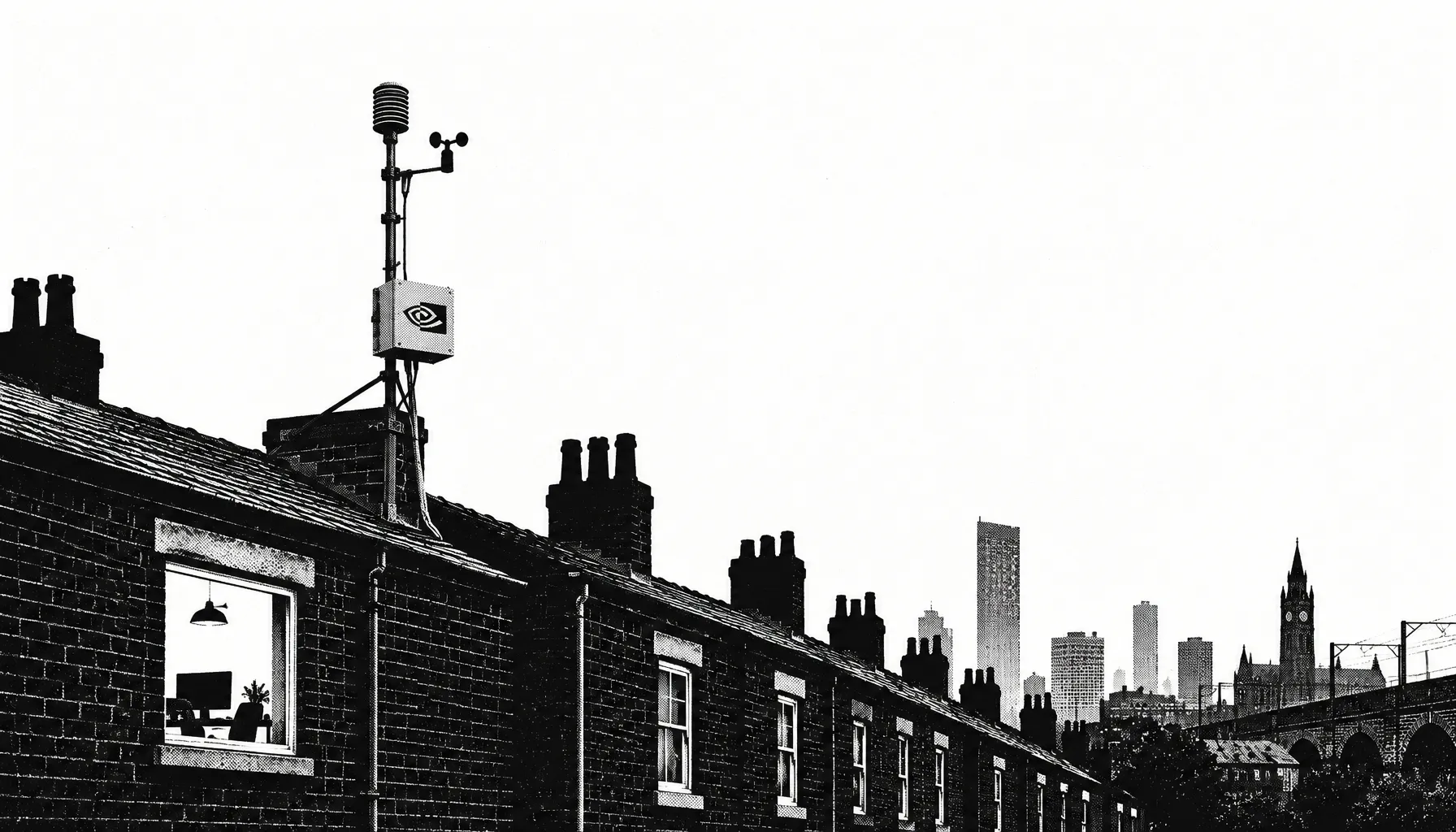
The researchers are also examining whether the model can combine with edge AI devices that collect real-time air-quality measurements. One proposed use is faster decision-making during events such as wildfires, when pollution can change quickly and local observations may be sparse.
An Open Workflow for Other Countries
Manchester’s team plans to release training data and workflows for the pollution models. The goal is to let researchers in other countries and cities retrain similar systems using local data rather than relying on a single UK-specific model.
Topping said the wider objective is for cities and national agencies to produce detailed pollution models after a short period on an AI supercomputer. NVIDIA presents that approach as an extension of Earth-2’s weather tools: researchers begin with an existing framework, supply domain-specific data and adapt the model to a new forecasting problem.
The project also points toward a more direct interface for scientists, clinicians and public agencies. Topping described a future system in which a user could ask what pollution is expected in a particular neighborhood and receive an answer produced by a chain of models grounded in local observations and atmospheric science.
For now, the concrete result is a UK-wide research model trained in two days on Isambard-AI and small enough to run on a desktop AI system. The next test is whether additional open data can turn its 2–3-square-kilometer predictions into reliable street-level forecasts.