The Pulse
Lake Mariner Fire Exposes Accountability Gaps in $3.2B AI Campus
A June fire at TeraWulf’s Lake Mariner data center in New York exposed gaps in emergency planning, water access and corporate accountability. The $3.2 billion project involves TeraWulf, Fluidstack, Google and Anthropic, while state official
AI.info Team ·
TeraWulf says it is responsible for safety at its Lake Mariner data center in Somerset, New York. The local fire chief says that, two months after a blaze at the unfinished facility, the site’s hydrants still appeared to be dry.
The dispute captures the accountability problem surrounding the $3.2 billion project. TeraWulf owns and operates the campus, but leases the land from a company owned by its chief executive, Paul Prager. UK-based Fluidstack is expected to run the center, Google holds warrants for a future 14 percent stake and guarantees Fluidstack’s lease payments, and Anthropic is among the AI companies whose demand helps justify the buildout.
When something goes wrong, the corporate structure leaves several possible answers to the question of who is responsible—and none of them necessarily sits with the company facing the public.
A fire exposed gaps before the campus opened
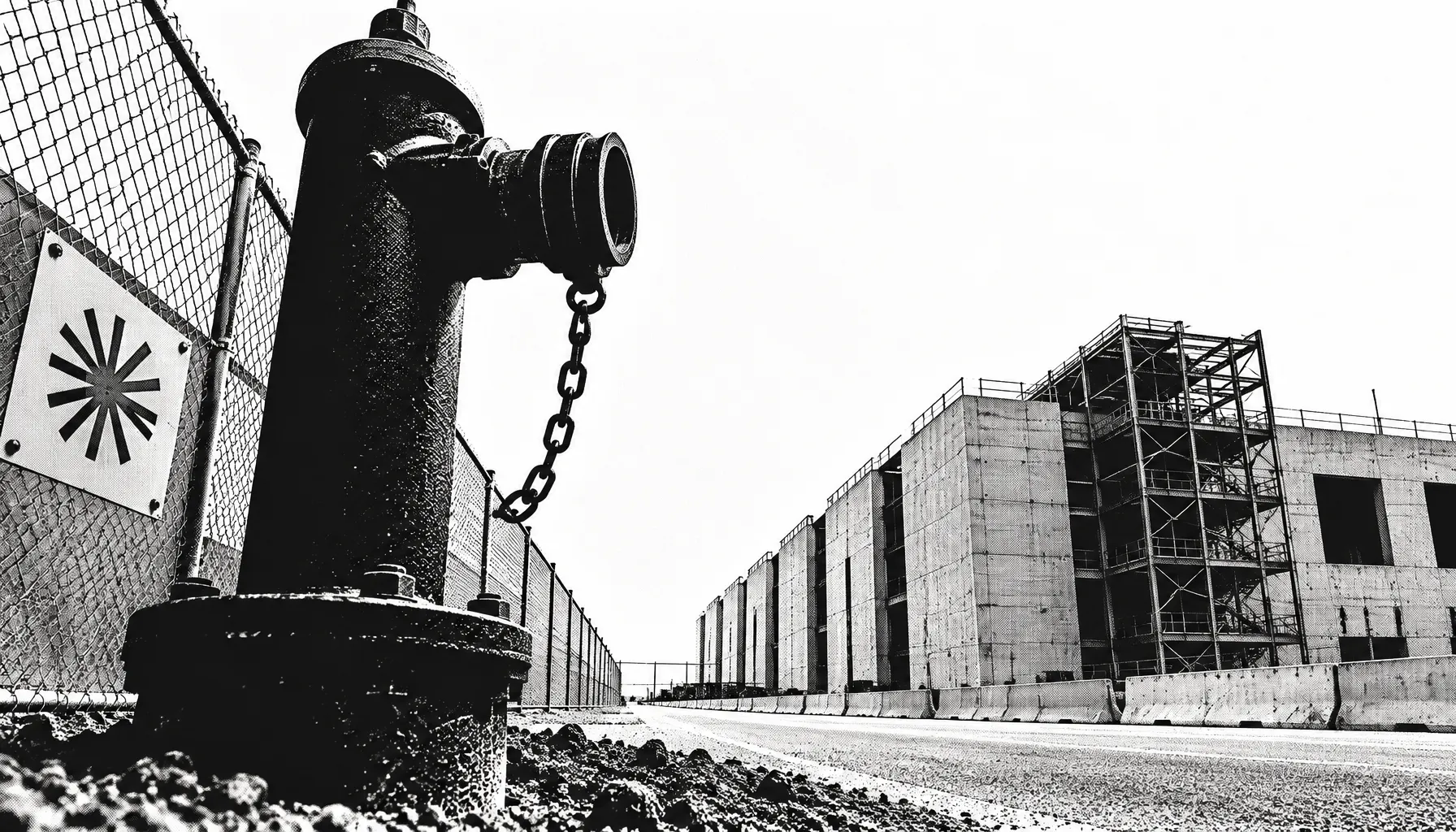
In early June, a fire broke out in a building still under construction at the former coal site on Lake Ontario. Firefighters reportedly found no working alarm, no suppression system and three inoperable hydrants. Safety data sheets that should have identified chemicals inside the building reportedly burned in the fire.
Steve Matisz, chief of the Barker Fire Department, told Ars Technica that his crew entered “kind of blind” while confronting heavy black smoke from chemicals it could not identify. “It’s been a difficult situation,” Matisz said. He also questioned the explanation that the safety sheets had been destroyed in the blaze.
No one was injured, and construction continued. TeraWulf later told Ars Technica that it handled “operational safety and emergency preparedness at the Lake Mariner Data Campus, including required safety systems and coordinating with local first responders.” Kerri Langlais, TeraWulf’s chief strategy officer, said the company had added Knox boxes, more hydrants and portable safety-data-sheet kits after an after-action review with the county.
Matisz’s account was less definitive. In mid-August, he said a Knox box representative had visited the site and scheduled a meeting, but he had not seen work on the hydrants. “As far as I know, [they] are still dry… I haven’t seen work done on them,” he said.
One campus, several corporate roles
Lake Mariner’s ownership and operating arrangements make the safety dispute harder to resolve. A lease agreement filed through TeraWulf’s corporate disclosures identifies Somerset Operating Company as the landlord and Lake Mariner Data as the tenant. Somerset Operating Company is controlled by Prager, TeraWulf’s chief executive.
The agreement also describes Beowulf Electricity & Data, an affiliate of the landlord, as the exclusive operator providing infrastructure, construction, operations, maintenance and administrative services. TeraWulf can serve as operator through its subsidiaries, but the structure gives several related entities a role in the facility.
Fluidstack adds another layer. The company is expected to run the center, while Google has agreed to guarantee its lease payments and holds warrants that could eventually give it a 14 percent equity position in TeraWulf. Anthropic’s computing demand is part of the commercial rationale for the project, but the company is not the facility’s direct owner or operator.
That division matters when the issue is not a contract dispute but a public-safety failure. TeraWulf can point to its operating role, Fluidstack can point to its tenant position, and the larger technology companies can point to their commercial agreements. Local responders, meanwhile, must deal with whatever exists on the ground.
The jobs promised to Somerset have shrunk
Questions about responsibility extend beyond the fire. A 2024 planning-board presentation said TeraWulf’s full buildout could employ between 35 and 40 people at a facility drawing as much as 500 megawatts.
That figure is far below the 165 permanent jobs and $85 million in capital investment promised in 2019, when Somerset Operating Company sought a power discount for the project. Prager did not respond to Ars Technica’s request for comment about the difference.
The New York Power Authority reviews compliance each year and can adjust the site’s benefits if commitments are not met. New York Governor Kathy Hochul has also pointed to the gap between the scale of data centers and their long-term employment.
“Despite the scale of these projects and the utility demands, data centers do not deliver significant, long-term jobs,” Hochul told reporters in July. Pilar Thomas, a former Interior Department deputy solicitor who teaches Tribal energy law, described the construction workforce as large but temporary, followed by a much smaller permanent staff unless operators commit to local training.
Anthropic covers some grid costs—not every local impact
Large data centers also raise questions about who pays for grid upgrades and higher system costs. Leah Stokes, a political scientist at the University of California, Santa Barbara, said a round-the-clock load can make the entire electricity system more expensive, including through grid constraints and backup generation during periods of high demand.
Anthropic addressed part of that concern in a February 2026 commitment to cover electricity price increases caused by its data centers, including all grid infrastructure costs and new generation needed to match its energy use. Lake Mariner falls under that ratepayer commitment, according to a source familiar with Anthropic’s position.
The commitment does not cover every issue surrounding the site. It does not establish who must verify noise limits, emergency readiness or clean-energy claims. Anthropic’s direct arrangement for a separate Kentucky facility gives it more control over contractual terms than its leased relationship at Lake Mariner.
TeraWulf’s description of Lake Mariner’s electricity has also changed. A 2024 corporate-responsibility report called the site 95 percent zero-carbon. A 2025 sustainable-finance disclosure referred instead to 91 percent low-carbon energy, while an April 2026 sustainability policy used combined “low- and zero-carbon” language.
The facility draws from the NYISO Zone A grid, which was 87 percent zero-emission in 2025, according to NYISO’s Power Trends 2026 report. That figure describes the wider regional grid, not electricity that can be traced to a specific generator at Lake Mariner. About 90 megawatts of the site’s capacity comes through the New York Power Authority’s High Load Factor Program, which buys a market-based mix that can include hydro, nuclear, natural gas, wind and solar.
Alex Chiaravalle, a spokesperson for the New York Power Authority, said the distinction matters: “Electricity is sort of a fungible resource. To claim something is renewable energy, or to claim something is hydropower, it would either have to be a customer of the Power Authority or there would have to be that market attribute tied to it.”
New York’s rules do not reach Lake Mariner
New York lawmakers passed the Responsible Data Center Development Act in June. The bill calls for environmental reviews, energy-efficiency standards, prevailing-wage requirements, public hearings, host-community benefits and a one-year pause on new permits for facilities drawing at least 20 megawatts.
Governor Hochul later signed a narrower executive order pausing new permits for hyperscale facilities above 50 megawatts. Lake Mariner is not covered because its 500-megawatt buildout had already been permitted.
Assemblyman Patrick Carroll, a Democratic co-sponsor of the legislation, called the executive order “a good start and a step in the right direction,” but said the bill was more comprehensive. The broader measure remained unsigned as of September 7, 2026.
In Somerset, the immediate problem is more concrete. Two months after the fire, firefighters were still relying on tanker trucks because the water-supply problems had not been fixed. “If there’s no hydrant for me,” Matisz said, “that fire is going to burn under their asses.”