The Pulse
Andromeda 2 outperforms drug-formulation baselines
A preprint posted September 16, 2026, reports that Andromeda 2 produced more high-performing paclitaxel formulations than Andromeda 1 and a wet-lab design-of-experiments campaign. No attributable quotation appears in the arXiv abstract or m
AI.info Team ·
Andromeda 2 wins on consistency, not on the single best result
Andromeda 2 produced substantially more strong paclitaxel formulations than both a previous optimization system and a conventional design-of-experiments campaign, according to a preprint posted on September 16, 2026. The study used a miniaturized automated laboratory to compare Andromeda 2 with Andromeda 1 and a wet-lab design-of-experiments campaign at a matched experimental budget.
Andromeda 2 recorded a 50% high-performance hit rate, compared with 17% for Andromeda 1 and 2% for the physical design-of-experiments campaign. The new system also identified 12 formulations that met all four target product profile objectives, while Andromeda 1 found six and the design-of-experiments campaign found none.
The result does not show that the autonomous system discovered a higher isolated maximum. The abstract says maximum AUC was comparable between Andromeda 2 and Andromeda 1. Its reported advantage came from producing more successful candidates across the campaign.
Paclitaxel exposes the limits of sparse experimentation
The study focuses on self-emulsifying drug delivery systems, or SEDDS, which can improve the oral bioavailability of poorly soluble drugs. Researchers selected paclitaxel as a demanding test case because of its high molecular weight and very low aqueous solubility.
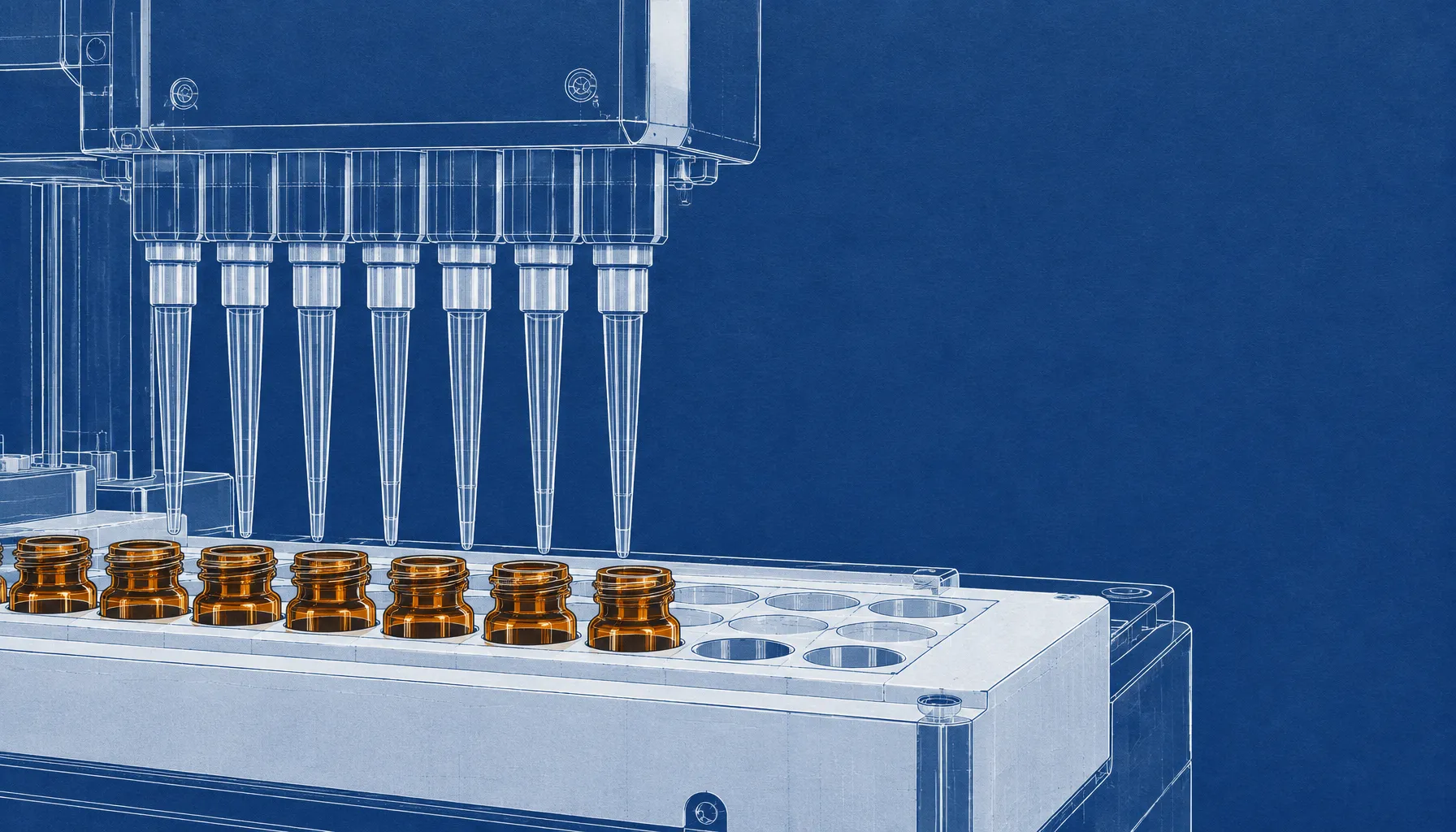
Robotic liquid handling prepared the formulations, while automated dispersion and dissolution, dynamic light scattering, and high-performance liquid chromatography measured their properties. The principal endpoint was the area under the curve for apparently solubilized paclitaxel in fasted-state simulated intestinal fluid between 10 and 240 minutes.
Andromeda 2’s median AUC was 70.1 mg·min/mL. Andromeda 1 reached 12.0 mg·min/mL, and the physical design-of-experiments campaign reached 3.5 mg·min/mL. The assay measures formulation performance under simulated conditions, not absorbed dose, oral bioavailability, or systemic drug exposure.
Andromeda 2 uses evidence from older experiments
The system differs from Andromeda 1 in how it begins a campaign. Andromeda 1 starts largely from the current experiment and updates probabilistic models as new measurements arrive. Andromeda 2 combines new measurements with structured in-house experimental evidence, including information from earlier formulation work.
The researchers used the paclitaxel test to examine whether information collected across other formulation programs could help the system work on a new active pharmaceutical ingredient.
A controlled ablation removed access to that structured in-house evidence while preserving the formulation objective and experimental setting. The full-evidence version produced a higher mean AUC, with the abstract reporting a 34% increase associated with access to the historical evidence.
The agent proposes; the laboratory still checks
Andromeda 2 coordinates proposal, critique, review, planning, and constraint-checking over a shared formulation context. It can invoke computational and experimental tools to design and execute successive formulation batches.
A formulation scientist reviews proposed batches for scientific reasonableness and experimental feasibility. The laboratory then tests the selected formulations and feeds the resulting measurements back into the system for later experiments.
The approach combines autonomous planning with human review and physical measurement. That design lets the system use prior experimental evidence while still checking each proposal through laboratory work.
The strongest formulation still needs biological testing
A selected Andromeda 2 formulation that met all four target product profile objectives showed an apparent effective paclitaxel loading of 19 ± 5% by weight at the first simulated-intestinal-fluid measurement. The authors compare that figure with a published paclitaxel SEDDS loading of 5.7% by weight, but caution that the studies used different formulation types, endpoints, and measurement methods.
The best Andromeda 2 formulation maintained apparently solubilized paclitaxel through 240 minutes and reached an AUC about 18 times higher than an unformulated-drug control. Those measurements describe physicochemical behavior in an in-vitro assay. They do not establish that the formulation improves intestinal absorption or produces better results in animals or patients.
The authors identify several limits, including the use of a single independently initialized campaign for each strategy, a design-of-experiments comparator that did not receive expert prescreening, and a study covering one active ingredient. They call for repeated autonomous campaigns, tests across chemically different APIs, digestion-coupled assays, and pharmacokinetic studies before drawing broader conclusions.
For now, the paper’s clearest finding is narrower and measurable: under a matched experimental budget, Andromeda 2 generated more high-performance paclitaxel formulations and more formulations meeting all four target product profile objectives than either Andromeda 1 or the physical design-of-experiments campaign.