The Pulse
Industrial Next Says Factory Robots Can Switch Tasks in Minutes
Industrial Next says its AI-powered robotic work cells can be retasked in minutes, and announced an evaluation partnership with BMW Group Technology Office. The startup describes training robots through simulation and demonstrations, but ha
AI.info Team · Written with AI ·
Industrial Next announced an evaluation partnership with BMW Group Technology Office on October 13, 2026, at TechCrunch Disrupt, putting a named automotive partner alongside its pitch for factory robots that can change tasks in minutes. The San Francisco startup says its AI-powered work cells can handle manufacturing jobs without the weeks of reprogramming and physical changes that often accompany a production-line switch. BMW’s role, as described in the announcement, is to evaluate the technology—not to deploy it in a production line.
Industrial Next takes its task-switching pitch to BMW
The startup builds self-contained robotic stations powered by models that connect visual input, task context and robot motion. Industrial Next says workers can teach a new task through simulation and demonstration rather than writing a fixed sequence of instructions for each product. The aim is to make automation useful for delicate work and product variations that can defeat robots configured for a single, repeatable operation.
“We can make robots do all these cool things like dance around, because there’s data for that, but we can’t make them assemble high-precision things,” Lukas Pankau, Industrial Next co-founder, told TechCrunch. He said the company uses simulated environments to train robots for high-precision manipulation, with simulations designed to approximate real-world dynamics. That approach addresses a data problem: physical tasks do not come with the huge training corpora available for internet-based AI models.
Phone assembly offers a test beyond the factory demo
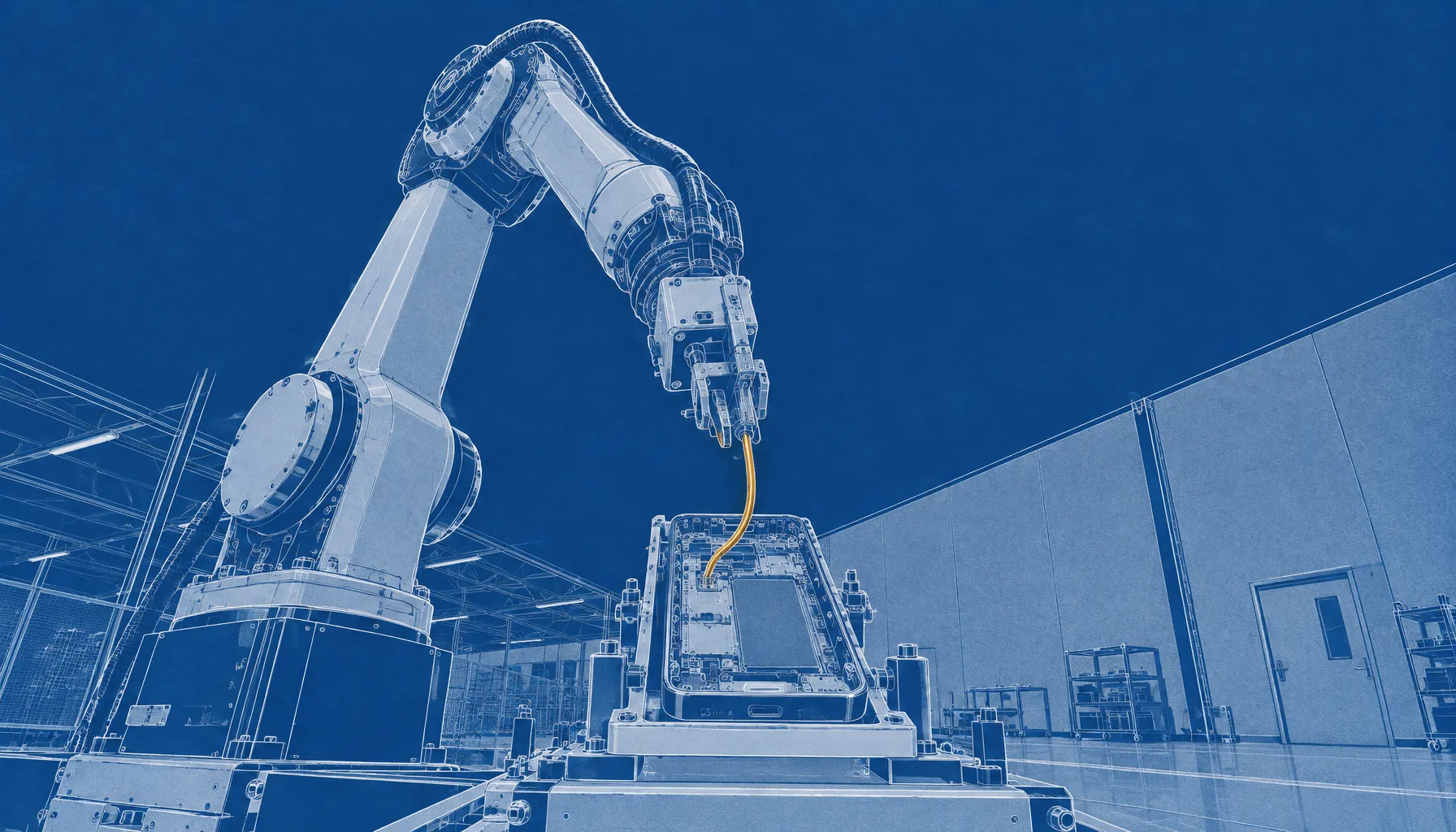
Pankau told TechCrunch that some Industrial Next workstations are already used to make a popular smartphone, but he did not identify the customer. He described tasks including threading a flexible cable and fitting a small connector cap—operations manufacturers had struggled to automate. He also cited a station that removes protective film from camera modules and buttons, saying it works at or above human speed and achieved 100% accuracy when moved to an unfamiliar phone model and production line.
Those performance figures are company claims relayed by Pankau, not results from a disclosed independent test. Industrial Next’s website advertises 99.9% or higher first-pass accuracy and says new tasks can be retaught in hours; elsewhere on the same page, it says changes that once took weeks can now take minutes. The company does not publish a test protocol or explain how those time measures vary by task, so the figures do not establish that every production change takes only minutes.
BMW’s evaluation is not a production rollout
The BMW Group Technology Office partnership gives Industrial Next a route to test its dexterous-manipulation systems in a manufacturing context. The announcement does not specify which tasks BMW will evaluate, how long the work will take, or what criteria will determine success. It also does not say BMW has bought the stations or placed them on a production line.
Industrial Next was founded in 2021 by Pankau and Allen Pan, both former Tesla employees, after they encountered the limits of conventional factory automation. Pankau described engineers able to use machine learning in vehicle design but stumped by older robot-programming systems. The company’s larger ambition is to extend its approach from electronics assembly to more complex manufacturing; for now, the concrete claims are a set of phone-production tasks and a BMW evaluation whose results have not yet been disclosed.