The Pulse
Google, NASA Robot Scores 85% in Early Medical-Bag Test
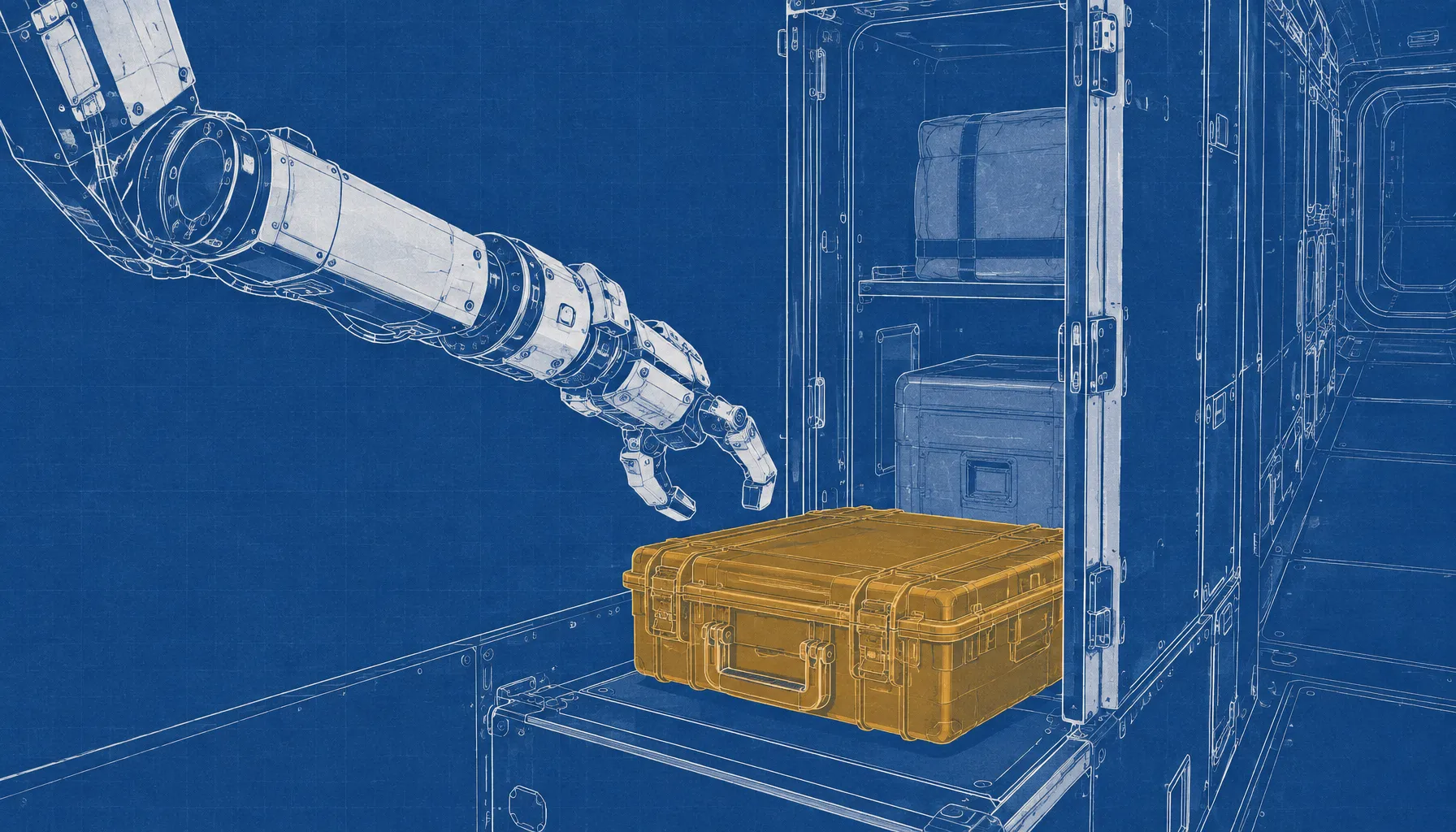
Google says a NASA collaboration tested a proof-of-concept robotic assistant for future Moon and Mars missions. In an early laboratory pick-and-place task, the system achieved an 85% baseline success rate while moving a medical bag.
AI.info Team · Written with AI · fact-checked ·
The robotic system Google and NASA are developing moved a medical bag with an 85% baseline success rate in an early laboratory test, Google said on October 27. The result came from a proof-of-concept pick-and-place task, not a demonstration on the Moon or Mars. The project targets future crewed missions where astronauts may need help with routine work and medical tasks far from Earth.
A medical bag, not a mission-ready robot
The test asked the system to locate and move a medical bag. Google says the work took place at NASA’s Johnson Space Center iMETRO facility and used Google DeepMind’s MuJoCo physics simulator to let the system practice complex movements in a virtual environment before handling real hardware. The company describes the 85% figure as an initial baseline from early lab environments, with further training and safety work still ahead.
The system combines an “eye-to-hand” camera arrangement, intended to improve spatial awareness, with Pi0, an open-source vision-language-action model developed by Physical Intelligence on Google Cloud infrastructure. These models connect language instructions to physical movement; Google says astronauts could direct the robot using ordinary English text prompts. The post does not report an operational deployment, a flight test, or a measured performance result in space.
Why a Mars crew could need help
Communication delays shape the project’s medical use case. Google says a Mars mission could face round-trip communication latency of up to 44 minutes, making real-time medical guidance from Earth nearly impossible. In that setting, a robot might retrieve and prepare an ultrasound machine while a crew medical officer examines the scan and treats an astronaut.
Google’s example is an astronaut with severe back pain, which could indicate kidney stones. The robot would handle equipment and physical preparation; a human medical officer would remain responsible for interpreting the scan and deciding on care. Google frames the system as crew support, not a replacement for human medical judgment.
“An astronaut on a future deep space mission to Mars could face severe operational challenges—including round-trip communication latencies of up to 44 minutes, making real-time medical guidance for crew nearly impossible.”
Jim Kelly, vice president, Federal, Google Public Sector
Training in the cloud, running at the edge
Google says it fine-tuned the 4-billion-parameter Pi0 model on Google Cloud G4 instances in 2.5 hours. The team then demonstrated that the fine-tuned model could run locally on compact, energy-efficient edge devices, which matters for spacecraft that cannot depend on a continuous connection to Earth-based data centers.
Over the past two years, Google says the team tested about 15 edge-computing devices to identify hardware suitable for lightweight, low-power use on future Mars missions. The announcement does not name the devices or give power, speed, or reliability measurements. Those omissions leave open how the model would perform under flight conditions and whether its computing needs fit within a crewed spacecraft’s constraints.
NASA teams are testing a support role
The collaboration includes NASA’s Human Research Program, the Johnson Space Center Robotics Team, and the Jet Propulsion Laboratory, working with Google Public Sector. Google says the robot is also being designed to manage cargo, equipment, tools, and compartments, tasks that could free crew members for scientific work. Its stated longer-term goal is a system that follows voice instructions under direct astronaut supervision.
For now, the announced 85% success rate belongs to an early laboratory task, while the proposed medical and logistics roles remain development goals. Google’s post describes a proof of concept, not a robot cleared for a lunar base or a Mars voyage. The next test the company identifies is more rigorous training and safety refinement.