The Pulse
FuriosaAI Raises $620 Million to Expand RNGD Chip Production
FuriosaAI announced a $620 million Series D on October 28, valuing the South Korean chipmaker at $2.9 billion. The company plans to expand production of its RNGD inference accelerator and develop a third-generation chip with Broadcom and ot
AI.info Team · Written with AI · fact-checked ·
“Taking an advanced AI chip from design to volume production is an exceptionally difficult undertaking.”
John Yetimoglu, chief investment officer, Infinitum
FuriosaAI announced a $620 million Series D on October 28, putting the South Korean AI-chip company at a $2.9 billion post-money valuation. The company says it will use the money to expand production and global deployments of its RNGD inference accelerator, while developing a third-generation chip for large AI clusters.
The round includes Korea’s National Growth Fund, which committed 370 billion won, or about $280 million, according to FuriosaAI. International investors named by the company include Cisco Investments, Infinitum, Jericho Capital, NeoFort Holding, QUDA Capital and Worldline Capital. Existing backers also returned, among them NAVER Ventures, DSC Investment and KDB Capital.
RNGD production moves beyond early deployments
FuriosaAI says RNGD entered mass production in January 2026. The company plans to produce 20,000 accelerator cards this year and says it has secured memory and fabrication capacity to more than double that amount in 2027. That production plan is central to the funding announcement: the company is seeking to move from shipping a second-generation chip into customer deployments toward supplying a larger global market.
FuriosaAI says RNGD is already running in customer environments, including Samsung SDS’s NPU-as-a-Service offering and on-premises hybrid-cloud deployments at LG Group companies. The company describes its customers as spanning AI cloud providers, sovereign AI programs, AI-native businesses and enterprises. Those examples offer evidence of commercial use, though FuriosaAI’s post does not disclose shipment totals, customer contract values or revenue from RNGD.
A 180-watt card for inference workloads
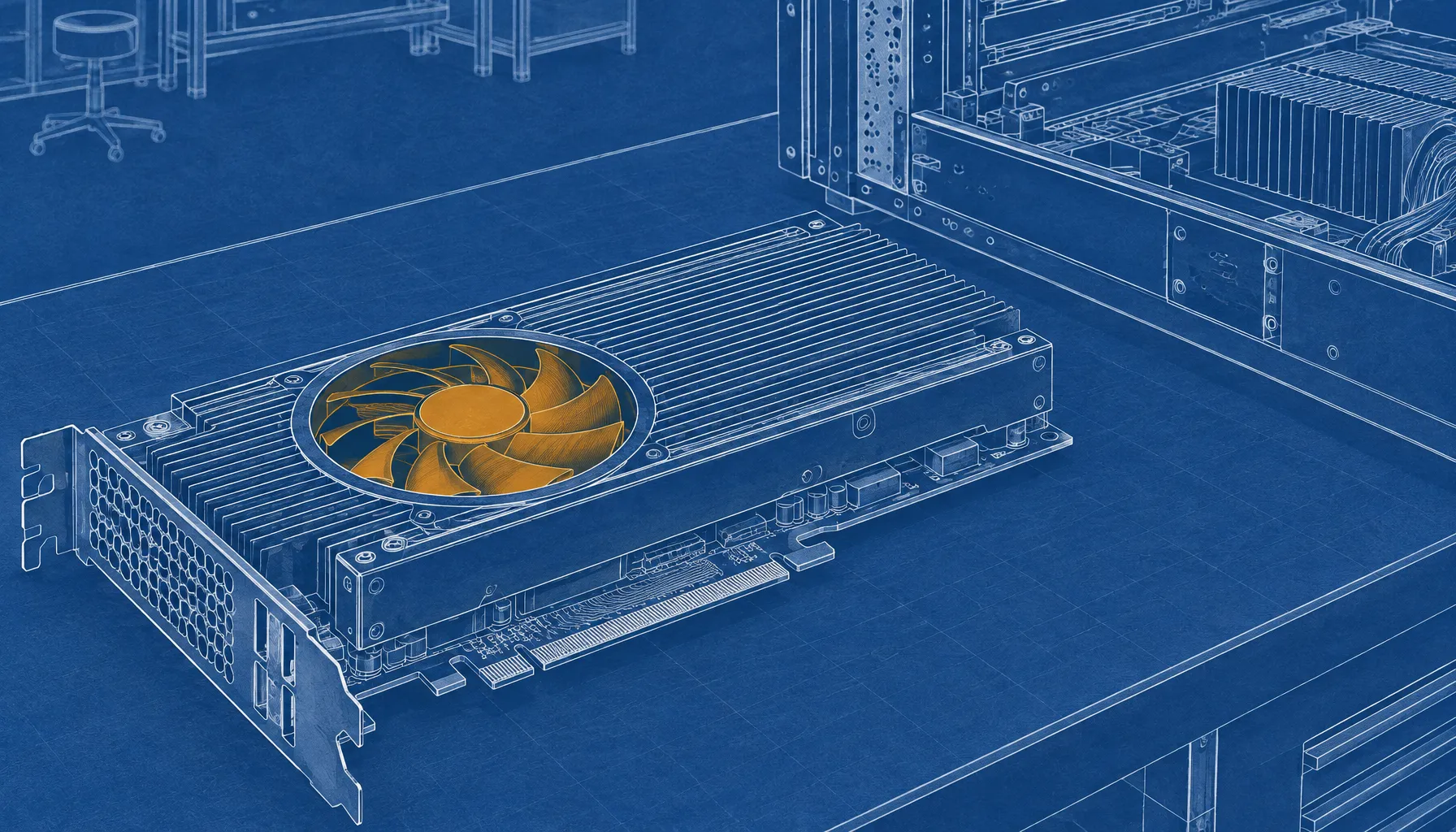
RNGD is designed specifically for inference, the repeated computation used to generate model outputs after training. FuriosaAI’s card draws 180 watts and uses air cooling. Eight cards form the company’s NXT RNGD Server, a 4U system rated at 3 kilowatts, 4 petaFLOPS in FP8 precision and 384 gigabytes of HBM3 memory.
The company says the server fits existing enterprise rack and power budgets without a cooling retrofit. It also claims that RNGD matches the throughput of Nvidia’s RTX PRO 6000 at the same card count while serving twice as many users per kilowatt. Those are FuriosaAI’s comparisons; its announcement does not provide independent benchmark results or test conditions alongside the claims.
The chip’s design centers on FuriosaAI’s Tensor Contraction Processor, or TCP. Rather than making fixed-size, two-dimensional matrix multiplication the basic operation, the architecture uses higher-dimensional tensor contraction, according to the company. FuriosaAI says its compiler plans across a model and deterministic execution reduces unnecessary data movement, while reconfigurable compute slices support different models and batch sizes.
Gen 3 development adds a second spending track
The Series D is also meant to fund a third-generation accelerator, which FuriosaAI says it is developing with Broadcom and other partners. The planned chip uses the company’s TCP architecture in a 2-nanometer, multi-die design with HBM4 or HBM4E memory. FuriosaAI positions Gen 3 for large clusters running advanced agentic models, a different scale of deployment from the enterprise systems currently using RNGD.
Software remains part of the company’s effort to make its hardware usable in production. FuriosaAI says it shipped four major software-development-kit releases in 2026, adding hybrid batching, prefix caching and native Kubernetes support. It reports that SDK 2026.4 increased token generation per watt across 18 models compared with version 2026.3, including a 138% gain on gpt-oss-120B; the company’s post does not describe an independent verification of that figure.
The company’s announcement ties its next stage to two concrete measures: raising RNGD output from 20,000 cards in 2026 and building a successor chip for larger clusters. Samsung SDS and LG Group deployments show RNGD has moved into customer use, while the funding is intended to finance the manufacturing scale and next-generation design needed to extend those deployments.