The Pulse
EVENET Tests Its Collision Model on Real CMS Data
A particle-physics model pretrained on 500 million simulated collisions was tested on CMS Open Data by rediscovering the established ϒ meson signal. The study also evaluates EVENET on searches for heavy resonances and exotic Higgs decays, a
AI.info Team · Written with AI · fact-checked ·
“We validate transfer to experimental data by rediscovering the ϒ meson in CMS Open Data.”
The authors of the Nature Machine Intelligence paper write
From simulated collisions to CMS records
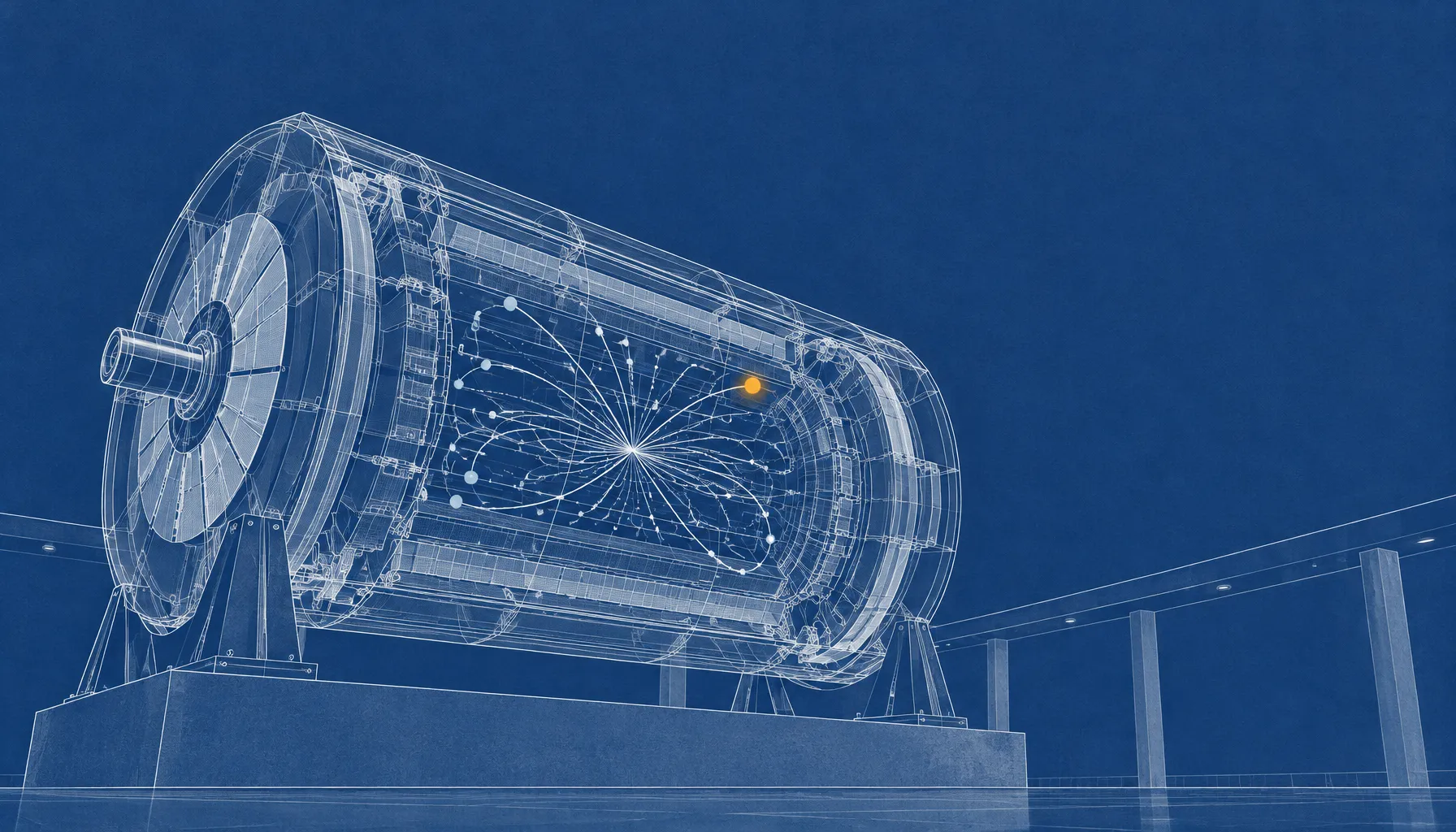
A research team reports that a model trained on simulated particle collisions can also be applied to recorded experimental data. The paper, published October 29, 2026, in Nature Machine Intelligence, introduces EVENET, an event-level foundation model designed to support multiple collider-physics analyses. Its reported test on CMS Open Data involves rediscovering the established ϒ meson signal; the paper does not present this as evidence for a new particle.
The researchers pretrained EVENET on 500 million simulated collision events, combining self-supervised learning with physics-informed supervision. In self-supervised learning, the model learns from data by reconstructing masked information; the physics-informed component uses supervision based on the structure and labels available in simulated events. The paper presents the approach as a way to build a reusable representation rather than train an entirely separate model for every analysis.
EVENET represents a collision as an unordered set of reconstructed physics objects, described in the paper as a particle cloud. A shared point–edge transformer processes that representation. Different task-specific components can then use it for process classification, matching reconstructed objects to parent resonances, grouping objects into final-state categories, or reconstructing masked or undetected particles. The generative reconstruction tasks include a diffusion-based method.
A shared model across physics tasks
The paper evaluates the model on several kinds of downstream analysis. These include searches for heavy resonances and exotic Higgs decays, as well as a study of quantum-correlation observables. The authors report that EVENET outperforms established and state-of-the-art baselines in searches for heavy resonances and exotic Higgs decays, particularly in low-statistics settings. For the quantum-correlation measurements, they report that the extracted observables remain stable under the systematic variations tested in the study.
The CMS analysis serves a different purpose: it tests whether a representation learned from simulation transfers to experimental data. The reported rediscovery of the ϒ meson is a check on that transfer, not a claim that the model has made a new observation or found a previously unknown resonance.
That distinction matters because simulation and recorded collisions are not interchangeable. A model can perform well on simulated examples yet face differences when applied to detector data. The paper frames transfer to experimental measurements as an important challenge for event-level models, and identifies the CMS result as evidence that EVENET can be used beyond simulated samples in at least one analysis.
Why an event-level representation
Collider experiments produce complex events containing variable numbers of reconstructed objects. The paper argues that methods focused on individual objects or narrowly defined tasks do not answer whether a common representation can be reused across broader analyses. EVENET’s design addresses that question by processing the full event and connecting a shared backbone to different analysis heads.
The authors present the work as a reusable model that requires a substantial one-time pretraining investment and can then be adapted to varied tasks. The results span simulated-data studies and the CMS Open Data test, but they do not establish that every downstream task has been validated on recorded collisions. Instead, the paper reports a range of applications for the shared representation and a specific experimental-data transfer test through the established ϒ signal.