The Pulse
Eka Closes $150 Million Series A at $1.45 Billion Valuation to Train Robots Through Touch
Eka Robotics has closed a $150 million Series A at a $1.45 billion post-money valuation, according to TechCrunch. Its system combines a force-sensitive gripper with a model that uses touch and contact to handle objects.
AI.info Team · Written with AI · fact-checked ·
Eka Robotics says its system can pick up about 1,500 objects weighing up to 1 kilogram in an hour—compared with roughly 600 for a human. The startup has closed a $150 million Series A at a $1.45 billion post-money valuation, led by a16z and F-Prime, according to TechCrunch’s October 20 report.
The company’s pitch is not simply a faster robot arm. Eka pairs a force-sensitive gripper with a model designed to use touch and physical contact as it handles objects, including items that could be damaged by a hard or poorly timed grasp. Eka says the robot succeeds at picking up objects more than 95% of the time.
Why Eka adds force to the model
Many robotic systems use vision-language-action models, which connect instructions and visual inputs to movement. Eka’s approach, which the company describes as vision-force-action, also feeds force information into the process. That gives the robot feedback when its gripper contacts an object and helps it adjust its grip rather than relying on sight alone.
“Vision is not the primary way in which you close this last millimeter problem,” Eka co-founder Pulkit Agrawal told TechCrunch. “Vision tells you roughly where the object is, what the pose is, but the actual grabbing, the actual searching is happening through forces.”
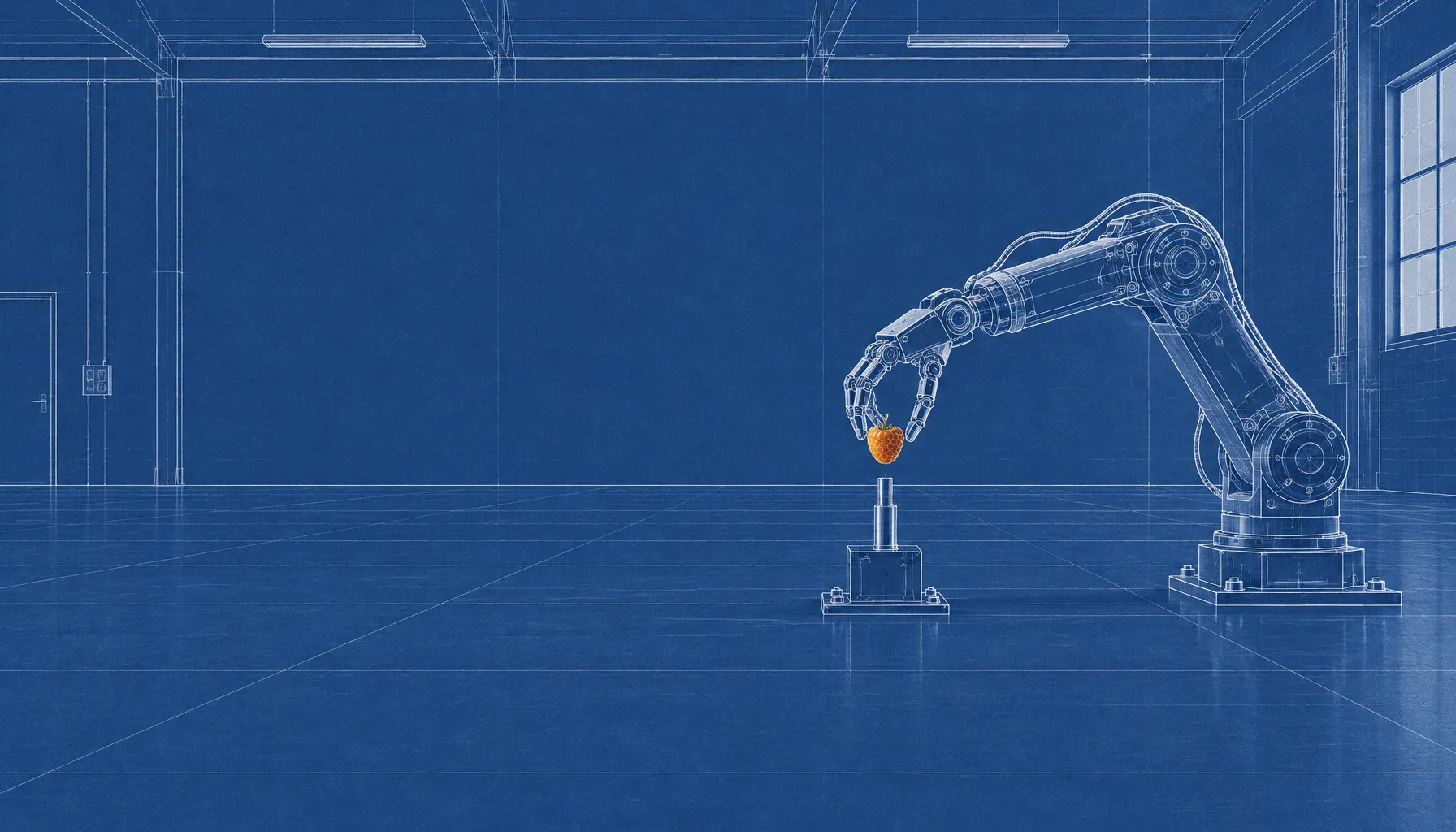
Eka designed a more flexible hand with additional force sensors. The company’s account of the system’s performance centers on the difference between locating an object and making contact with it safely: a robot may see where a raspberry is, but must still regulate its grip to avoid crushing it.
Simulation supplies robot experience
Eka uses a physics simulator to model the forces a robot encounters while grasping objects, then turns those scenarios into an environment for reinforcement learning. The founders say the method can generate thousands of hours of robot experience in minutes. Their bet is that simulation can expand training beyond human demonstrations and video collected through hours of manual work.
Kris Hauser, a professor at the University of Illinois Urbana-Champaign, told TechCrunch that Eka’s robot adapted to many different objects without retraining. He also said reinforcement learning could let the system move beyond the examples presented during training. Those observations come from demonstrations and do not establish how the system will perform across varied factory conditions.
Industrial use is the next test
Eka is running pilots with industrial customers on pick-and-place work and wire manipulation, but the company has not named those customers. Moving from a demonstration to a production line brings different demands: a system must keep operating reliably over long periods and handle tasks beyond picking and placing objects.
Hauser told TechCrunch that one test will be whether Eka’s robots can work with integrators on assembly lines without breaking for a year. He also questioned how broadly the techniques will transfer to tasks beyond pick-and-place. Those are open issues for a company whose early performance claims focus on object handling.
Agrawal said Eka’s gripper costs less than $1,000 and is rated for 5 million duty cycles; the company’s stated target is 20 million, a benchmark he associated with standard industrial arms. Eka is starting with pick, arrange and place work, alongside wire handling. The funding gives the company room to pursue those deployments, but the field test remains whether its grippers can meet industrial reliability demands at that cycle count.