The Pulse
Dream Labs Raises $90M and Opens Its Dream-1 Robot API
Dream Labs says Dream-1 is available through a public API and can control unfamiliar bimanual robots with parallel grippers. The company also shows fine-tuned examples on robots with dexterous hands and other end effectors, after collecting
AI.info Team · Written with AI · fact-checked ·
“Dream-1 today is a manipulation policy for bimanual robots with parallel grippers. It’s a starting point.”
Dream Labs, the authors of the research post, write
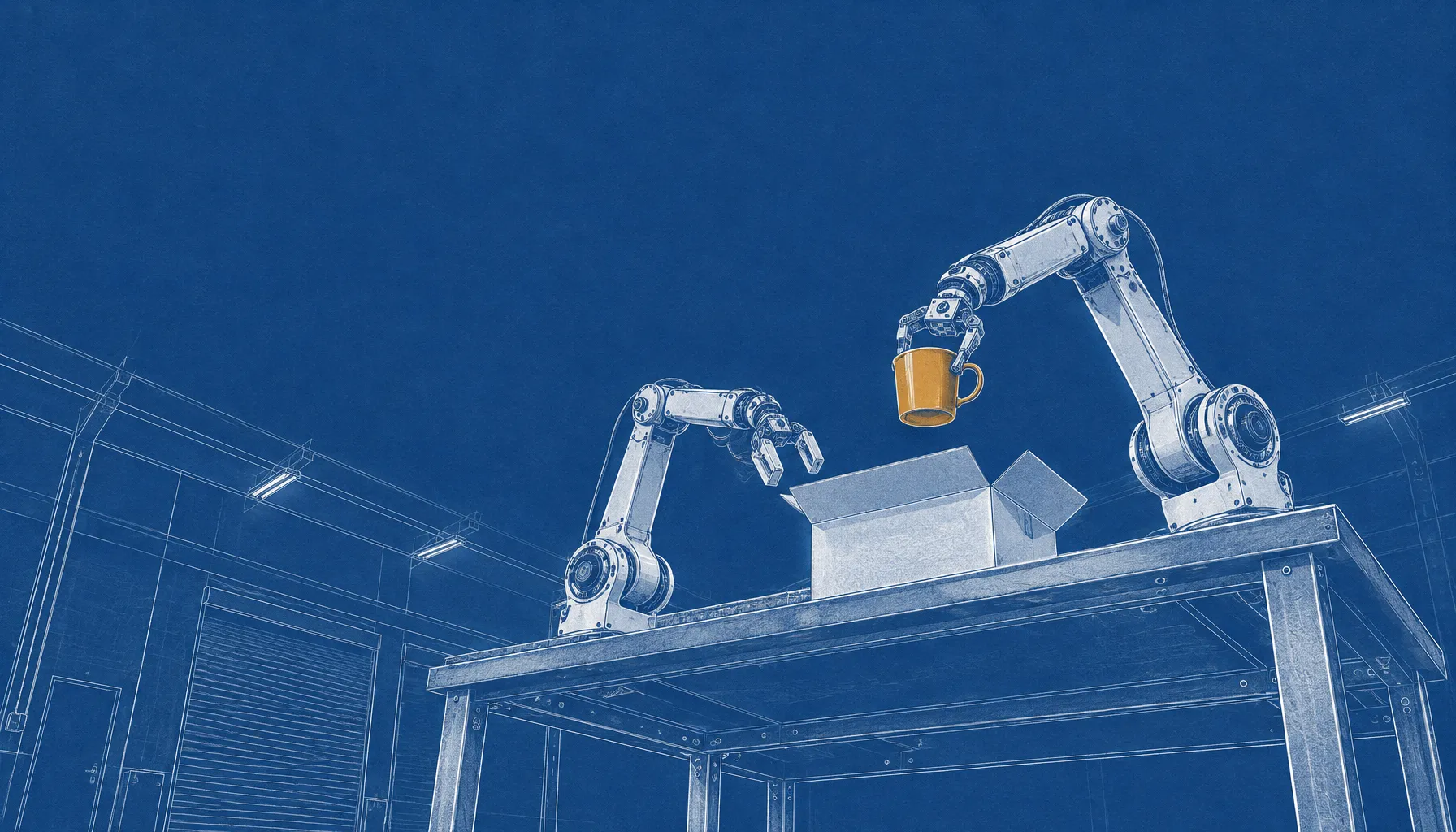
Dream Labs says it is coming out of stealth with $90 million in seed funding and opening Dream-1 through a public API. The San Francisco company is pitching the model as a shared control layer for robots from different makers, rather than software tied to one machine. Its description sets a narrower boundary for the product at launch: Dream-1 can control unfamiliar bimanual robots with parallel grippers.
Dream-1 turns camera views into robot actions
The company calls Dream-1 a World Action Model, or WAM. It says the model learns to predict video and actions together, then uses a robot’s camera feed and a plain-language instruction to produce actions. That approach is intended to let a model apply what it has learned to unfamiliar robot bodies and tasks without first collecting demonstrations from each new machine.
Dream Labs says Dream-1 can predict end-effector poses: where each gripper should be and whether it should be open or closed. The robot’s own inverse-kinematics solver converts those poses into joint commands. This shared action space lets the model address robots with two arms and parallel grippers, while its performance depends in part on each robot’s solver. The company says robots whose workspace or kinematics and dynamics differ sharply from what Dream-1 has seen may produce infeasible predicted future states. It also says the model predicts where a gripper ends up, not how the arm moves to reach the pose.
The company reports tests across 27 simulated robots
Dream Labs says it tested Dream-1 in simulation on 27 robots it had not trained on, and published 21 clips of real bimanual robots. The examples include manipulation tasks such as moving objects, closing drawers and folding fabric. The company also lists beta testing at 12 sites, while noting that performance varies across robots.
Those results come from the company’s launch material, not a broad independent replication. Dream Labs describes its launch as an early sign of zero-shot transfer between robot embodiments, rather than a solved general-purpose control problem. It says one-shot adaptation—adding data from a particular robot—still performs better than using the model with no robot-specific data.
A public API costs $3 an hour
Dream-1 is available through Dream Labs’ public API at $3 per hour; a lighter version, Dream-1-flash, costs $2 per hour, according to the company. Each model call returns 1.6 seconds of actions, which Dream Labs equates to about 2,250 calls per hour. The company says the service is available to robot builders and developers.
Dream Labs also offers fine-tuning for cases where zero-shot performance falls short. In examples on its site, it uses five minutes of a robot’s own data to adapt the model. For robots further from its training data, the page shows a Dexmate robot with Sharpa dexterous hands after 77 minutes of data, and a YAM robot fitted with a compliant gripper and modified knife gripper after 98 minutes. These examples show fine-tuned capabilities, distinct from the model’s stated zero-shot scope of bimanual robots with parallel grippers.
The limits are part of the launch claim
Dream-1 is not yet a general controller for every kind of robot: the company describes its current model as a manipulation policy for bimanual robots with parallel grippers. Its launch page also demonstrates fine-tuning Dream-1 to control Dexmate with Sharpa dexterous hands after 77 minutes of robot-specific data. The company presents dexterous hands and mobile manipulators as possible extensions of a broader robot foundation model, while distinguishing those from the product’s current zero-shot capabilities.
The $90 million round backs a concrete first product, but the product’s present boundaries are also concrete: two arms, parallel grippers, a camera-to-action API and performance that varies across hardware. Dream Labs’ central test is whether that starting point can save robot makers from building a separate controller for every machine and task. For now, its examples show that adaptation can improve performance, and the amount of robot-specific data varies across embodiments.