The Pulse
Ataraxos Beats Stratego Champion 15–1, With Four Draws
Ataraxos beat Stratego champion Pim Niemeijer in a 20-game series, winning 15 games, losing one and drawing four. The system combines self-play reinforcement learning with search over hidden information, using far less compute and training
AI.info Team · Written with AI ·
Ataraxos won 15 of 20 games against Stratego champion Pim Niemeijer, losing one and drawing four in a series reported in a paper published September 30, 2026. The result puts an artificial intelligence system ahead of a top human in a game that has resisted well-funded AI efforts because players conceal their pieces’ identities. The researchers say Ataraxos reached that level with a few thousand dollars’ worth of training compute.
“Ataraxos defeated the most decorated human Stratego player of all time by a large margin—achieving, to our knowledge, the first superhuman result in the game’s history—while consuming orders of magnitude less compute and data than previous efforts.”
Samuel Sokota et al., “Scalable decision-making for games of imperfect information”
Stratego’s hidden pieces complicate every move
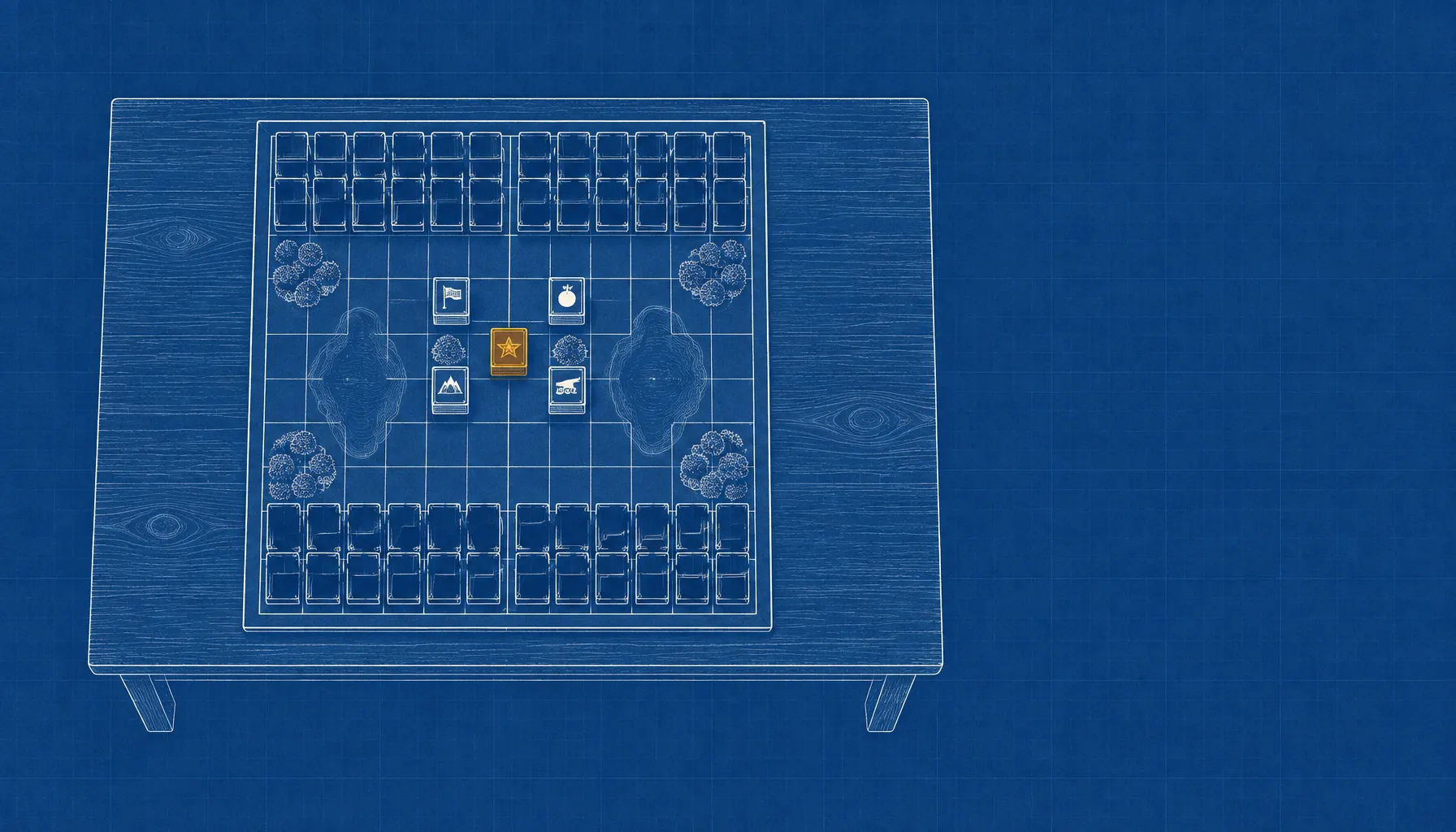
In classic Stratego, each player secretly arranges 40 pieces on a 10-by-10 board before play begins. Pieces have different ranks and abilities, but opponents cannot see their identities until a battle reveals them. The paper puts the number of possible piece configurations above 1033, making it difficult for an AI to plan by simulating a small set of known positions.
Ataraxos combines self-play reinforcement learning with search at the time of a move. Its training separates the game’s two stages: one process learns how to arrange pieces, while another learns how to move them. A belief network, trained on self-play games, estimates hidden information; at play time, search combines that network with the move-selection network.
The researchers describe the problem as more than choosing a promising move on the visible board. An agent must also reason about what the opponent’s hidden pieces might be and how both players’ earlier choices shape those possibilities. The approach is designed to handle that uncertainty without relying on the large information transformations used by earlier methods for smaller hidden-information games.
One H100 handled the tournament search
During the Niemeijer evaluation, Ataraxos used a search 40 plies deep with 1,000 rollouts. On a single NVIDIA H100 GPU, the procedure averaged about 1.26 seconds per move, according to the paper. The games ran on Strategus, an online competition platform, under its default 15-minute clock with three seconds added per move.
Training used 16 H100 GPUs for one week; training the belief network took another four days on four H100s. The main reinforcement-learning run generated 163 million completed games and 208 billion environment steps. Compared with the prior Stratego effort discussed in the paper, the researchers report roughly one-five-hundredth the compute cost, one-thirtieth the self-play games and one-hundredth the training examples.
Those comparisons cover both resource use and the scale of training data, not just the time required to run the final search. Ataraxos relies on a GPU-accelerated simulator written in CUDA C++, built to generate training data and support search while limiting memory use. Its search still requires substantial computation at play time, but the reported match used one H100 rather than a large cluster.
The same approach reached other games
The paper also applies the methods to Barrage Stratego, Hanabi and dou dizhu. In Barrage Stratego, a variant with eight pieces per player, Ataraxos won four 50-game series against three top-ranked players, each a two-time world champion. For Hanabi, the team reports a new state of the art; in dou dizhu, it reports beating the previous state-of-the-art bots.
Those results span competitive, cooperative and team-based games, but the central test remains Stratego’s concealed setup and the match against Niemeijer. A 20-game series is a defined evaluation, not proof that an AI will outperform every expert under every format or opponent. The paper’s result is narrower and concrete: Ataraxos won 15 games, lost one and drew four while using a search averaging about 1.26 seconds per move on one H100.