The Pulse
Amazon researchers report faster routing for 1,125 robots
Amazon researchers report that a mathematical approach found routes for 1,125 robots in 67 seconds, within 6.5% of the optimal cost. The work uses a Schrödinger bridge to narrow a path-planning problem before calculating individual routes.
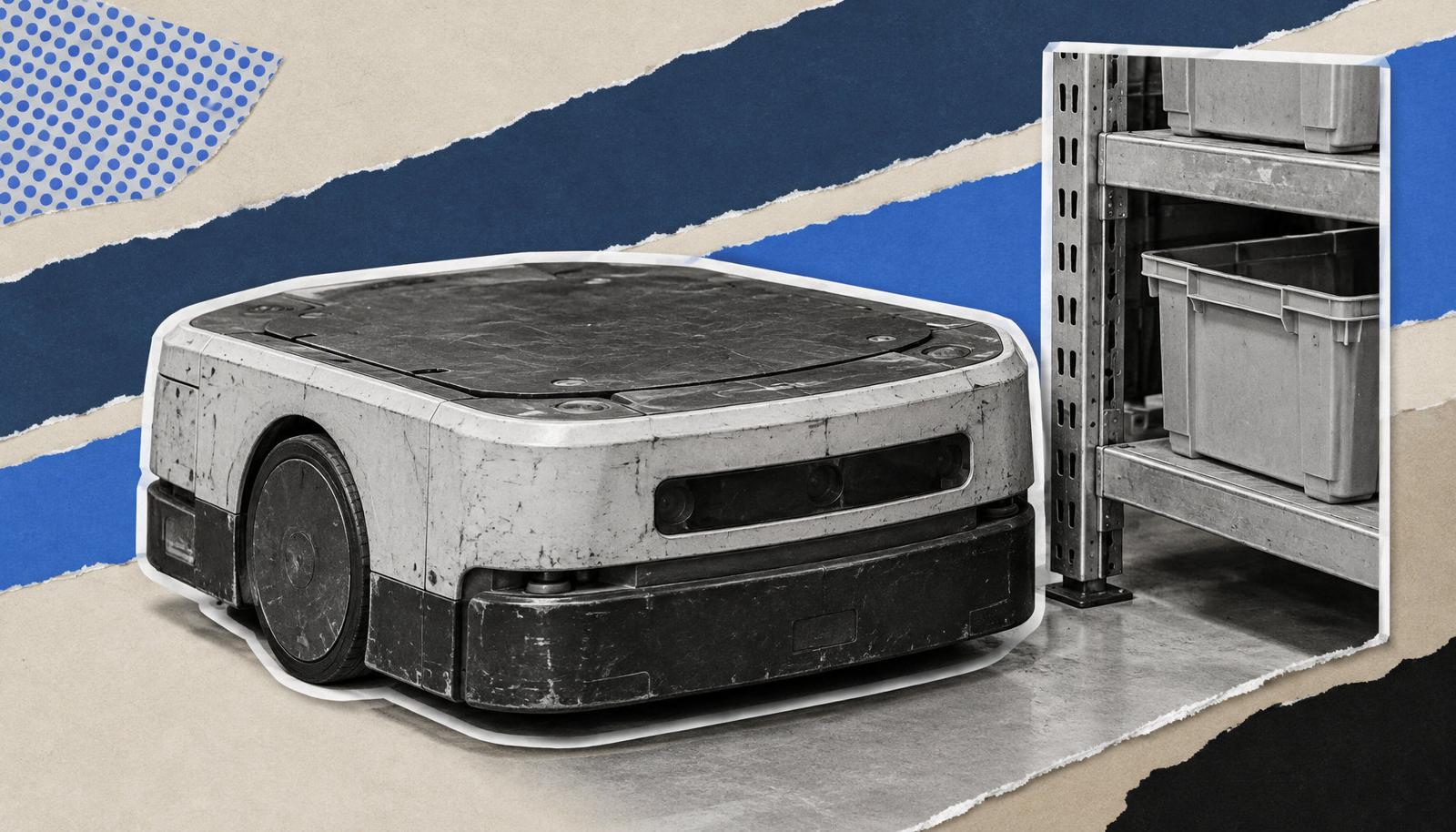
Amazon researchers say a mathematical method found routes for 1,125 robots in 67 seconds, with a cost within 6.5% of the optimal solution. The comparison used a 150 by 150 grid and a 30-step planning horizon, according to an Amazon Science post.
An exact method took 478 seconds to produce optimal trajectories for the same problem, which had 3.4 million decision variables. The post, published November 24, describes research presented at this year's International Conference on Machine Learning.
Planning paths without collisions
The work addresses anonymous multi-agent path finding, a problem in which any robot can go to any destination. The paper is by Usman A. Khan of Amazon Robotics and Boston College, and Joseph W. Durham of Amazon Robotics.
In Amazon's warehouse model, robots move on a rectangular grid. At each time step, a robot can move north, east, west or south, or wait; the paths must be coordinated to avoid collisions.
The company says Amazon Robotics operates more than a million robots across more than 300 warehouses worldwide. Inside a single warehouse, thousands of robots share the floor, moving inventory for order fulfillment and stock replenishment.
From transport to robot routes
The exact approach treats route planning as a form of optimal transport: finding a minimum-cost way to move from starting locations to destinations. Its multimarginal formulation represents robot locations at intermediate times as well as at the beginning and end, allowing the model to account for paths through space and time.
The researchers preserve a mathematical property called total unimodularity in the constraints of their optimization problem. That property allows the linear program to produce integer solutions rather than fractional results that could, for example, send part of a robot along one route and part along another.
For the grid example, Khan writes that the exact method found optimal trajectories in 478 seconds, while a non-totally-unimodular formulation often failed to find even one feasible solution in 12 hours. He notes that the exact runtime might still be impractical.
A faster approximation
For the faster approach, the researchers use a Schrödinger bridge, a probabilistic formulation they compare to modeling robots as particles in a hot gas. The paper describes a set of likely paths, called a shadow transport, produced using Sinkhorn-type iterations.
That shadow guides the removal of parts of the underlying graph before a smaller linear program calculates integer routes. The approach trades exact optimality for a reduction in computational complexity, while retaining the structure used to obtain whole-robot paths.
The authors report that, as problem size grew in their experiments, the reduced problem incurred less than 10% cost degradation while eliminating approximately 60–80% of the original graph's edges. The result is for the anonymous setting, in which robots are not each required to reach a particular assigned target.
Sources
- Original source · Blog post Amazon Science “Lazy gas, hot gas, and a thousand robots” amazon.science
Other pages read
- arXiv “Optimal and Scalable MAPF viaMulti-Marginal Optimal Transport and Schrödinger Bridges” arxiv.org
Related stories
- Google details EmbeddingGemma 2’s multimodal design in report
- Cornell researchers use one smartwatch to estimate full-body motion
- Waddle-1 scores 81.4% on Robocurve's real-robot benchmark, with no model-call cap
- FocalPoint takes its S-GNSS positioning software beyond cars to mobile robots and drones
- Embo raises $110 million to develop world models for robots