The Pulse
Aether AI’s CRIS-0 Checks Each Step in Long Robot Tasks
Aether AI introduced CRIS-0, a robot system that combines a causal world model with an agent that verifies task stages. The company says it can retry or replan when disturbances, failed tools or changing conditions interrupt a task.
AI.info Team · Written with AI ·
A robot can finish a movement without accomplishing what a person asked it to do. Aether AI’s new system, CRIS-0, is designed to catch that gap: it checks the outcome of each task stage and can retry or replan when the result differs from expectations. The company published its announcement on October 8, describing tests on physical robots that include disturbances, long tasks and unfamiliar objects.
CRIS-0 checks outcomes, not just movements
CRIS-0 combines two components: a Causality-guided Robot Agent, which organizes a task into stages, and a Causal World Model, which predicts how actions may change the physical world. The agent updates its representation of the task from observations and tool feedback, then verifies whether each stage succeeded before moving on. Aether frames that verification as a way to catch local failures before they affect later steps.
“CRIS-0 is a causality-driven robotic intelligence system that integrates a Causal Agent with a Causal World Model to construct structured causal representations of the physical world, enabling robots to actively explore, intervene in, reason about, and adapt to their environments.”
Lingjun Mao et al., Aether AI
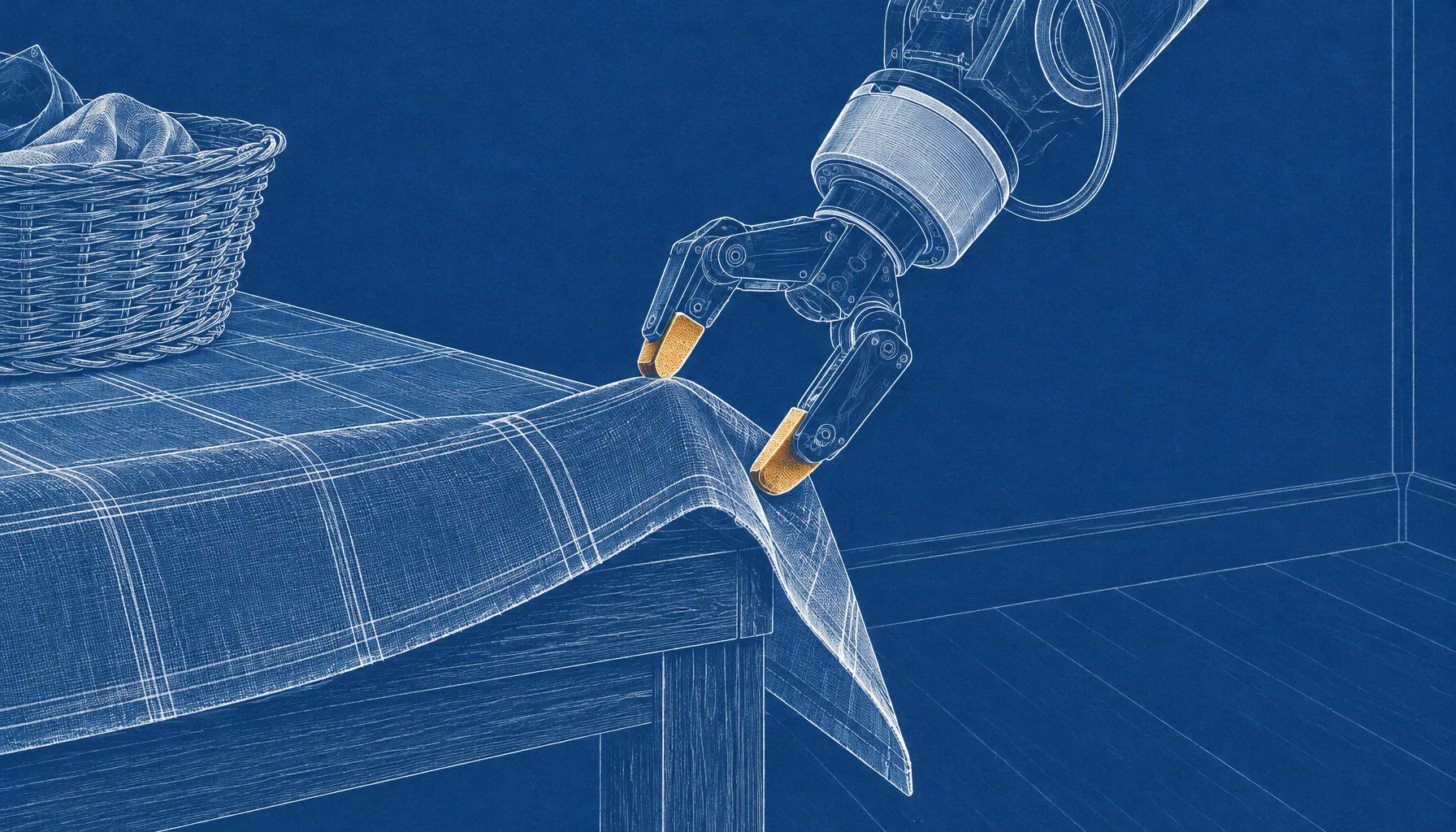
The system begins with a small set of demonstrations, which can be teleoperated, and uses them to identify variables relevant to a task, break it into stages and set verification criteria. A tablecloth-alignment example tracks whether the cloth is grasped, how far its corner sits from the target and whether it has slipped. If a check fails, CRIS-0 can retry the stage, return to an earlier one or revise a tool after an error.
A planner chooses from several kinds of tools
CRIS-0 does not use one policy for every part of a job. Its planner can call learned policies for contact-heavy manipulation, agent-generated functions that use SAM3, RGB-D observations and inverse kinematics, navigation based on SLAM, world-model predictions and verification scripts. A task graph links stages to the tools and conditions for moving between them.
That division lets the system use different methods for different demands. In a pot-grasping example, a generated function first locates the handle and positions the gripper; a learned policy handles the grasp. The company says that if a tool returns an error, such as an inverse-kinematics solution that violates joint limits, the agent can revise the function using that feedback and retain the corrected version after it works.
Real-robot tests, without published success rates
Aether says it evaluated CRIS-0 on real robots under disturbances, across long tasks, with underspecified requests, on complex manipulation and with new objects. The post describes examples including a coffee bag or grinder being moved during a task, and says the system can return to the affected stage rather than continue from an outdated state. It also describes a tablecloth task broken into stages such as pushing, grasping, folding and placing.
The announcement does not give trial counts, success rates or comparisons against other systems for those tests. Its descriptions establish what Aether says the system is designed to do, but do not quantify how often it succeeds or how its performance compares with a baseline. The demonstrations also rely on task-specific variables, stage definitions and verification criteria built from demonstrations and feedback.
The stated aim: adapting as tasks change
Aether presents CRIS-0 as a step toward robots that can handle changing conditions without a person directing every action. Its post says the system can tailor object selection to a user’s preferences and use shared skills in new scenarios. The company’s announcement focuses on the architecture and capabilities; it does not provide a release date, price or information about commercial availability.