tools
Skild Brain
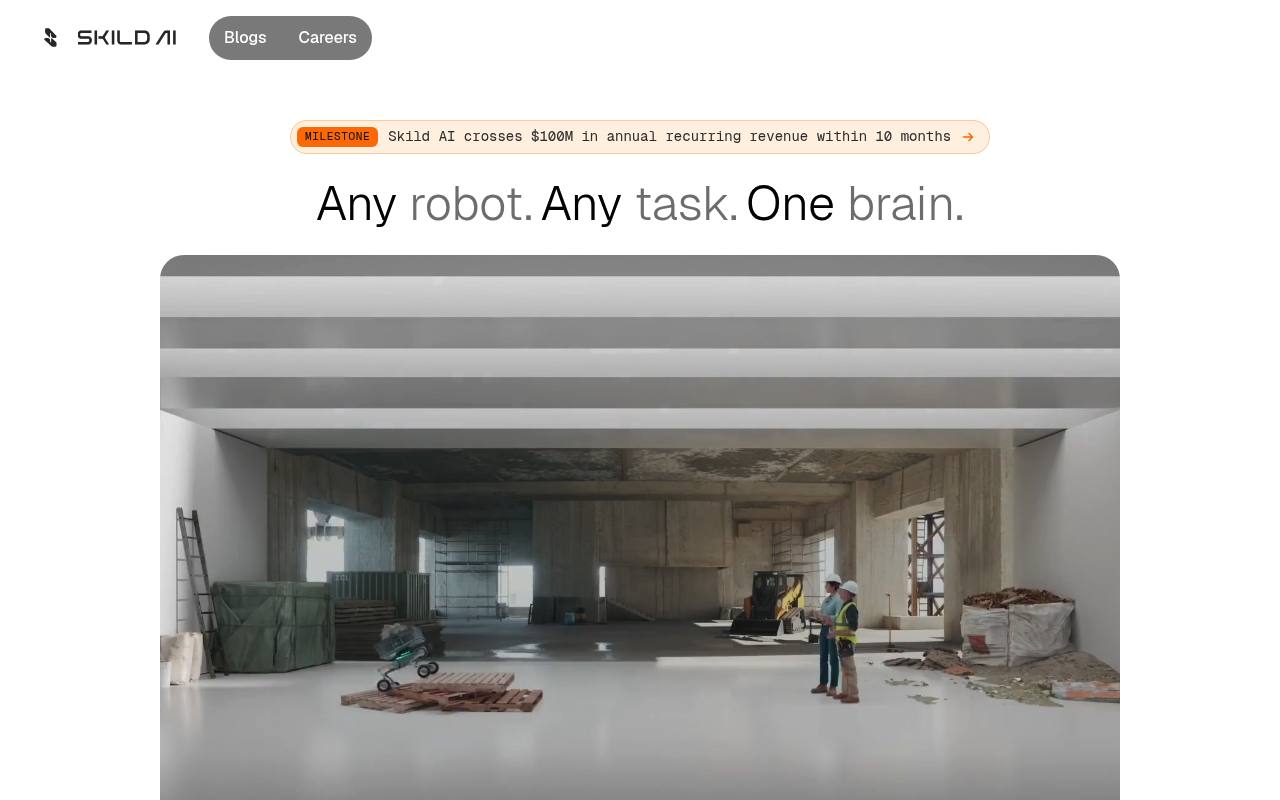
Skild Brain is a robotics foundation model that helps different robot types perform navigation, manipulation, inspection, and packing tasks.
In inglese
Skild Brain is Skild AI’s unified robotics model for controlling quadrupeds, humanoids, tabletop arms, mobile manipulators, and other machines. It uses visual input, robot feedback, human videos, simulation, and deployment data to perform navigation and physical tasks.
Robotics companies and industrial operators can use it for inspection, mobile manipulation, autonomous packing, manufacturing, warehousing, delivery, and security. The product is not presented as a consumer chatbot, and Skild AI does not publish public tiered pricing; commercial access and deployment terms require contacting the company.
Features
- Controls multiple robot morphologies, including quadrupeds, humanoids, arms, and mobile manipulators
- Performs navigation and manipulation through a hierarchical action policy
- Learns task behavior from human video demonstrations
- Executes unseen tasks from a single video prompt with S1
- Supports long-horizon tasks lasting up to 10 minutes
- Provides API-based access to grasping, handover, and navigation skills
- Supports security, inspection, mobile manipulation, and autonomous packing applications
Use cases
- Inspect dangerous or unstructured environments with autonomous robots
- Automate grasping, handover, and navigation on mobile platforms
- Pack products using learned dexterous and precise motions
- Deploy robots for warehouse moving and fulfillment tasks
- Automate changing assembly operations in factories
- Teach robots new physical tasks through video demonstrations
Pros
Cons
Latest updates
- Physical Self-Play
A post-training result for physical AI via self-play: a base model like S1 can learn to complete tasks, like soccer.
- Introducing S1: In-Context Learning for Robotics
S1 is our robotic foundation model, built from the ground up as an in-context learner: show it a single video…
- The case for an omni-bodied robot brain
We created a universe with 100,000 different robots and trained our AI to control them all.
- One Model, Any Scenario: End-to-end Locomotion from Vision
We present a single model that can perform end-to-end locomotion from visual inputs.
Capabilities
- Acts for you — “The tasks run for up to ten minutes, span dozens of manipulation steps, and are driven by a single visual demonstration.” source
- Developer API — “These skills are abstracted away using an API call, allowing users to build applications without worrying about details of the unstructured, messy real world.” source
Pricing
- Prices checked
- 2026-09-25