tools
MLflow Review 2026 — Open-Source ML Experiment Tracking and LLM Evaluation
MLflow is the open-source ML lifecycle platform for experiment tracking, model registry, and LLM evaluation. Free Apache 2.0, integrates with every ML framework.
In inglese
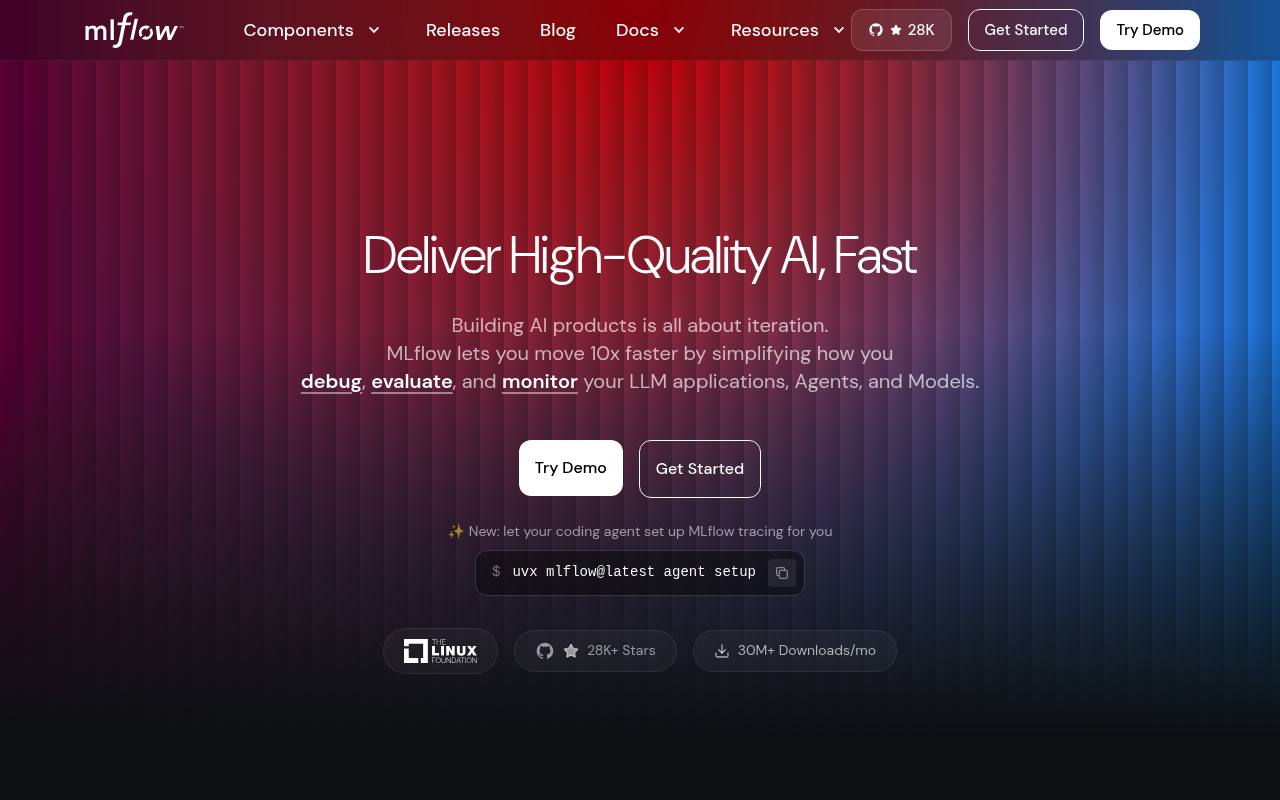
MLflow helps data scientists and AI engineers track experiments, package and register models, evaluate outputs, manage prompts, trace LLM applications, and deploy agents. It includes observability, an AI Gateway, model serving, and APIs for Python, TypeScript, Java, and R workflows.
The core project is free and self-hosted under the Apache 2.0 license. Self-hosting requires your own infrastructure; managed MLflow services are offered separately through MLflow Cloud and cloud providers.
Features
- Trace LLM applications and agents with OpenTelemetry-based observability
- Evaluate models, agents, prompts, and datasets with built-in metrics and judges
- Track experiments, parameters, metrics, artifacts, and model versions
- Register, package, serve, and deploy machine learning models
- Manage prompt versions with lineage tracking and prompt optimization
- Route model requests through an OpenAI-compatible AI Gateway
- Deploy agents with the FastAPI-based MLflow Agent Server
- Open-source under the Apache 2.0 license
Use cases
- Track machine learning experiments and compare model runs
- Evaluate chatbot and agent quality before production release
- Monitor production traces, latency, safety, usage, and costs
- Register and deploy models across different serving environments
- Govern prompts and model access across an AI engineering team
- Host and observe production agents through an API endpoint
Pros
Cons
Latest updates
- MLflow 3.16.0 Highlights: Build-Your-Own Trace Views, a Redesigned Trace Explorer, and Span Links (3.16.0)
Build trace views in plain English, use the trace explorer, and record links between spans.
- MLflow 3.15.0 Highlights: MCP Registry, a Smarter Assistant, and Multimodal Judges (3.15.0)
Register and share MCP servers, choose LLM providers in the Assistant, save and share Runs table views, transfer artifacts using presigned URLs, and evaluate image…
- MLflow 3.14.0 Highlights: One-Line Agent Onboarding, Review Queues, Pytest Integration, and the LLM Playground (3.14.0)
Onboard apps with mlflow agent setup, collect trace reviews, manage evaluation datasets in the UI, run pytest regression tests, and use an in-browser LLM Playground.
- MLflow 3.13.0 Highlights: Role-Based Access Control, Trace Archival, Coding Agents, and Hermes Agent Support (3.13.0)
Define roles and assign them to users; archive traces; onboard coding agents; choose MLflow Assistant engines; deploy with Helm; trace Hermes Agent; set span log levels.
- MLflow 3.12.0 (3.12.0)
Store multimodal content in tracing spans as artifact attachments; trace Codex, Gemini, and Qwen agents; set gateway guardrails; paginate traces.
Capabilities
- Command line — “The easiest way to start MLflow server is to run the mlflow CLI command in your terminal.” source
- Self-hosted — “Thousands of users and organizations run their own MLflow instances to meet their specific needs.” source
- API — “This page hosts the API documentation for MLflow.” source
- Official SDKs — “Python API” source
- Builds agents and workflows — “Hands-on guides and code examples for building Agents and LLM applications with MLflow.” source
- Traces and evaluates — “Capture complete traces of your LLM applications and agents to get deep insights into their behavior.” source
Get it
Pricing
- Prices checked
- 2026-09-25