tools
LocalAI Review 2026 — Free OpenAI API Replacement Running Locally
LocalAI is a free, OpenAI-compatible AI API running entirely on your hardware. Supports text, images, speech, and embeddings. No GPU required. Docker deployment.
In inglese
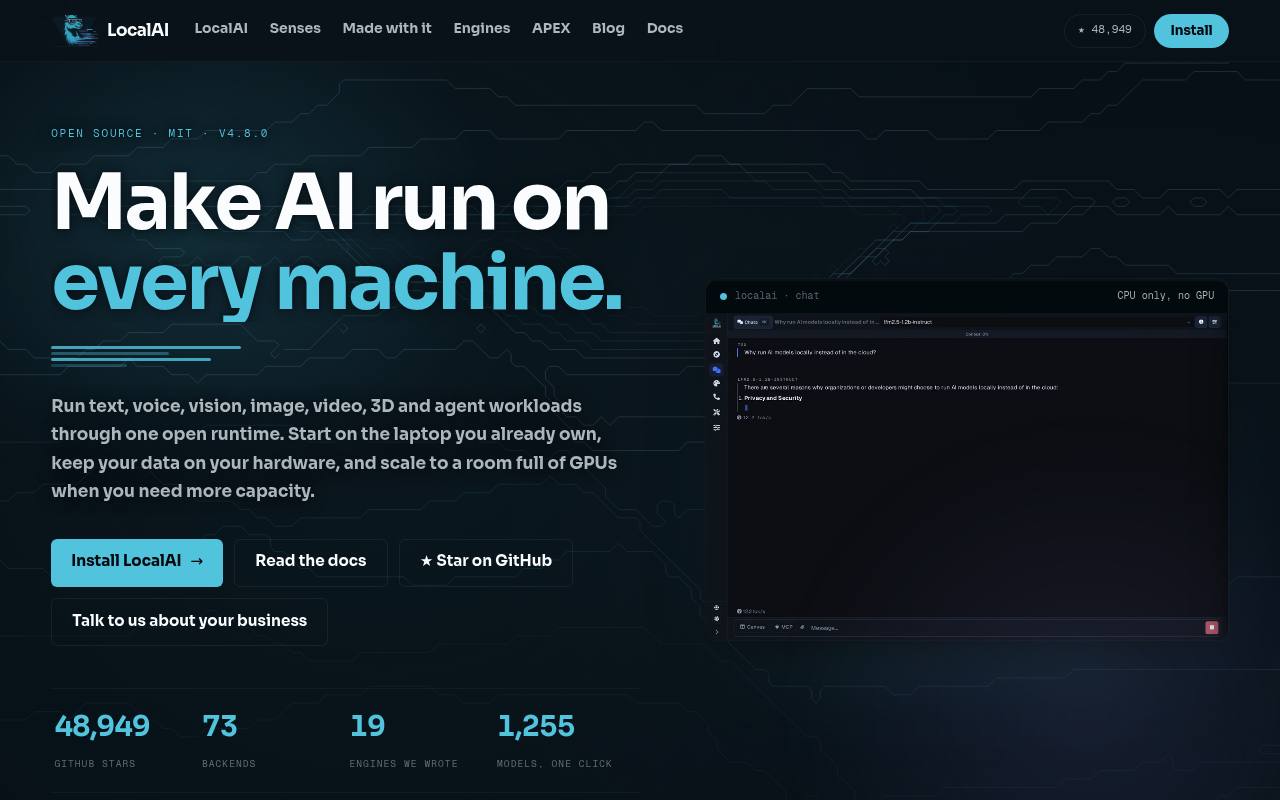
LocalAI is an open-source AI stack for running language, vision, image, audio, video, and embedding models locally. It provides a small core, separate backends installed on demand, a web interface, and OpenAI- and Anthropic-compatible APIs.
It is used by developers, teams, and self-hosters who want local inference, private data handling, model flexibility, agents, or distributed deployment. The software is free, but hardware, hosting, storage, and model-related infrastructure can cost extra.
Features
- OpenAI-, Anthropic-, and Open Responses-compatible APIs
- Web interface for chat, model management, agents, image generation, and monitoring
- Run language, vision, image, video, speech, and embedding models
- Automatic backend installation when a model requires it
- GPU support for NVIDIA, AMD, Intel, Vulkan, and Apple Metal
- Distributed mode with worker nodes, federation, and model sharding
- AI agents with MCP tool support
- MIT licensed and open source
Use cases
- Run private AI inference on laptops, servers, or other local hardware
- Build applications against a local OpenAI-compatible API
- Serve multimodal models without sending data to a cloud provider
- Create local agents with tools, memory, and MCP integrations
- Scale inference across multiple machines with distributed mode
Pros
Cons
Latest updates
- v4.10.0 (v4.10.0)
Added a fleet operations dashboard, credentials.yaml authentication, and CLI end-to-end latency and throughput benchmarking.
- v4.9.0 (v4.9.0)
Authentication now defaults to deny; chat supports context compression, canonical model/backend pages, and video serving in vllm-cpp.
- v4.8.0 (v4.8.0)
Added the vllm-cpp backend, 3D generation, a multi-family audio.cpp engine, hardware-matched gallery builds, and distributed-mode fixes.
- v4.7.0 (v4.7.0)
Added UI-managed voice cloning, video and audio-driven avatar generation, interleaved reasoning with tool calls, and audio engines.
- v4.6.0 (v4.6.0)
ROCm backends run on GPU; chat supports conversation forking, and PII/audit events have a Prometheus counter.
Capabilities
- Runs commands — “It runs shell commands behind an approval gate you control, delegates to sub-agents, and loads MCP servers, plugins and skills.” source
- VS Code — “Install on openSUSE and drive it from VS Code” source
- Command line — “Run local-ai chat and you are talking to an agent that already knows where your models are.” source
- Choice of models — “Every tier of every model we quantize, ranked against the hardware you actually have and installed with one click.” source
- Self-hosted — “keep your data on your hardware, and scale to a room full of GPUs when you need more capacity.” source
- API — “One binary with an OpenAI-compatible API in front of it.” source
- Runs models for you — “Point an existing client at it and the calls keep working, except now the model is on your machine.” source
- Builds agents and workflows — “Run local-ai chat and you are talking to an agent that already knows where your models are.” source
- Search over your data — “Agents, MCP, skills, RAG, interactive tools” source
Pricing
- Prices checked
- 2026-09-25