tools
GAIA-3
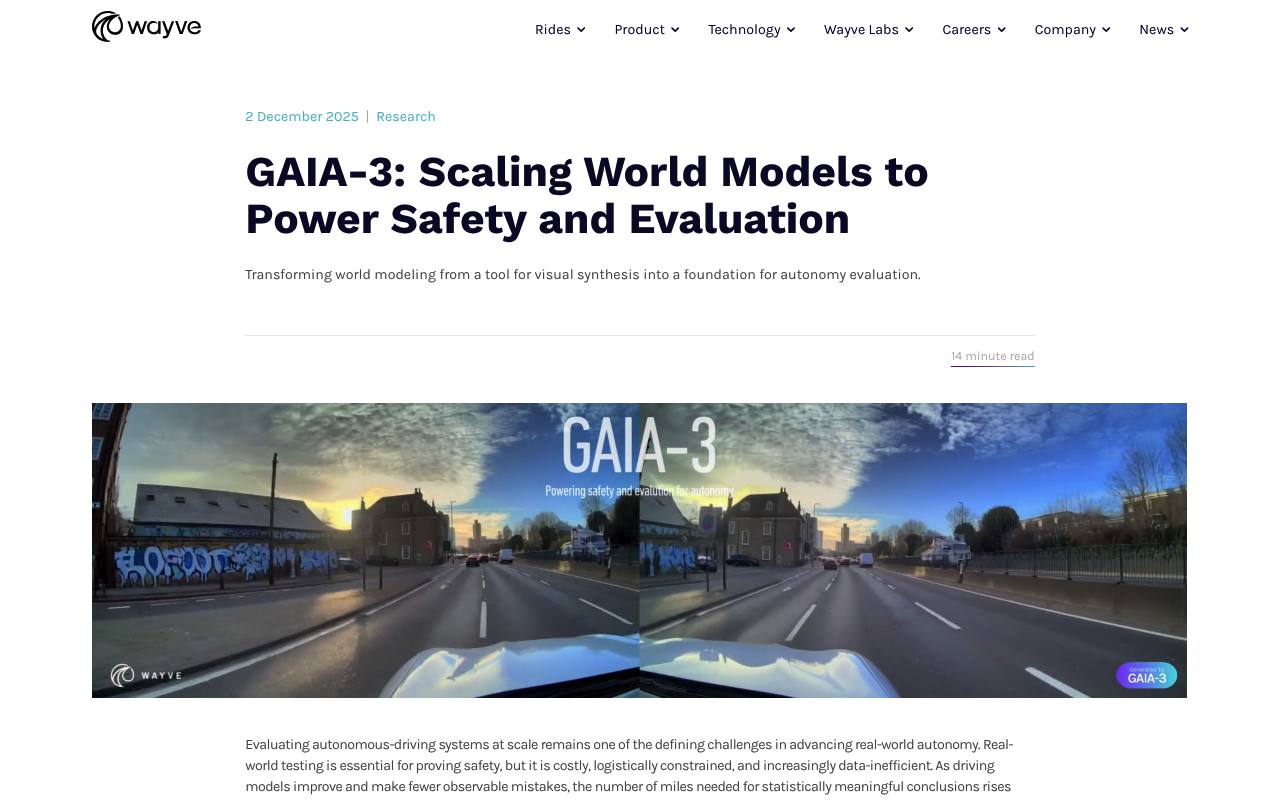
GAIA-3 is Wayve’s generative world model for creating controllable driving scenes and evaluating autonomous-driving systems.
In inglese
GAIA-3 generates realistic driving-scene variations from real-world sequences. It can alter the ego vehicle’s trajectory while keeping other agents and scene elements consistent, and can vary lighting, weather, semantics, and camera embodiment.
Wayve uses it for offline evaluation, safety-critical scenario generation, robustness testing, and comparison of autonomous-driving models. The site does not list a public product price, API, or downloadable release.
Features
- Generates controlled variations of real-world driving sequences
- Alters ego-vehicle trajectories while preserving other scene elements
- Creates safety-critical collision and near-miss scenarios
- Generates controlled changes in lighting, weather, and scene appearance
- Transfers scenes across different camera rigs and vehicle embodiments
- Supports repeatable offline evaluation test suites
- Produces long, coherent driving-scene generations
Use cases
- Generate safety-critical scenarios without recreating them on public roads
- Evaluate driving models against controlled what-if interventions
- Test robustness across lighting, weather, and visual conditions
- Transfer evaluation scenes between vehicle camera configurations
- Create virtual NCAP-style testing scenarios
- Compare autonomous-driving policies offline
Pros
Cons
Latest updates
- GAIA-4: Multimodal World Models Powering Closed-Loop Simulation for Safe and Scalable Autonomy (GAIA-4)
Puts the Wayve AI Driver in the loop, transforming world modeling from scene generation into a way to measure end-to-end safety at scale.
- GAIA-3: Scaling World Models to Power Safety and Evaluation (GAIA-3)
GAIA-3 combines the realism of real-world data with the control of simulation.
Pricing
- Prices checked
- 2026-09-25