tools
Altana Atlas
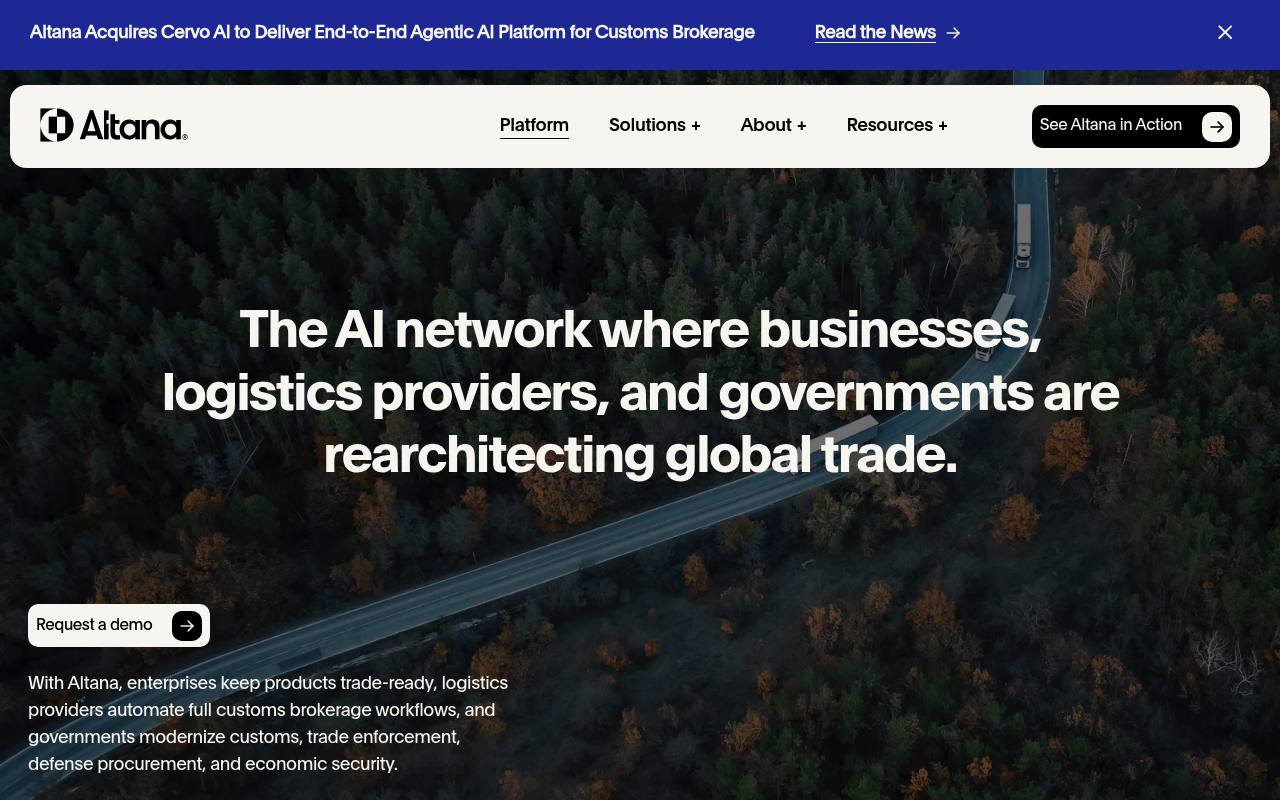
Altana Atlas maps products, suppliers, trade activity, and risks across global value chains for businesses and governments.
In inglese
Altana Atlas combines customer data, supplier information, public records, commercial sources, and logistics data into a supply chain graph. It helps users map multi-tier value chains, investigate risk, manage product data, and share verified Product Passports.
Businesses, logistics providers, customs brokers, and government agencies use it for classification, origin determination, duty calculation, tariff analysis, compliance screening, enforcement, and disruption modeling. Altana does not publish standard pricing; access is offered through a demo and customer-specific arrangements.
Features
- Map multi-tier value chains using product and supplier data
- Create and share verified Product Passports
- Classify products and determine country of origin
- Calculate duties and evaluate free-trade agreement qualification
- Screen supply chains for forced labor and other risks
- Model tariff changes and supply-chain disruptions
- Collaborate with suppliers, logistics providers, and regulators
- Analyze networks for trade risks and opportunities
Use cases
- Trace products and suppliers across multiple supply-chain tiers
- Screen value chains for forced-labor and compliance exposure
- Prepare customs classifications, origin decisions, and duty calculations
- Model tariff changes and disruptions before they affect operations
- Share product and origin information with logistics providers and regulators
- Investigate risky shipments and trade relationships
Pros
Cons
Latest updates
- Editing an entry now requires the entry processing editor role, and country of origin screening gets sharper flagging plus a report of its own.
Editing requires the entry processing editor role; country of origin flags are more precise, and a new country of origin report is available.
- Entry Processing now runs on the entry processing viewer and editor roles, and you see only the entries your catalog access covers.
Opening Entry Processing requires the entry processing viewer role; entry results are limited to catalogs you have access to.
- Shipper and manufacturer now belong to the line item, and product info fills in for line items matched to a product profile.
Each line item now carries its own shipper and manufacturer; Product Info no longer comes up blank when a product profile is matched.
- More entry context in the full-page view, AI descriptions in HS breadcrumbs, and entry-list & CSV-upload improvements.
Entry details stay in a summary panel in the sidebar; HS-code paths show AI-generated descriptions, and CSV-uploaded entries show the source file's name.
- Classification, misclassification, and vague-description results are consolidated into a single Classification check; the entry-list tab and the misdeclared-origin flag get clearer names; and you can
Classification, misclassification, and vague-description results are consolidated into one check; you can now export an entry to CSV.
Pricing
- Prices checked
- 2026-09-26