Research
X-Planner: Event-Structured Task Planning for Embodied Intelligence
X-Planner: Event-Structured Task Planning for Embodied Intelligence Overview Research area: Embodied AI / robot task planning, sitting between high-level language instruction and low-level Vision–Lang
In inglese
- arXiv
- 2609.25187
- Published
- 2026-09-21
- Authors
- Howard Lu, Shalfun Li, Porter Pan, Cris, Lumen, Cyril, Eric Hu, Lily Li, Maeve Zhang, Robert Wang, KZ Zheng, Viggo Chen, Tim Ding, Regsis Cheng, YJ Xiao, Kian, Hai Lin, Alan Song, Elise Ma, Gody Li, Victor Yao, Yohann Tang, Ingrid Yu, Jason He, James Wang, Ryan Yu, Ping Yang, Chris Pan, Vincent Chen, Roy Gan, Hao Wang, Qian Wang
AI summary
X-Planner: Event-Structured Task Planning for Embodied IntelligenceOverview
Research area: Embodied AI / robot task planning, sitting between high-level language instruction and low-level Vision–Language–Action (VLA) control.
Technical level: Advanced. The paper combines multimodal data curation, Transformer architecture modification (depth-staggered latent decoding), and real-robot evaluation.
Scope (one sentence): The paper presents X-Planner, a planning front-end that supplies a downstream world-action model with either interpretable event captions or parallel continuous latent "chain-of-thought" states, trained on a three-source, hierarchically annotated robot dataset.
What This Paper Is About
Modern VLA systems map observations and instructions directly to actions, which works for short skills but leaves the intermediate task structure implicit for long-horizon manipulation. Existing chain-of-thought planners tend to use coarse task-level labels that hide event boundaries (regrasps, failed contacts, retries) and to decode reasoning one token at a time. X-Planner addresses both problems at once by supervising plans at the level of "semantic events" — coherent spans of behavior like reaching, grasping, lifting, or placing — and by offering a latent plan form that avoids token-by-token serialization inside the planner.
Key Contributions
-
Multisource, hierarchical planning supervision. Ego, UMI, and teleoperation demonstrations are unified under an L3 Task / L2 Subtask / L1 Action / L0 Segment hierarchy, with source-dependent annotation depth: teleoperation supports all four levels, while Ego and UMI retain L1–L3 because their faster motions make L0 boundaries hard to annotate reliably. Annotated takeover times supervise error recognition during execution, and human-designed failure demonstrations supplement policy-collected errors to reduce reliance on one policy's failure distribution. A 1,500-episode analysis subset characterizes semantic and temporal coverage.
-
Staircase Decoding with two plan forms. A shared Qwen-series VLM backbone exposes either a discrete interface that emits interpretable structured event states, or a latent interface that relays continuous CoT states across staggered Transformer depths. The latent form is a lightweight Mixture-of-Transformers branch coupled to the frozen backbone, partitioned at a relay depth N_r, so lower layers encode shared visual–language context and upper layers update latent positions in parallel with independent causal caches.
-
Frozen latent-to-text reconstruction. A prefix projector maps the K_c latent states into the embedding space of a frozen lightweight language model, which reconstructs the corresponding textual CoT trace. Only the staircase branch and the prefix projector are optimized; the reconstruction model stays fixed. This provides a semantic anchor rather than matching a specific sequence of autoregressive hidden states.
-
Offline and real-robot evaluation. Offline two-step planning text is scored with BERTScore-F1 and a Doubao Judge Overall rating; the complete system is evaluated on real tabletop bimanual arms in event mode across a Reasoning Manipulation suite and a Generalization suite.
Main Findings
- Offline planning text ranks second of four. On the offline two-step planning comparison, X-Planner scores BERTScore-F1 of 0.9011 and Overall of 1.411. Qwen scores 0.8878 / 1.367, Doubao 0.8846 / 1.366, and kimi3 0.9108 / 1.434. X-Planner exceeds Qwen by 0.0133 and Doubao by 0.0165 on BERTScore-F1, and trails kimi3 by 0.0097. Both metrics give a consistent ranking.
- Highest Reasoning Manipulation average. On the Reasoning Manipulation suite (Sort Headphone, Classify Items as Shape, Press Button in Order, Pair Up Items, Pick Fruits into Basket), the X-Planner-conditioned policy achieves an average Task Progress of 71.60, versus 59.50 for U-Scratch, 56.40 for π0.5, 32.70 for DreamZero, and 31.60 for LingBot-VA — a margin of 12.10 percentage points over the strongest reported baseline, U-Scratch.
- Task-level pattern is mixed. X-Planner scores 84% on Sort Headphone (same rounded value as U-Scratch), 78% on Classify Items as Shape (below U-Scratch's 82%), 64% on Press Button in Order, 36% on Pair Up Items (below π0.5's 77%), and 96% on Pick Fruits into Basket. U-Scratch scores higher on shape classification and π0.5 performs best on item pairing.
- Largest margin in Generalization. On the Generalization suite, X-Planner averages 53.75 Task Progress, versus 28.50 for DreamZero, 24.00 for π0.5, and 18.50 for U-Scratch — a 25.25 percentage point margin over the strongest available baseline. LingBot-VA is marked N/A because no result was available for this suite.
- Data coverage statistics. The deterministic analysis subset retains 1,500 of 1,654 candidate episodes, removing 154 redundant frequent combinations while preserving all 167 datasets, 30 named task categories plus an unknown label, and the observed tail of semantic and action labels. Shares are dominated by rigid objects (58.2%), scene grounding (39.4%), and office/public scenes (28.5%). Temporal ECDFs have medians of five subtasks and 37.1 s, with 90th percentiles of 15 subtasks and 113.1 s; subtask counts reach 65 and episode duration reaches 822.7 s.
- Action and complexity profiles. The manifest contains 41 named atomic-action labels inferred from two ground-truth subtask captions per episode, with one unmatched episode. Move, grasp, and place cover 68.4%, 57.0%, and 40.3% of episodes; pick-and-place, opening/closing containers, and sorting/storage cover 85.8%, 28.8%, and 27.5%. Action-complexity bins 1–3, 4–6, and >6 account for 58.9%, 30.7%, and 9.3%; subtask-complexity shares are 28.2%, 35.3%, and 35.4%, with 1.1% unknown labels in both metadata fields.
- Selection trims dominant modes. Retained-minus-candidate shifts are negative across the board: rigid objects −3.7 percentage points, scene grounding −2.0 pp, source-group and camera-count shifts at most −0.6 pp; for atomic actions, Place −3.3 pp, Move −2.4 pp, Grasp −1.5 pp.
- Explicitly not established. The paper states that neither evaluation establishes an end-to-end latency advantage. Error bars are omitted from the robot results because trial-level scores and uncertainty estimates were not provided, and no statistical significance is claimed. The robot results evaluate the complete event-mode system and do not separately estimate the contribution of error-supervision data, the discrete plan representation, the latent form, the staircase schedule, or any individual training objective.
Methodology in Plain English
The team built a planning layer that sits in front of an existing world-action model rather than replacing it. They gathered demonstrations from three sources — egocentric video, UMI, and teleoperation — and labeled them with a shared four-level hierarchy, keeping only the levels each source can support reliably. Instead of one caption per episode, supervision covers three moments: an ordered initial plan at execution start, an ongoing state during execution (current event, next event, normalized progress, continuation state, error recognition), and an episode-end marker at the last available media frame. Errors are taught partly through annotated takeover times in intervention episodes and partly through human-performed demonstrations of deliberately designed failures.
On the model side, one VLM backbone serves two interfaces. The discrete one emits a structured JSON-like response and is trained with standard autoregressive supervision over the assistant tokens. The latent one runs a lightweight branch that splits the Transformer at a relay depth: the first latent position passes through the lower layers to produce a shared relay representation, then upper blocks update all reasoning positions in parallel. To keep those continuous states meaningful, a frozen small language model is asked to reconstruct the text CoT trace from them, and only the branch and the prefix projector are updated. A separate alignment loss matches the planner's projected text features to the geometry the fixed downstream text encoder expects, so the planner can slide into the existing cross-attention pathway. On the robot, the team compares systems on matched tasks, instructions, multi-view observations, and scene randomization, scoring with a dense 0–100 Task Progress metric that credits partial completion rather than binary success.
Why This Matters
Research impact. The paper reframes embodied planning around action-grounded semantic events rather than fixed-length chunks or episode captions, and it argues that plan granularity should follow changes in behavior rather than an externally imposed level. Staircase Decoding also offers a concrete alternative to the usual serial latent-CoT rollout, shortening the planner's serial critical path while keeping a text-based semantic anchor — and the paper is careful to separate what the architecture reduces (serial computation) from what it does not yet demonstrate (end-to-end latency).
Real-world applications:
- Tabletop and warehouse manipulation, where ordered multi-step tasks such as sorting, pairing, and instruction-conditioned picking require grounding categories and relations before acting.
- Human-in-the-loop robot supervision, since the discrete event state is inspectable and editable by a human or upstream agent and supports error recognition during ongoing execution.
- Failure analysis and recovery, where takeover-time annotations and deliberately designed failure demonstrations give a template for teaching a system to notice when execution is going wrong.
- Foundation-model integration, because the planner conditions a fixed downstream world-action model through its native text pathway, so it can be added as a front-end rather than requiring retraining of the whole stack.
Industry relevance. The work targets the integration seam between high-level agents and embodied control, a practical concern for anyone building robot systems on top of pretrained VLA or world-action backbones. Its use of a shared backbone for both a readable interface and a compact computational one reflects a real deployment tradeoff between interpretability and speed, and its evaluation protocol (matched task definitions plus a dense progress metric) is the kind of setup industrial robot evaluation needs.
Future Directions
- Controlled ablations and timing measurements. The paper explicitly lists controlled comparisons of the two plan forms and end-to-end timing as future work, since the current experiments evaluate only the complete event-mode system and do not isolate any single component or establish a latency advantage.
- Closing the oracle-context gap. Training histories and optional initial plans are annotation-derived, while deployment conditions on rolling model outputs; rollout-aligned supervision is proposed to narrow this mismatch.
- Streaming event discovery. Replacing offline event discovery with a streaming process that can revise plans online is named as a further direction.
- Beyond tabletop bimanual arms. Evaluation on mobile or humanoid platforms remains future work, and the paper notes that episode-end labels mark synchronized media boundaries rather than independently establishing task success.
Target Audience
Robotics and embodied-AI researchers working on task planning, VLA systems, or latent reasoning; engineers integrating planning front-ends with pretrained world-action models; and readers interested in data annotation design for long-horizon manipulation, particularly those weighing interpretable text plans against compact continuous representations. Readers looking for a Beginner-Friendly introduction to VLA planning will find the architecture sections dense, since the paper assumes familiarity with Transformer depth schedules, cross-attention conditioning, and chain-of-thought decoding.
Authors’ abstract
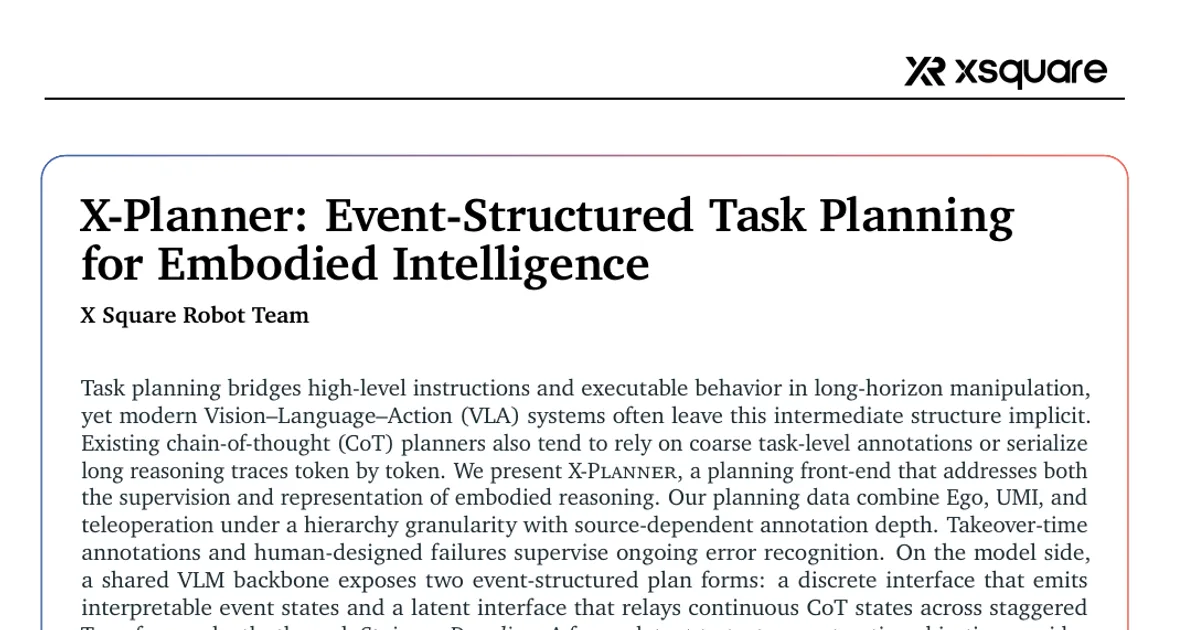
Task planning bridges high-level instructions and executable behavior in long-horizon manipulation, yet modern Vision-Language-Action (VLA) systems often leave this intermediate structure implicit. Existing chain-of-thought (CoT) planners also tend to rely on coarse task-level annotations or serialize long reasoning traces token by token. We present X-Planner, a planning front-end that addresses both the supervision and representation of embodied reasoning. Our planning data combine Ego, UMI, and teleoperation under a hierarchy granularity with source-dependent annotation depth. Takeover-time annotations and human-designed failures supervise ongoing error recognition. On the model side, a shared VLM backbone exposes two event-structured plan forms: a discrete interface that emits interpretable event states and a latent interface that relays continuous CoT states across staggered Transformer depths through Staircase Decoding. A frozen latent-to-text reconstruction objective provides a semantic anchor for the latent representation. Offline two-step planning evaluation places X-Planner second among four evaluated models on both BERTScore-F1 and a judge-based Overall score. In real-robot experiments, respectively, outperforming the evaluated baselines. These results characterize planning-text quality and downstream execution.