Research
Pushing the Frontier of Black-Box LVLM Attacks via Fine-Grained Detail Targeting
Overview Research area: Adversarial machine learning, specifically transfer-based black-box attacks against Large Vision-Language Models (LVLMs), with a focus on gradient behavior inside ViT-based vis
- arXiv
- 2602.17645
- Published
- 2026-02-19
- Authors
- Xiaohan Zhao, Zhaoyi Li, Yaxin Luo, Jiacheng Cui, Zhiqiang Shen
AI summary
Overview
- Research area: Adversarial machine learning, specifically transfer-based black-box attacks against Large Vision-Language Models (LVLMs), with a focus on gradient behavior inside ViT-based vision encoders.
- Technical level: Advanced. The paper combines empirical gradient diagnostics with formal variance and embedding-drift theorems.
- Scope: This paper diagnoses why the state-of-the-art local crop-matching attack M-Attack produces unstable, near-orthogonal gradients, and proposes four modular fixes (MCA, ATA, Patch Momentum, PE+) bundled as M-Attack-V2 to push attack success rates higher on frontier commercial LVLMs.
What This Paper Is About
Black-box attacks on LVLMs are hard because the attacker has no access to gradients from the victim model and must rely on surrogate models to craft perturbations that transfer. The prior state of the art, M-Attack, matches small local crops of a source image to crops of a target image using surrogate ensembles, but the authors show that this crop-level matching produces gradients that are almost uncorrelated across iterations, which destabilizes the optimization. The goal of this work is to identify the causes of that instability and to redesign the local-matching pipeline so that the surrogate gradients become smoother, more temporally coherent, and more transferable to closed commercial models such as Claude 4.0, Gemini 2.5-Pro, and GPT-5.
Key Contributions
-
Diagnosis of near-orthogonal crop gradients. The authors show for the first time that crop-level matching yields high-variance, near-orthogonal gradients, and attribute this to two factors: ViT translation sensitivity producing spike-like patch gradients, and an overlooked structural asymmetry between the source and target crop branches.
-
Reformulation of local matching as an asymmetric expectation, over a distribution of local transformations on the source and a distribution over target semantics, with a variance bound (Theorem 3.1) and an embedding-drift bound (Theorem 3.5) supporting the design.
-
Two gradient-denoising modules: Multi-Crop Alignment (MCA), which averages gradients over K independently sampled local views per iteration, and Auxiliary Target Alignment (ATA), which replaces aggressive target augmentation with a small set of semantically correlated auxiliary images under only mild transformations.
-
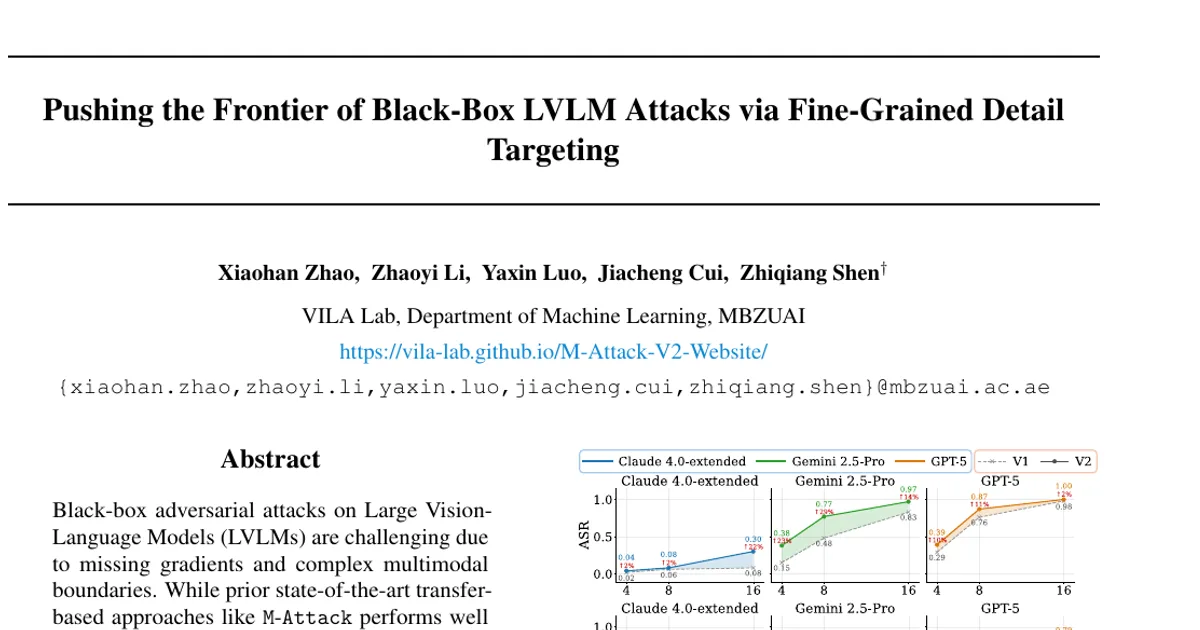
Patch Momentum (PM) plus a refined Patch Ensemble (PE+) of surrogates deliberately chosen to span diverse patch sizes, together producing large ASR gains on frontier LVLMs (Claude-4.0 8% to 30%, Gemini-2.5-Pro 83% to 97%, GPT-5 98% to 100%).
Main Findings
-
Gradient similarity collapses with small crop shifts. Cosine similarity between gradients from two crops in a fixed iteration decays rapidly and falls below 0.1 once the IoU is below 0.8, despite shared pixels. Results are averaged over 200 runs.
-
Consecutive source gradients are almost orthogonal in M-Attack. The similarity between consecutive source gradients is almost zero in the original method, while M-Attack-V2 improves it to around 0.2.
-
ViTs react differently than CNNs to crop translation. A ResNet-50 gradient pattern remains consistent when large pixel regions overlap, whereas the ViT gradient pattern changes dramatically. MCA smooths this effect, keeping high-activity regions stable (upper left and center right) where the single-crop case shifts focus from center right to lower left.
-
A modest number of crops is enough. Averaging K=10 almost-orthogonal gradients still yields benefit because the uncorrelated variance component shrinks as 1/K; K=10 shows accelerated convergence with a smaller margin improvement from K=100.
-
Simple averaging plus a well-chosen ensemble is effective. Rather than proposing a new aggregation rule, the authors first profile embedding-level transferability across a large candidate pool over 1k images and find cross-model, especially cross-patch-size, transfer difficult. This motivates the final ensemble PE+, comprising CLIP†-G/14, CLIP-B/16, CLIP-B/32, and CLIP†-B/32.
-
Attention maps explain the selection. Selected models consistently focus attention on the main object, whereas discarded models spread attention over background regions, suggesting that emphasizing core semantic content transfers better than dispersed, model-specific patterns.
-
Commercial LVLM results. On GPT-5, M-Attack-V2 reaches ASR 1.00 with KMRa 0.92, KMRb 0.79, KMRc 0.30 (versus M-Attack at 0.98, 0.89, 0.65, 0.25). On Claude 4.0-thinking, ASR rises to 0.30 (KMRa 0.27, KMRb 0.17, KMRc 0.04) versus 0.08 for M-Attack. On Gemini 2.5-Pro, ASR reaches 0.97 (KMRa 0.87, KMRb 0.72, KMRc 0.22) versus 0.83.
-
Perturbation norms rise slightly. M-Attack-V2 has ℓ1 0.038 and ℓ2 0.044 versus 0.030 and 0.036 for M-Attack. The authors attribute this to previous methods being under-optimized due to near-orthogonal gradients, and state that user studies reported in the appendix show nearly identical human imperceptibility between M-Attack and M-Attack-V2.
-
Open-source LVLM results. On Qwen-2.5-VL, M-Attack-V2 achieves KMRa/b/c 0.87/0.67/0.27 and ASR 0.95; on LLaVA-1.5, 0.96/0.83/0.29 and ASR 0.96.
-
Faster convergence under budget constraints. M-Attack-V2 approaches optimal results within 300 steps, whereas M-Attack requires an additional 200 steps. At 100 and 200 steps M-Attack shows a notable performance drop.
-
Vision reasoning does not confer robustness. Against GPT-o3 (o3-2025-04-16), M-Attack-V2 reaches KMRa 0.91, KMRb 0.71, KMRc 0.23, and ASR 0.98. GPT-o3 exhibits slightly better robustness than GPT-4o, and its reasoning process shows certain degrees of suspicion on some images, sometimes using python tools for zooming.
-
Ablations. On Gemini-2.5-Pro and Claude-3.7-extended, removing MCA, ATA, or PM individually reduces performance; for example, removing PM drops Gemini 2.5-Pro KMRb by 0.10 to 0.62, and removing PM on Claude 3.7-extended drops KMRa by 0.12 to 0.44.
Methodology in Plain English
The attack starts from a clean source image, a target image, and an ensemble of open surrogate vision encoders. Rather than matching whole images, the method repeatedly crops a local region from the source and a local region from the target and tries to make their surrogate embeddings similar, nudging the source pixels within an ℓ∞ ball of size ϵ=16 across 300 optimization steps.
The authors found that this crop-by-crop matching produces wildly inconsistent gradient directions. The reason is that ViTs split images into fixed non-overlapping patches, so shifting a crop by a few pixels reshuffles which pixels belong to which token, changes the self-attention, and produces spiky pixel-level gradients. On top of that, the source crop and target crop play asymmetric roles: cropping the source changes the perturbation directly in pixel space, while cropping the target only moves the reference embedding in feature space.
Their fix has four parts. First, instead of one source crop per step, they draw K=10 independent crops and average their gradients, which is an unbiased Monte Carlo estimator that reduces variance. Second, instead of aggressively augmenting the target, they add P=2 auxiliary images retrieved from a semantically correlated distribution (COCO images selected by CLIP-B/16 embedding similarity) and apply only mild augmentations to the target and auxiliaries, using a random resized crop of [0.9, 1.0], a horizontal flip with p=0.5, and a rotation of ±15°. A weight λ=0.3 interpolates between the original target and the auxiliary neighbors. Third, they reinterpret momentum as Patch Momentum: each crop watching a pixel is replayed in later iterations with geometrically decaying weight, which lets rarely sampled regions such as corners persist and prevents gradient starvation. Fourth, they pre-select an ensemble of surrogates with diverse patch sizes that demonstrably transfer well, and use plain averaging rather than a sophisticated aggregation rule.
Optimization uses PGD with Adam, step size α=1.275 for M-Attack-V2 (versus α=0.75 for Claude and α=1.0 for other methods in the baselines), with β1=0.9 and β2=0.99. Per-iteration complexity is O(K(3+P)) because only the source crops are back-propagated and the auxiliary targets are only forward-propagated; the authors note this doubles overhead when P=3, and that the extra cost is parallelizable.
Why This Matters
Impact on research. The paper reframes a practical transfer-attack pipeline as a variance-reduction and sampling-quality problem, and supplies a concrete diagnostic (gradient cosine similarity versus crop IoU) that other adversarial-robustness researchers can reuse. It also documents an understudied angle: which surrogates are pre-selected matters as much as how their gradients are aggregated, an observation the authors say has been less studied and reported before.
Real-world applications (implied by the work, not enumerated as such in the paper):
- Red-teaming and safety evaluation of commercial multimodal assistants before or after deployment, since the paper shows frontier models including GPT-5, Claude 4.0, and Gemini 2.5-Pro remain attackable.
- Benchmarking the robustness of vision-language systems used in image captioning, VQA, and visual reasoning pipelines.
- Auditing whether reasoning modules add measurable robustness, given the finding that GPT-o3 shows only limited improvement and can suspect but not reliably detect adversarial images.
- Informing defense and detection work by exposing which visual features (main-object attention versus dispersed background attention) drive transferable attacks.
Industry relevance. The method is described as simple and modular, requiring no new aggregation rule, and its reported overhead is parallelizable. Any organization that exposes LVLM APIs or deploys multimodal models inherits a realistic attacker baseline measured directly against commercial endpoints, and the reported imperceptibility study (M-Attack and M-Attack-V2 nearly identical, both outperforming all other methods) is directly relevant to how seriously these perturbations must be treated.
Future Directions
- Better auxiliary-set construction. The paper notes the auxiliary set can be built in various ways, such as image-image retrieval or diffusion methods; only CLIP-B/16 retrieval from COCO is used here, so other constructions remain untested.
- Combining PE+ with advanced aggregation. The authors position PE+ as a first-stage pre-selection that can be used directly or plugged into more sophisticated aggregation schemes, leaving that combination open.
- Closing the residual gap on the hardest victim. Claude 4.0 remains at ASR 0.30 versus 1.00 on GPT-5 and 0.97 on Gemini 2.5-Pro, so the mechanisms that make Claude more resistant are not explained.
- Whether reasoning models can be trained to detect adversarial manipulations. The authors observe GPT-o3's reasoning module is not explicitly trained to detect them; the paper truncates before stating formal limitations or conclusions, so those are not reported in the available text.
Target Audience
Adversarial machine learning and AI safety researchers, particularly those working on transfer-based black-box attacks, ViT gradient behavior, and robustness of multimodal models. Also relevant to ML engineers and security teams responsible for evaluating or hardening LVLM deployments, and to graduate students already familiar with gradient-based optimization, surrogate ensembles, and momentum methods who want a worked case study in diagnosing and repairing unstable gradients.
Authors’ abstract
Black-box adversarial attacks on Large Vision-Language Models (LVLMs) are challenging due to missing gradients and complex multimodal boundaries. While prior state-of-the-art transfer-based approaches like M-Attack perform well using local crop-level matching between source and target images, we find this induces high-variance, nearly orthogonal gradients across iterations, violating coherent local alignment and destabilizing optimization. We attribute this to (i) ViT translation sensitivity that yields spike-like gradients and (ii) structural asymmetry between source and target crops. We reformulate local matching as an asymmetric expectation over source transformations and target semantics, and build a gradient-denoising upgrade to M-Attack. On the source side, Multi-Crop Alignment (MCA) averages gradients from multiple independently sampled local views per iteration to reduce variance. On the target side, Auxiliary Target Alignment (ATA) replaces aggressive target augmentation with a small auxiliary set from a semantically correlated distribution, producing a smoother, lower-variance target manifold. We further reinterpret momentum as Patch Momentum, replaying historical crop gradients; combined with a refined patch-size ensemble (PE+), this strengthens transferable directions. Together these modules form M-Attack-V2, a simple, modular enhancement over M-Attack that substantially improves transfer-based black-box attacks on frontier LVLMs: boosting success rates on Claude-4.0 from 8% to 30%, Gemini-2.5-Pro from 83% to 97%, and GPT-5 from 98% to 100%, outperforming prior black-box LVLM attacks. Code and data are publicly available at: https://github.com/vila-lab/M-Attack-V2.