Industry Transformation
The AI-Powered City: How Urban Infrastructure Is Being Rewired for Machine Intelligence
Traffic signals that learn, sewer sensors that pay for themselves, and a gunshot detector that cost Chicago $500,000 and still has no replacement: what AI in city infrastructure has actually delivered, and the pattern behind the wins and th

Gabriele Masetti ·
Cities have always been infrastructure problems disguised as places to live: pipes, wires, signals, and schedules layered on top of each other, mostly designed decades before anyone imagined a camera that could count cars or a model that could predict a water main failure. What's changed in the last few years isn't that cities suddenly became smart — it's that the sensing layer got cheap enough, and the models got good enough, that machine intelligence is now quietly making decisions about how traffic flows, how buses run, how water moves, and who gets flagged by police. Some of that is working. Some of it has already blown up in spectacular, well-documented ways. Both halves of the story matter.
The traffic light that learns
The most mature version of AI urban infrastructure is also the least glamorous: traffic signal timing. For most of the twentieth century, signal cycles were fixed by engineers using traffic counts taken once and rarely revisited. Two projects have tried to replace that with continuous, adaptive control.
Surtrac, developed at Carnegie Mellon University's Robotics Institute, has been running in Pittsburgh since 2012. Rather than a central computer optimizing an entire grid, each intersection runs its own local model, communicating projected outflows to its neighbors so the whole corridor adjusts in something close to real time.
The initial deployment in Pittsburgh's East End produced a 25% reduction in travel times and cut wait times by more than 40%, with emissions down about 21%, according to evaluations published by the Department of Transportation and Carnegie Mellon's own project reporting. The city has since drawn roughly $20 million in federal and state funding to expand Surtrac from around 50 intersections toward 200.
| Deployment | Location | Result |
|---|---|---|
| Surtrac adaptive signals | Pittsburgh | 25% shorter travel times, 40%+ less wait time |
| Project Green Light | 100+ cities worldwide | Up to 30% fewer stops, ~10% lower emissions |
| SBS Transit predictive maintenance | Singapore (~1,000 buses) | ~20% drop in bus breakdowns |
| South Bend sewer sensors | South Bend, Indiana | ~70% cut in sewer overflows |
| HOFOR leak detection | Copenhagen | ~50% cut in repair times |
Google's Project Green Light takes a different architecture: rather than controlling signals directly, it mines Google Maps driving data to model stop-and-go patterns at intersections and hands city traffic engineers specific timing recommendations, which engineers themselves decide whether to implement. That human-in-the-loop design is deliberate — cities don't want to hand signal control to a private company's black box, and Google, chastened by other smart-city misadventures, seems to have learned that lesson.
Green Light now runs in more than 100 cities, from Haifa and Kolkata to Hamburg, Boston, Bangkok, Bengaluru, and Manchester. Google reports up to a 30% reduction in stops and a 10% cut in greenhouse gas emissions at optimized intersections, across what it puts at up to 47 million car rides a month. Boston is the deepest single deployment: 114 optimized intersections across 20 neighborhoods, where the city — not Google — reported a 20% average drop in unnecessary stops and a 13.5% average cut in delay.
Most of these are Google's own published figures rather than independently audited numbers — but the underlying mechanism (using anonymized, aggregated Maps telemetry that already exists at enormous scale) is more verifiable than most smart-city claims, since the traffic data long predates the AI application.
What both projects share is modesty of scope. Neither claims to solve congestion; both claim measurable, marginal gains on emissions and delay at specific intersections. That's a useful baseline for judging the rest of the AI-city pitch, because most of what follows promises far more and delivers far less certainty.
Buses, breakdowns, and the bunching problem
Transit agencies have a narrower, more tractable AI problem than traffic engineers: they already own the vehicles, the schedules, and the maintenance logs, so prediction is mostly a data problem rather than a physics one. Singapore's SBS Transit rolled out an AI-driven predictive maintenance system across roughly 1,000 buses, using sensor and service-log data to flag likely failures before they cause breakdowns; the operator has reported around a 20% drop in bus breakdowns following the rollout. That's a meaningfully different claim from most AI-transit marketing — it's an operational metric (breakdowns per fleet), not a projected emissions estimate.
The other perennial transit headache — bus bunching, where vehicles on the same route clump together because a delay early in the line cascades — is a scheduling optimization problem that machine learning is reasonably well suited to. Adjusting dispatch and holding decisions in near-real time, rather than sticking to a fixed timetable, can reduce wait-time variance without adding buses to the fleet.
Deloitte's transit-sector research has found roughly 70% of transit agencies plan to increase AI investment over the next three years, mostly in this predictive-maintenance and dispatch-optimization space rather than anything resembling autonomous operation. It's unglamorous, back-office AI — closer to inventory forecasting than to the humanoid-robot version of a smart city — but it's also one of the few categories with verifiable before/after operational numbers instead of vendor projections.
The invisible networks: water and power
Water utilities have quietly become one of the more successful AI-adjacent infrastructure stories, mostly because the underlying sensor technology — acoustic leak detection — predates AI and the machine learning layer is doing something narrow and well-defined: distinguishing the acoustic signature of a leak from ambient noise. South Bend, Indiana, facing a mandated $500 million sewer overhaul, deployed IoT sensors across 150 miles of pipe and used the resulting data to target repairs, cutting sewer overflows by roughly 70%.
Missoula, Montana fitted acoustic sensors to hydrants across 340 miles of pipe and found more than a dozen leaks during a pilot period that would otherwise have gone undetected for months. Copenhagen's utility, HOFOR, uses similar sensor networks to triage leak severity and location, and reports cutting repair times by about half.
None of these are AI moonshots; they're pattern-classification problems bolted onto infrastructure that utilities were going to have to sensor-instrument anyway, which is probably why they've produced some of the most concrete, auditable numbers in this entire field.
The electric grid is a messier case, because the AI story there is now tangled up with the AI industry's own soaring power demand. PJM Interconnection, the regional grid operator serving a large swath of the mid-Atlantic and Midwest, announced a partnership with Google in April 2025 to apply Google Cloud and DeepMind tools to one of the grid's worst bottlenecks: the multi-year backlog of interconnection requests for new power projects, especially renewables, awaiting engineering review.
The pitch is that AI can accelerate the paperwork and modeling that currently keeps solar and battery projects stuck in queues for years. It's a real deployment, but it's also a slightly uncomfortable irony: the same industry whose data centers are straining grid capacity is now selling grid operators the tools to relieve that strain.
There is finally a cycle to judge it against: PJM's reformed interconnection process closed its first application window on 27 April 2026 with 811 projects totalling roughly 220 GW — led by 106 GW of gas-fired generation and 67 GW of storage, against 15 GW of solar and 5 GW of wind, which is not the renewables-unblocking story the partnership was sold on. Tapestry, the Google X moonshot behind the tool, published its own numbers in June 2026: the site-control paperwork behind those applications reviewed at a median runtime of six minutes and fifteen seconds, 99% of it finished inside an hour. That is document triage, measured by the vendor, rather than an approval moving faster.
When the cameras become the controversy
Not every AI infrastructure deployment survives contact with the public, and the clearest cautionary tale is ShotSpotter (now sold under its parent company SoundThinking) in Chicago. The acoustic gunshot-detection system used a network of microphones and machine classification to alert police to suspected gunfire, and the company claimed roughly 97% accuracy.
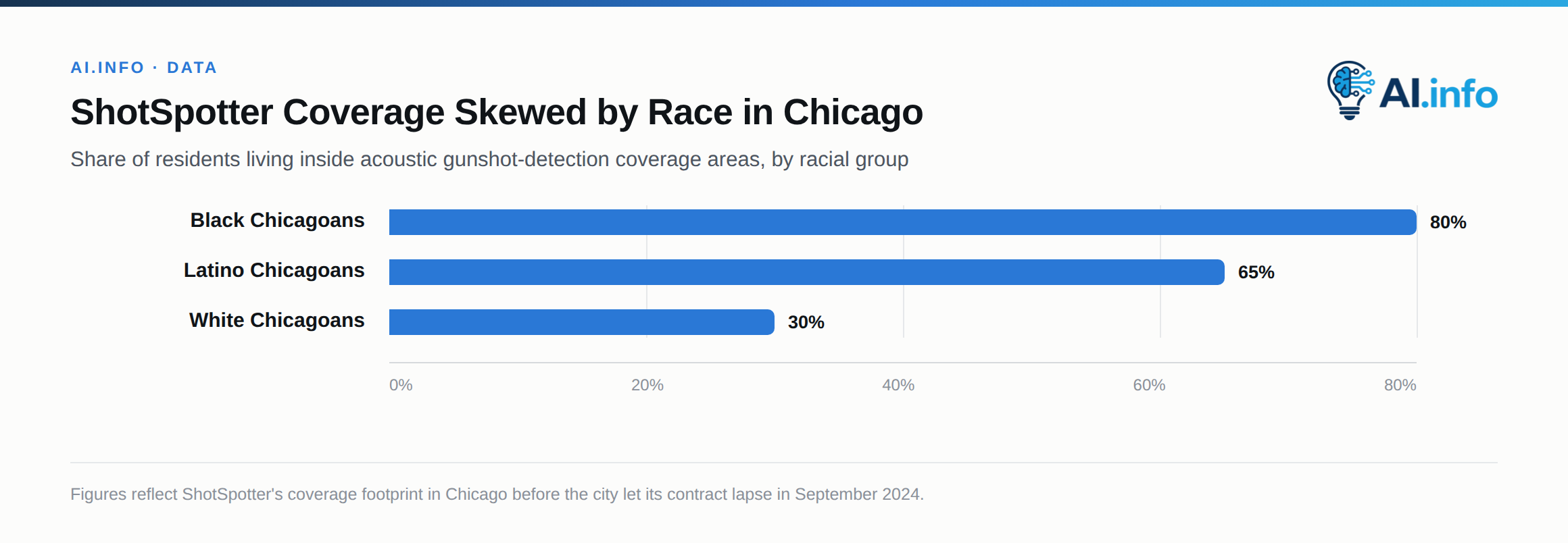
Independent scrutiny told a very different story: a MacArthur Justice Center study found that over a 21-month period, 89% of ShotSpotter deployments turned up no gun-related crime at all, and Chicago's own Office of Inspector General corroborated that the system generated tens of thousands of police deployments each year that turned up nothing. Coverage was also concentrated almost entirely on the South and West sides, with roughly 80% of Black Chicagoans and 65% of Latino Chicagoans living inside coverage areas versus about 30% of white residents.
Mayor Brandon Johnson declined to renew the contract, and it lapsed in September 2024; in August 2025 the city agreed to settle a class-action lawsuit over the technology, conceding that an alert alone doesn't justify a police stop. The lesson isn't that acoustic sensing is inherently bad — it's that a system's advertised accuracy rate is meaningless without knowing what counts as a true positive, and in ShotSpotter's case that determination depended on police voluntarily filing paperwork they had every incentive to skip.
The bill kept arriving after the contract lapsed. In March 2026 a federal judge approved a $500,000 settlement for Michael Williams, who spent close to a year in jail on a murder charge built largely on a ShotSpotter alert before prosecutors dropped the case in July 2021. SoundThinking restated its standing position — ShotSpotter identifies gunfire, not individuals, and charging decisions belong to police and prosecutors — which is true, and is why the accuracy percentage was never the number that mattered.
Chicago has not replaced the system either. Nine vendors answered the city's solicitation during 2025, no contract had been awarded by June 2026, and the procurement office told the council that a contract of this complexity normally takes about two years, which would put an award in early 2027. Cancelling a surveillance contract turns out to be far faster than deciding what should stand in its place.
Facial recognition has followed a similar arc, though earlier and more explicitly through legislation. San Francisco banned municipal use of facial recognition in May 2019, the first U.S. city to do so; Oakland and Somerville, Massachusetts followed within weeks, and by the early 2020s more than a dozen cities had some form of ban, including Boston, Portland, New Orleans, and Pittsburgh.
But the ban movement did not merely stall after 2021; it went into reverse. New Orleans rolled back its own 2020 ban in July 2022, letting police request facial recognition for violent-crime investigations, and Jackson, Mississippi repealed its 2020 ban unanimously in February 2025 at the request of its police chief, replacing it with an approval requirement and a civilian oversight board. A 2024 Washington Post investigation also found police in both Austin and San Francisco, cities with bans on their books, routinely asking officers in unrestricted jurisdictions to run facial recognition searches on their behalf. A ban on a city's own systems does little if the search can simply be outsourced a county over, and less still if the council that passed it can vote it away.
| City | Action taken |
|---|---|
| San Francisco | First US city to ban municipal facial recognition (May 2019) |
| Oakland | Banned within weeks of San Francisco |
| Somerville, MA | Banned within weeks of San Francisco |
| Boston, Portland, Pittsburgh | Among 12+ cities with bans by the early 2020s |
| New Orleans | Banned 2020, partly reversed by council vote in July 2022 |
| Jackson, MS | Banned 2020, repealed unanimously in February 2025 |
The smart city that never got built
If there's one story that every AI-and-cities pitch should be measured against, it's Sidewalk Labs' Quayside project in Toronto. Alphabet's urban-innovation subsidiary won a bid in 2017 to redevelop roughly 12 acres of Toronto's waterfront into what was pitched as one of the most heavily sensored neighborhoods on Earth — heated pavement, modular buildings, autonomous delivery, and pervasive data collection meant to optimize everything from traffic to trash pickup.
It collapsed in May 2020, and the official reason given was unprecedented economic uncertainty tied to the pandemic. But the project had already been bleeding credibility for two years before COVID gave it a face-saving exit. Ann Cavoukian, the former Ontario privacy commissioner Sidewalk had hired as a privacy consultant, resigned in October 2018 after the company wouldn't commit to de-identifying sensor data at the point of collection — instead proposing a civic data trust that would decide, after the fact, which technologies got to keep identifiable data.
Sidewalk also expanded its ambitions mid-process, at one point proposing a footprint 16 times larger than the original site, which read to Toronto residents and officials as scope creep from a company that hadn't yet earned trust on the original, much smaller plan.
Quayside is the clearest evidence that the hardest part of an AI-powered city isn't the modeling — it's the governance question of who owns the data a sensored neighborhood generates, and no amount of sophisticated engineering fixes a project that can't answer that question convincingly.
Digital twins: planning tool or planning fantasy
Singapore's Virtual Singapore project is the most mature attempt to build a full-city digital twin — a 3D, data-rich model integrating buildings, infrastructure, and environmental data, first launched in 2014 and declared complete in 2022. Unlike Quayside, it was built by the government itself, through the Singapore Land Authority, rather than an outside tech vendor, which sidesteps a lot of the data-ownership anxiety that sank Sidewalk Labs.
Planners use it to simulate scenarios — new transit lines, flood response, solar potential on rooftops — before committing capital. More recently, the platform has begun incorporating a generative AI layer, reportedly allowing planners to query the model in natural language rather than through GIS software directly, and Singapore has announced plans to extend the approach underground, building a subsurface digital twin to manage the buried utility infrastructure that a dense, land-constrained city has to route beneath everything else.
The caveat with digital twins generally is that a simulation is only as good as the assumptions baked into it, and cities that have tried to import the Singapore model wholesale have mostly discovered that Singapore's advantages — a single government with unusually centralized authority over land, utilities, and data, plus decades of consistent investment — don't transfer easily to a fragmented American metro area with dozens of overlapping agencies and no single body that controls both the traffic signals and the water mains.
What the pattern actually shows
Line up these cases and a pattern emerges that's less exciting than the AI-powered-city framing suggests but more useful. The deployments with the clearest, most verifiable results — Surtrac, Green Light, the water-leak sensor networks, Singapore's transit predictive maintenance — share two traits: they operate on a narrow, well-defined signal (traffic flow, acoustic leak signatures, vehicle sensor data) and they keep a human making the final call, whether that's a traffic engineer implementing a signal-timing suggestion or a maintenance crew dispatched on a predicted failure.
The deployments that blew up — ShotSpotter, Quayside — shared the opposite traits: broad, ambiguous signals (a sound that might be a gunshot, a neighborhood's worth of behavioral data) paired with automated consequences that had real effects on people's lives before a human meaningfully reviewed them. The AI-powered city, where it's actually working, looks less like a control room out of a science-fiction movie and more like better plumbing — sensors, models, and dashboards making existing bureaucratic processes marginally more responsive.
Where it's failed, it's failed for reasons that had less to do with the algorithms and more to do with who got to decide how the data would be used, and whether anyone outside the vendor could check the math.