Industry Transformation
The Sovereign AI Race: Why Every Nation Wants Its Own Foundation Model
Mistral at EUR 21 billion, India aiming at 200,000 GPUs, and a Saudi national model built on Chinese open weights: what nations are actually buying when they buy sovereign AI, and what stays licensed elsewhere.
Gabriele Masetti ·
A Term Nvidia Coined, and a Bill Nations Are Now Paying
"Sovereign AI" started as a marketing phrase. Nvidia popularized it a few years ago to describe a nation's capacity to produce artificial intelligence using its own infrastructure, its own data, and its own workforce — models trained on local languages and cultural context, run on hardware physically located within a country's borders, and governed by that country's laws rather than a foreign cloud provider's terms of service. It was, not coincidentally, also a very good way to sell GPUs to finance ministries that had never bought a data center before.
The phrase stuck because it named something real. By 2025, heads of state, sovereign wealth funds, and telecom incumbents from more than a dozen countries were showing up at Nvidia's GTC conference to talk about their national AI roadmaps, and Jensen Huang built an entire "Sovereign AI Summit" track around them.
For a while Nvidia reported sovereign AI as a distinct line, and said the business more than tripled year over year to over $30 billion in fiscal 2026. The line has since dissolved into the aggregate. Results for the quarter ended 26 July 2026, reported a month later, show $96.2 billion of revenue and $89.0 billion of data center revenue with no sovereign breakout. The same release says the company "is not assuming any Data Center compute revenue from China" in its outlook — one clause that describes the subject better than any summit keynote.
What's driving it is a genuine anxiety, not just vendor hype. Governments watched the generative AI wave arrive almost entirely from a handful of American labs — OpenAI, Google, Anthropic, Meta — with a Chinese counter-wave from DeepSeek, Alibaba, and others close behind. Neither camp trains primarily in Hindi, Arabic, Japanese, Korean, or the eleven official languages of Southeast Asia. Neither camp is accountable to a foreign government's export licensing regime, data-protection law, or procurement rules.
For a country that expects AI to sit inside its hospitals, courts, tax authorities, and armed forces within a decade, "we'll just use whichever American or Chinese model is best" is not a policy — it's an exposure. So an unusually broad coalition of states, from Gulf monarchies to European republics to East Asian democracies, arrived independently at the same conclusion: they need their own foundation models, their own compute, and preferably their own chips.
The Gulf's Full-Stack Bet
No region has moved faster or spent more visibly than the Gulf. The UAE's Technology Innovation Institute (TII), a government research body in Abu Dhabi, has built the Falcon family of open-weight language models since 2023, and in May 2025 released Falcon Arabic — the first Arabic-language model in the Falcon series, which TII says outperforms other regionally available Arabic models on the Open Arabic LLM Leaderboard — alongside Falcon H1, a more efficient architecture aimed at running well on modest hardware.
TII sits inside a wider ecosystem anchored by G42, the Abu Dhabi AI conglomerate whose subsidiaries span cloud infrastructure, healthcare AI, and space technology, and which has become the UAE's primary vehicle for AI diplomacy with Washington.
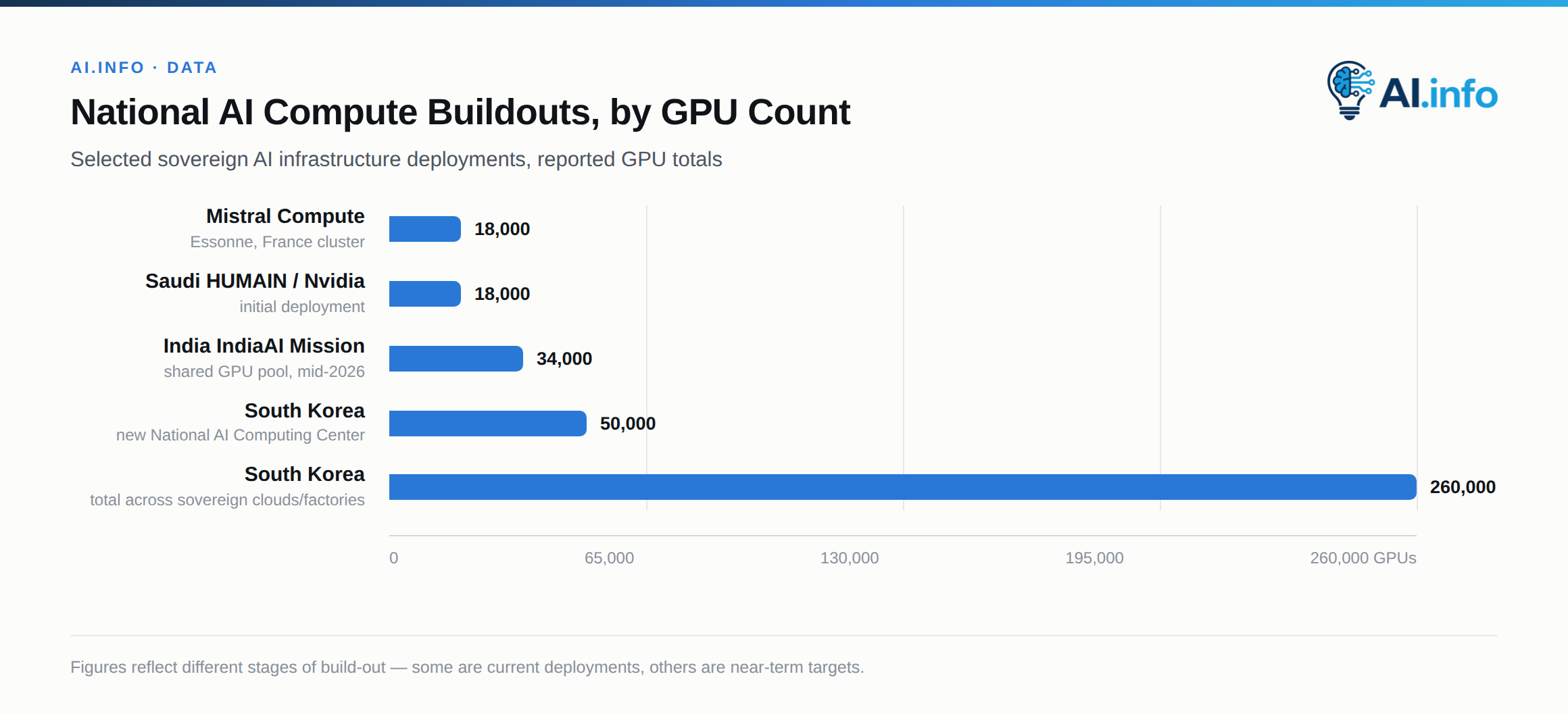
Saudi Arabia has taken an even more capital-intensive path. HUMAIN, a company under the Public Investment Fund chaired by Crown Prince Mohammed bin Salman, launched in May 2025 with a mandate covering data centers, cloud, models, and applications. Its first partnership with Nvidia calls for an initial deployment of 18,000 GB300 Grace Blackwell systems, scaling toward several hundred thousand GPUs and roughly 500 megawatts of capacity over five years — alongside a separate deal for the Saudi Data & AI Authority to deploy up to 5,000 Blackwell GPUs for a national AI factory and smart-city applications.
Crucially, none of this happens without Washington's sign-off: US export authorizations for HUMAIN reportedly permit purchases equivalent to up to 35,000 GB300-class chips, contingent on security and reporting conditions — a reminder that "sovereign" compute in the Gulf is still licensed sovereignty, granted by an outside power.
HUMAIN's own model arrived on 3 September 2026. humain-m3, announced as a frontier Arabic language model in research preview, was developed by MiniMax — a Chinese lab — on its M3 base. Saudi Arabia's national AI champion runs American chips it needs a US licence to buy, serving a model built on Chinese open weights. At the layer the public actually touches, sovereignty turned out to be an integration job.
| Deal | Detail |
|---|---|
| HUMAIN initial Nvidia deployment | 18,000 GB300 Grace Blackwell systems |
| HUMAIN 5-year target | Several hundred thousand GPUs, ~500 MW capacity |
| US export authorization for HUMAIN | Up to 35,000 GB300-class chips |
| Saudi Data & AI Authority deal | Up to 5,000 Blackwell GPUs for a national AI factory |
Europe's Answer Runs Through Paris
France has staked its sovereign-AI strategy on a single national champion: Mistral AI, the Paris startup founded in 2023 that has become the closest thing Europe has to a frontier-model competitor to OpenAI or Anthropic. The French state doesn't own Mistral, but the relationship functions as strategic alignment — Bpifrance, the state investment bank, has co-invested in Mistral's funding rounds, and the company draws on public infrastructure like the Jean Zay supercomputer.
Mistral's September 2025 Series C raised €1.7 billion at an €11.7 billion valuation, led by the chipmaking-equipment giant ASML, and the company launched "Mistral Compute," an 18,000-GPU Nvidia Grace Blackwell cluster housed in a 40-megawatt data center in the Essonne region.
The valuation has since nearly doubled. On 8 September 2026 Mistral announced a €3 billion Series D at a post-money valuation above €21 billion, pitched at making sovereign, open-weight AI the frontier rather than the fallback. A month earlier it had announced in-region inference, open models and new European infrastructure — an answer to the specific objection that a European model served out of an American data center is not a European model.
France also announced roughly €109 billion in AI infrastructure commitments at the Paris AI Action Summit in February 2025 — among the largest sovereign AI pledges outside the US and China — plus a separate €655 million allocation for AI tools built specifically for the French civil service. Mistral has also begun supplying models for French military applications, folding the sovereignty argument directly into defense procurement.
| Country/Region | Program | Commitment |
|---|---|---|
| France | AI infrastructure pledges (Paris AI Action Summit) | ~€109 billion |
| EU (InvestAI) | Mobilize AI investment by 2030 | ~€200 billion (€50B public) |
| EU (InvestAI Facility) | AI Gigafactories (up to 5) | €20 billion |
| India | IndiaAI Mission | ₹10,372 crore (~$1.25 billion) |
| South Korea (Naver/Nvidia/Brookfield) | National AI factory expansion | ~$10 billion, 55 MW to 200 MW by 2028 |
Brussels, meanwhile, is trying to build sovereignty at the bloc level rather than leaving it to individual member states. The InvestAI initiative, unveiled at that same Paris summit, aims to mobilize roughly €200 billion in AI investment across the EU by 2030, split between roughly €50 billion in public money and a much larger private component — a target that several European analysts have since criticized as more aspiration than committed capital.
A more concrete piece is the €20 billion InvestAI Facility earmarked to help build up to five "AI Gigafactories," each envisioned with well over 100,000 advanced AI processors. That sits alongside the EuroHPC Joint Undertaking's AI Factories program, which in December 2024 selected seven consortia — spanning Finland, Germany, Greece, Italy, Luxembourg, Spain, and Sweden, and involving more than fifteen member and associated states — to build AI-training capacity on top of Europe's existing supercomputing network.
The explicit goal, in the European Commission's own language, is to reduce dependence on non-European compute suppliers. Whether that's achievable while the underlying chips still come almost entirely from Nvidia is a separate question.
Asia's Parallel Tracks
India's approach is the most state-directed of the major democracies. The IndiaAI Mission, launched by the government in 2024 with an allocation of roughly ₹10,372 crore (on the order of $1.25 billion), set out to build national compute capacity, datasets, and sovereign foundation models simultaneously.
Counting the shared GPU pool is harder than it should be: published figures for empanelled capacity in early 2026 ranged from 38,000 to 58,000 processors, depending on the source and the month. The target is not ambiguous. On 27 February 2026, at the Rising Bharat Summit, Ashwini Vaishnaw put the mission's goal at 2 lakh — 200,000 — GPUs. Infrastructure builds from firms like L&T and Yotta supply much of it; Yotta's "Shakti Cloud" platform alone brings more than 20,000 Blackwell Ultra GPUs online.
The mission's flagship model effort landed with Sarvam AI, selected in April 2025 to anchor India's sovereign LLM ecosystem; the company open-sourced two mixture-of-experts models, Sarvam-30B and the larger Sarvam-105B, both trained on IndiaAI Mission compute and unveiled at the India AI Impact Summit in February 2026. A separate initiative, BharatGen, has released its own multilingual model, Param2, aimed at the same goal of adequate coverage for India's many official languages — something no foreign frontier lab has prioritized. The single-anchor framing has not survived the programme: hundreds of model proposals went in, dozens of them for large language models, and BharatGen's line out of IIT Bombay has run alongside Sarvam's throughout.
Japan's version leans smaller and more efficiency-focused, shaped by the country's tight energy constraints. The government-backed GENIAC program, run through NEDO, has since 2024 given dozens of domestic AI projects access to subsidized GPU clusters across two six-month cycles. The most visible beneficiary is Sakana AI, a Tokyo startup founded in 2023 by former Google researchers David Ha, Llion Jones, and Ren Ito, which raised $135 million in a Series B round at a $2.65 billion valuation to build compute-efficient, culturally aligned models for finance and defense use cases rather than trying to out-scale Silicon Valley.
On the enterprise side, SoftBank's subsidiary SB Intuitions has built its own homegrown LLM, Sarashina — a roughly 460-billion-parameter model by SoftBank's own account — and in November 2025 launched a lighter enterprise-facing version, Sarashina mini, as an API; SoftBank has said it will roll out generative AI services built on Sarashina through its Oracle-Alloy-powered "Cloud PF Type A" platform starting in June 2026, explicitly framed around preserving data sovereignty.
NTT has pursued a parallel, smaller-footprint track with tsuzumi, a lightweight LLM (offered in 0.6-billion and 7-billion-parameter versions) built entirely from scratch rather than adapted from an existing open-source base; its October 2025 update, tsuzumi 2, targets the financial, medical, and public sectors and is pitched as a safer, more culturally fluent domestic alternative to running Western models through every internal workflow.
South Korea has paired a similar model effort with an unusually large compute build-out. Naver, the country's dominant internet company, continues to develop its HyperCLOVA X model line while expanding a sovereign-cloud partnership with Nvidia around a gigawatt-scale data center. In October 2025 the Ministry of Science and ICT said it would deploy up to 50,000 Nvidia GPUs across a new National AI Computing Center and domestic cloud providers including NHN Cloud, Kakao, and Naver Cloud, within a national build Nvidia put at more than 260,000 GPUs across sovereign clouds and AI factories. In late July 2026 Naver, Nvidia and Brookfield put roughly $10 billion behind expanding that national AI factory from 55 to 200 megawatts by 2028, with Brookfield funding up to $9 billion and Nvidia investing about $1 billion.
Singapore, without the compute ambitions of its larger neighbors, has instead concentrated on linguistic coverage: AI Singapore's SEA-LION family of open-source models, trained on roughly a trillion tokens with heavy representation of the eleven official languages of Southeast Asia — including Thai, Vietnamese, Burmese, Khmer, and Lao — exists specifically to correct for how poorly mainstream Western models handle the region's low-resource languages.
The Chip Chokepoint Underneath All of It
Every one of these national programs runs into the same bottleneck: almost all of them depend on Nvidia hardware, and Nvidia hardware exports are a US foreign-policy instrument. The Biden administration's "AI Diffusion Rule," issued in January 2025, tried to formalize this by sorting the entire world into tiers — close allies got largely unrestricted access to flagship GPUs, a middle tier faced caps and licensing, and adversary states were walled off.
The rule never took effect. The Trump administration rescinded it in May 2025, arguing it alienated partner governments and handed market share to non-American suppliers, and replaced blanket tiers with bilateral deals — the kind that produced the HUMAIN and Nvidia arrangement in Saudi Arabia.
China policy swung even harder within the same year. Nvidia's China-specific H20 chip was deliberately engineered to comply with the Diffusion Rule's least-restricted tier, then the Commerce Department reversed course in April 2025 and blocked it anyway, then reversed again in July and August, issuing export licenses on terms that reportedly included the US government taking a 15% cut of proceeds — only for Chinese regulators to discourage domestic buyers from purchasing the chips at all on security grounds, effectively killing the product regardless of what Washington allowed.
In December 2025 the administration went the other direction again, opening the more powerful H200 to China, and by May 2026 Washington had cleared H200 sales to ten Chinese firms. Almost nothing moved. China's customs agents were told in January 2026 that the H200 was not permitted; Nvidia halted H200 production for the Chinese market in March; by August, reporting put actual arrivals at a small fraction of the approved quota, and Nvidia's own guidance assumes no China data center compute revenue at all.
Both governments can close the tap, and in 2026 both did — Washington by licence, Beijing at the border. The whiplash illustrates the core problem for any country building "sovereign" AI on American silicon: sovereignty over your own model doesn't mean much if the hardware underneath it can be re-licensed, re-restricted, or re-priced by a foreign government on a few months' notice.
Sovereignty Without Independence
That is the tension nobody's marketing material quite resolves. A country can train its own model, host it on its own soil, and write its own data-protection rules — and still be entirely dependent on a foreign supplier for the physical layer everything runs on. The UAE, Saudi Arabia, France, India, Japan, and South Korea are all, by design or default, building their national AI capacity on Nvidia GPUs, because there is currently no serious alternative at the scale required.
China is the one major exception, having been forced by years of export controls to build a parallel stack around Huawei's Ascend chips and domestically trained models, which is its own kind of forced sovereignty — expensive, slower, but not licensed by anyone else's government. That stack has begun to face outward: the Arabic model Riyadh unveiled in September 2026 was built on Chinese open weights, not American ones.
Data localization requirements add a second, less headline-grabbing layer to the same push. The EU's data-protection framework, India's evolving data-protection law, and similar rules across the Gulf and East Asia increasingly require that certain categories of data — government records, health data, financial records — be processed and stored within national borders. That's a real and enforceable form of sovereignty, distinct from and easier to achieve than owning frontier-model training capability.
It's also why so many of these national AI strategies bundle model-building with data-center construction: a domestically trained model that still has to phone home to a foreign cloud for inference doesn't actually solve the localization problem.
What the Race Actually Determines
The sovereign AI race isn't really a contest over who builds the best model — by most public benchmarks, Falcon, Mistral, Sarvam, and Sarashina all trail the current frontier set by the largest US and Chinese labs, and none of their backers claim otherwise. It's a contest over who gets to set the terms under which AI operates inside a given jurisdiction: whose content policies apply, whose export license can shut off compute, whose language and legal system the model actually understands, and whose government can be compelled — by court order, by regulation, or by geopolitical pressure — to hand over or withhold access.
Falcon and Mistral matter to Abu Dhabi and Paris less because they're competitive on leaderboards and more because they're not subject to a US administration's next policy reversal. That distinction, not raw model quality, is what's actually driving finance ministries to write nine- and ten-figure checks. The chips underneath still are subject to exactly that kind of reversal, which is why the sovereignty on offer right now is partial, contingent, and — as the H20 and H200 sagas showed — revocable within a single fiscal year.