Industry Transformation
Physical AI and the Humanoid Robot Moment
Humanoid robots are past the demo reel and into measured pilots: Figure 03 at BMW, Digit at GXO and Mercado Libre, Apollo at Mercedes-Benz. In 2026 one maker listed and a second agreed a $2.5bn SPAC. Deployments are still counted in tens of
Gabriele Masetti ·
The Pilots Are Real, and So Are Their Limits
For a few years, humanoid robots existed almost entirely in demo reels: a backflip, a folded towel, a walk across a stage. That period is not over, but it is no longer the whole story. By September 2026, a small number of humanoids are clocking real, repeated shifts inside real factories and warehouses, doing narrow tasks under close supervision, generating the kind of operational data that marketing videos never could.
BMW's Spartanburg, South Carolina plant ran Figure AI's Figure 02 robot for roughly ten months, five days a week, ten hours a shift, retrieving and positioning sheet-metal parts for welding. Over that pilot, according to BMW and Figure's own figures, the robot moved more than 90,000 components, logged about 1,250 operating hours and around 1.2 million steps, while the line built more than 30,000 BMW X3s.
GXO Logistics has a multi-year, industry-first Robots-as-a-Service agreement with Agility Robotics to run Digit humanoids in its distribution centers, and by November 2025 Digit had passed 100,000 totes moved at a GXO facility in Georgia. Apptronik's Apollo has moved past the proof-of-concept stage with Mercedes-Benz, GXO and manufacturing partner Jabil — trailer unloading, pallet handling, lineside parts delivery. On 1 July 2026 it unveiled Apollo 2, in bipedal and wheeled-base versions, alongside a 90,000-square-foot data-collection site in Austin it calls Robot Park. Apptronik calls Apollo 2 the platform it learns on and Apollo 3, not yet shipped, the commercial product.
| Metric | Value |
|---|---|
| Components moved | 90,000+ |
| Operating hours logged | ~1,250 |
| Steps logged | ~1.2 million |
| BMW X3s built on the line | 30,000+ |
That is the honest state of "Physical AI" in manufacturing: real machines, real employers, real hours logged — and still, in every case, a single task or a small task family, inside a controlled facility, with a lot of engineering support standing just off camera.
Why Manufacturing and Logistics Are the Beachhead
Humanoid marketing talks about general-purpose labor; the commercial strategy of every serious player is the opposite — pick the narrowest, most repetitive, most structured task available and prove it works before touching anything harder. Warehouses and auto plants are attractive first customers because they are already built around standardized totes, pallets and fixtures sized for human bodies. A humanoid can, in principle, drop into that environment without the building being rebuilt around it — the main argument for two legs and two arms over a cheaper wheeled arm on a cart.
Figure AI and BMW: From Pilot to Second Generation
Figure's BMW engagement did not stop at Figure 02. The companies moved to Figure 03, a redesigned generation aimed at logistics work — sorting unsequenced components into delivery trolleys for the assembly line — a task BMW has said could scale more easily across plants than the original welding-support job. Figure announced the robot's arrival at BMW on 30 June 2026; Sacra's profile puts the deployment at about 40 units.
The factory scaled faster than the fleet. On 29 April 2026 Figure said its BotQ plant had gone from one Figure 03 a day to one an hour in under 120 days, delivering more than 350 third-generation robots at an end-of-line first-pass yield "now over 80% and improving weekly". Unaudited company numbers, but they describe a production line rather than a prototype shop.
BMW also opened a pilot with a different humanoid, Hexagon Robotics' AEON, at its Leipzig, Germany plant: an initial test deployment in December 2025, a further round planned for April 2026, and a full pilot phase targeted for summer 2026 — Europe's first humanoid trial inside BMW's production network. Neither company has since confirmed that the summer pilot began. Running two robot programs in parallel, at two plants, is itself a signal: BMW is treating humanoids as a technology to evaluate and hedge, not a single vendor bet.
Figure itself has scaled up financially even faster than its robot count. The company raised more than $1 billion in a Series C round that closed in September 2025 at a $39 billion post-money valuation, with investors including Nvidia, Microsoft, Intel Capital, Brookfield Asset Management, Jeff Bezos's Bezos Expeditions and the OpenAI Startup Fund. Figure ended its earlier collaboration agreement with OpenAI and built its own vision-language-action model, Helix, in-house — a sign of how quickly leading humanoid companies have concluded that the AI "brain" is too central to outsource.
That conviction now has a price tag. On 3 September 2026 Figure signed a partnership with Nscale for up to 100,000 GPUs on Nvidia's Vera Rubin platform, committing $3.5 billion — several times its total equity raised, for a fleet counted in hundreds of robots.
| Company | Capital Raised/Committed | Valuation (if disclosed) |
|---|---|---|
| Figure AI | $1 billion+ (Series C, Sept 2025) | $39 billion |
| Apptronik | $935 million+ (Series A extension, Feb 2026) | ~$5.3 billion |
| Hyundai (Atlas production) | $26 billion (US investment) | — |
| Unitree | ~$900 million raised, Shanghai IPO, 19 Aug 2026 | ~$9 billion at IPO; ~$30 billion on 9 Sept 2026 |
| Agility Robotics | >$620 million gross proceeds, SPAC merger announced 24 June 2026 | $2.5 billion |
Agility Robotics: The Warehouse Workhorse
Agility's Digit is the most operationally proven humanoid in the field, in the narrow sense that it has done the same job — picking empty totes off shelves or conveyors and moving them a short distance — across multiple paying customers for the longest stretch. Beyond the GXO deployment, Agility has also placed Digit units at Schaeffler Group facilities and, since February 2026, at a Toyota manufacturing plant in Canada handling tote loading and unloading.
Digit was also the first humanoid Amazon tested, at its robotics R&D site in Sumner, Washington — evaluation, not a commitment to fleet-wide deployment. Agility has said it has secured more than $300 million in multi-year orders for its newer Digit v5 hardware, contingent on contractual milestones, with a sales pipeline it describes as more than 30 customers — impressive by robotics-industry standards, still tiny relative to the labor force these companies actually employ.
On 24 June 2026 Agility agreed to go public through a $2.5 billion merger with Churchill Capital Corp XI, listing as AGLT, with more than $620 million of gross proceeds including a PIPE of about $200 million led by Foxconn, expected to close during 2026. The operating record in the pitch is Digit at Schaeffler, GXO, Toyota Motor Manufacturing Canada and Mercado Libre, and more than 65,000 hours across nine customer facilities — roughly thirty-two work-years.
Apptronik, Hyundai's Atlas, and the Auto Industry's Bet
Boston Dynamics unveiled a fully electric Atlas at CES 2026 — six feet, roughly 198 pounds, 56 degrees of freedom, carrying about 44 pounds one-handed and reaching 7.5 feet overhead. A sharp departure from the hydraulic Atlas that spent a decade doing parkour for YouTube.
Hyundai, which owns Boston Dynamics, has committed the first production units to its own Robotics Metaplant Application Center and to Google DeepMind, and says it will put Atlas into its own manufacturing from 2028, backed by a $26 billion US investment and a factory designed for 30,000 units a year. Hyundai Mobis will supply the actuators — an automaker vertically integrating humanoid parts the way it already does engines.
Apptronik follows the same instinct — align with an automaker that needs the labor and can help fund and build the hardware. Its Series A, after a February 2026 extension, totals more than $935 million from Google, Mercedes-Benz, PEAK6, AT&T Ventures, John Deere and the Qatar Investment Authority, at a reported valuation around $5.3 billion. The overlap of investors across these companies — Google backing both Apptronik and, through DeepMind, Boston Dynamics's AI stack — shows how concentrated the capital behind this industry actually is.
Learning to Move: The Software Behind the Hardware
The hardware gets the headlines, but the problem that decides whether any of this scales is teaching a robot to act competently in an environment nobody programmed it for. The dominant approach is imitation learning: collect demonstrations, often from teleoperated robots or human video, and train a model to map what the robot sees to what it should do next.
Google DeepMind's RT-2, published in 2023, was an early vision-language-action (VLA) model — trained jointly on internet-scale image-and-text data and real robot demonstrations, so it inherits some of a language model's ability to generalize to objects it never practiced on. Physical Intelligence's pi0 pushed further, pairing a pretrained vision-language model with a faster "action expert" trained with flow-matching to produce continuous motor commands.
Nvidia has built a platform around the same idea: Isaac GR00T N1, released in March 2025, is described as the first open foundation model for humanoid reasoning and skills, and has run on robots including Fourier's GR-1 and 1X's hardware; a follow-up, GR00T N1.6, arrived in September 2025 with better whole-body coordination for tasks like opening heavy doors. GR00T 1.7, open under an Apache 2.0 licence, is pretrained on about 32,000 hours of real demonstration and human ego-centric data and about 8,000 of simulation, per Nvidia's release post of 7 July 2026. On 31 May 2026 Nvidia also published an open reference humanoid for academic labs — a Unitree H2 Plus body, Sharpa Wave hands, a Jetson AGX Thor module — to be sold by Unitree from late 2026.
Simulation and the Sim-to-Real Gap
Because real robot demonstrations are slow and expensive to collect, simulation has become central to training — but simulated physics never perfectly matches a real robot's motors, friction and sensor noise, a mismatch researchers call the sim-to-real gap. A policy that balances and grasps perfectly in simulation can fail on the first unmodeled bump, cable or slippery tote.
Nvidia's answer is to generate synthetic training data cheaply — the company has reported generating 780,000 synthetic robot-motion trajectories, roughly 6,500 hours of human demonstration, in eleven hours, and says blending it with real recordings improved GR00T N1's task performance by roughly 40% over training on real data alone.
Common mitigations include domain randomization — varying simulated physics during training so a policy doesn't overfit to one exact simulated world — and whole-body control layers that keep a robot stable when a learned policy asks for something physically awkward.
The Cost Curve Is Bifurcating
One of the more concrete, verifiable developments in 2025–2026 has been how differently priced humanoid hardware has become depending on who is building it and for what market. Unitree, the Chinese robotics manufacturer, sells its G1 humanoid starting around $16,000 for a base configuration, with higher-spec "EDU" versions running up to roughly $74,000, and its larger H1 platform priced from about $90,000 into the low six figures depending on configuration.
Unitree has said it is targeting around 20,000 humanoid shipments in 2026, up from about 5,500 in 2025 — real unit-volume growth, even if the total remains minuscule next to industrial-robot-arm shipments. By contrast, Western firms selling into enterprise contracts (Figure, Apptronik, Boston Dynamics) do not publish comparable retail prices, because their business model is service contracts and pilots, not off-the-shelf sales — a structural difference in go-to-market that matters as much as any spec sheet.
In August 2026 that difference acquired a public price. Unitree listed on Shanghai's STAR Market on 19 August at 150.80 yuan a share, raising about $900 million at roughly a $9 billion valuation, and closed its first day up 460%, after an intraday high that briefly valued it near $66 billion. By 9 September the stock sat 53% below that peak, near $30 billion and still over three times the offer price. The cheapest humanoid hardware in the world now belongs to the one maker marked to market every day.
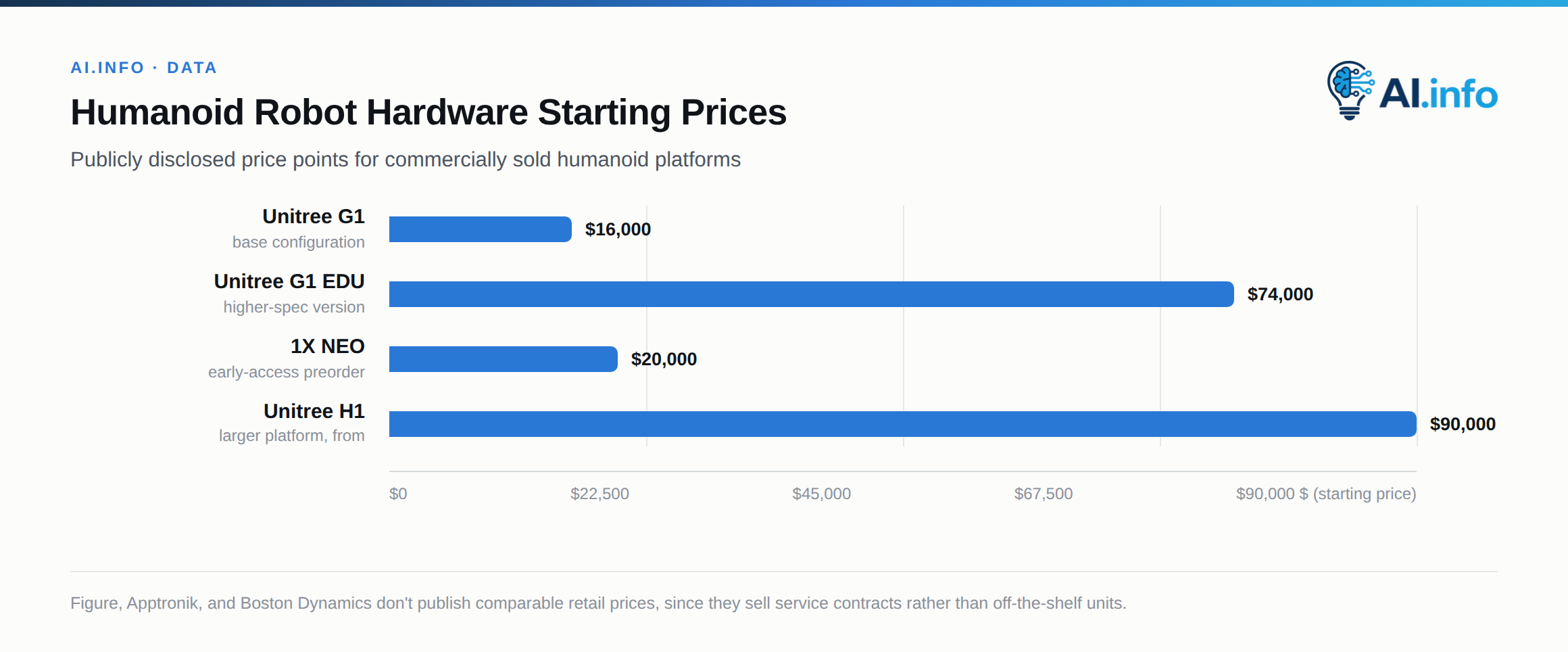
1X Technologies has taken a third path, aiming at the home rather than the factory: its NEO robot, announced in October 2025, takes early-access preorders at $20,000 or a $499-per-month subscription, with the company saying it sold out first-year capacity of more than 10,000 units in five days. Its 58,000-square-foot NEO Factory in Hayward, California opened on 30 April 2026, built for 10,000 robots a year and, 1X says, more than 100,000 by the end of 2027; consumer shipments were promised for 2026. Even a company marketed around household chores has struck deals to put its robots in factories — an admission that structured industrial tasks are still easier to deliver than an unstructured home.
Funding Has Outrun Deployment
Set the financial numbers next to the operational ones and the gap is stark. Figure AI is valued at $39 billion and has committed $3.5 billion to GPUs; Apptronik has raised nearly $1 billion; Unitree's market capitalisation swung from $9 billion to $66 billion to $30 billion inside three weeks.
Tesla, meanwhile, has still never published a confirmed production number for Optimus. It cleared the old Model S/X line at Fremont during 2026 to make room for one, told JPMorgan in August 2026 that the Gen 3 design was finalised and external sales could begin in the second half of 2027, and started a slow ramp around September. Musk had forecast thousands of working robots by 2026; in January he acknowledged none were yet doing useful work at Tesla.
XPeng switched on what it calls the first automated humanoid production line, in Guangzhou, in September 2026 — with nothing shipping to customers before 2027.
That divergence — large valuations built on deployments numbering in the dozens of robots, against a headline program that has never confirmed mass production — is the clearest sign that capital is pricing a future the factory floors have not delivered.
How Early This Actually Is
Stated plainly: no independent, verified demonstration has shown a humanoid robot completing a complex, unstructured task fully autonomously and reliably outside a controlled pilot. Industry convention now assumes that any demo not explicitly and specifically labeled autonomous involved teleoperation, and serious outlets have started reporting accordingly.
Rodney Brooks, the roboticist who co-founded iRobot, wrote in September 2025 that the idea humanoids will match human manual dexterity within decades is "pure fantasy thinking," pointing to the roughly 17,000 specialized touch receptors packed into a human hand as a sensing problem current robot hands don't come close to solving.
Bessemer Venture Partners, an investor in the space, calls this robotics' "GPT-2.5 moment" — real capability, still a wide gulf from the 99.9%-plus reliability continuous industrial deployment requires. Morgan Stanley has flagged the risk of a correction as speculative capital meets the slower reality of hardware and safety certification.
A narrower claim survives that caution: for tightly scoped, single-task industrial jobs — moving totes, sorting parts, feeding a welding station — humanoids are past the demo stage and into repeatable, measured pilots, with a plausible path to modestly wider deployment over two to three years.
The gap between "works for one task on one line at BMW" and "works across a warehouse the way a forklift does" is still enormous, and closing it depends less on hardware than on whether foundation models like GR00T can generalize skills across tasks the way their creators claim — a question none of the 2026 pilots has answered.
What Would Have to Be True for This to Scale
The test for the next two years isn't whether more pilots get announced — the committed capital nearly guarantees that. It is whether one deployment graduates from a single task to several without proportionally more human supervision, whether enterprise hardware costs fall the way Unitree's consumer hardware has, and whether a model trained on one robot's data transfers skill to a different body without months of re-collection.
Until one of those three things happens at scale, the humanoid robot moment remains a moment of pilots, financing rounds and carefully produced videos — a real beginning, not yet a labor-market event.