Industry Transformation
The Autonomous Vehicle Endgame: What Really Has to Happen Before Self-Driving Cars Are Everywhere
Waymo runs 500,000 paid rides a week across 14 metros — and pulled every US freeway ride for two months in 2026 after driving into construction zones. What still stands between working robotaxis and everywhere.
Gabriele Masetti ·
The numbers that actually matter now
Strip away the keynote slides and the "full self-driving" branding, and the state of autonomous vehicles in September 2026 comes down to a small set of hard numbers. Waymo, Alphabet's robotaxi unit, is delivering roughly 500,000 paid rides a week from a fleet of about 4,000 vehicles across 14 US metros. Ten metros were on the list in March 2026, when the weekly figure was above 400,000; Nashville opened in June, and Denver, San Diego and Tampa started public service on 1 September 2026. Waymo's own target is one million paid rides a week by the end of 2026, which requires the volume to roughly double in four months.
That is up tenfold from about 50,000 weekly rides in May 2024. In February 2026 Waymo closed a $16 billion funding round at a $126 billion valuation, with Alphabet as the largest backer alongside Sequoia and DST Global.
| Company | Scale | Notes |
|---|---|---|
| Waymo | ~500,000 paid rides/week | ~4,000 vehicles, 14 US metros (Sept 2026) |
| Zoox | ~1 million riders reported | Paid service in Las Vegas; free, waitlisted in SF |
| Baidu Apollo Go | 1,000+ driverless vehicles in Wuhan | 3.4 million rides in Q4 2025 |
| Kodiak Robotics | 7,300 autonomous loads | 2.8 million miles, 1,900+ hours |
That is genuinely a lot of real, paid, driver-out rides. It is also a fraction of the roughly one billion trips Uber facilitates every month worldwide. The honest way to read the AV story in 2026 is not "solved" versus "vaporware" — it's a technology proven to work in specific places, under specific conditions, at a cost structure still not obviously better than paying a human driver. The gap between "Waymo works great in Phoenix" and "self-driving cars are everywhere" is this piece's actual subject, and it is bigger and more structural than most coverage admits.
What "driverless" actually means: the SAE ladder
Almost every argument about autonomous vehicles gets confused because people use "self-driving" to describe two fundamentally different things. SAE International's levels of driving automation, the industry-standard framework, draw the real line at Level 3.
Level 2 ("partial automation") is what's in most new cars with adaptive cruise and lane-centering, including Tesla's Full Self-Driving (Supervised): the car can steer, accelerate and brake, but the human is still the legally responsible driver and must supervise constantly. Level 3 ("conditional automation") shifts liability to the system while it's engaged within a defined domain, but still expects the human to take back control on request — this level has barely been deployed at scale anywhere.
Level 4 ("high automation") is the one that matters for the robotaxi business: the vehicle handles the entire driving task with no human fallback, but only inside a defined operational design domain — specific streets, weather, speeds. Level 5 — any road, any condition, no domain restriction — remains, as most engineers in the field will say plainly, theoretical.
Waymo, Zoox and Baidu's Apollo Go are Level 4 systems operating in geofenced areas. Tesla's consumer FSD product is Level 2; Tesla's Austin robotaxi service is trying to become Level 4. Confusing these categories is how most AV hype gets manufactured — a Level 2 driver-assistance feature and a Level 4 driverless taxi solve different problems, and progress on one doesn't automatically transfer to the other.
The long tail: why Level 4 doesn't casually become Level 5
The core technical obstacle to "everywhere" is what the industry calls the long-tail problem. The scenarios an AV handles easily — lane-keeping on a sunny freeway, stopping at a red light — cover the overwhelming majority of driving time and are, at this point, largely solved.
What's left is an effectively unbounded catalogue of rare events: a couch in the middle of a highway, a police officer waving traffic through a red light, a plastic bag that might be a rock, a school bus with its lights malfunctioning, black ice on a bridge deck in a state where the car has never driven in snow. Individually each scenario is vanishingly rare. Collectively, rare events dominate the actual risk in driving, because ordinary situations are, by definition, the ones humans and machines both already handle well.
Precisely for that reason, AV companies expand market by market instead of declaring victory nationally: each new city, weather pattern and class of road user requires re-validating the system against a new long tail. It is also why the flagship safety failures of 2025 and 2026 at the most advanced companies were long-tail failures rather than routine ones.
In December 2025, Waymo issued a voluntary software recall covering 3,067 vehicles after Austin school district officials documented 19 instances of Waymo vehicles failing to stop for stopped school buses with flashing lights — a rare-but-catastrophic scenario that drew an NHTSA defects investigation in October 2025 and, on 23 January 2026, a separate NTSB inquiry into more than 20 incidents in Austin. It opened that file after reports that earlier updates had not stamped the behaviour out, and the school district asked Waymo to stop operating during pick-up and drop-off hours.
In Wuhan, China, more than 100 Apollo Go robotaxis reportedly froze mid-traffic in a mass fleet malfunction in early 2026, causing multiple collisions — the kind of correlated software failure a geographically concentrated fleet is uniquely exposed to. Scale doesn't just multiply the good outcomes; it multiplies the tail as well.
The largest such failure so far arrived in the spring of 2026 on the freeway. Waymo vehicles drove past ramp-closure signs into sections of highway shut for construction — six times in Phoenix in April, seven in the San Francisco Bay Area in May, at least 13 documented instances. Waymo restricted freeway operations on 19 May and suspended public freeway rides nationwide on 21 May.
We have temporarily paused freeway operations, as we work to integrate recent technical learnings into our software and expect to resume these routes soon. — Waymo spokesperson, statement to the San Francisco Standard, 21 May 2026
On 8 June it recalled nearly 4,000 robotaxis; NHTSA paperwork described software that prioritised avoiding other freeway hazards or failed to recognise the construction zone, with a fix still under development. Freeway rides began returning on 29 July, Phoenix first. Two months without freeway service is no rounding error for a company whose argument for scale is that surface streets are the hard part.
| Incident | Company | Outcome |
|---|---|---|
| Freeway construction-zone entries (13+ instances) | Waymo | All US freeway rides suspended 21 May 2026; ~4,000 vehicles recalled 8 June; Phoenix service resumed 29 July |
| School bus stop-arm failures (19 instances) | Waymo | Voluntary recall of 3,067 vehicles (Dec 2025); NTSB inquiry opened 23 Jan 2026 |
| Pedestrian dragged ~20 feet | Cruise (GM) | $500,000 DOJ settlement; program wound down (Dec 2024, $10B+ losses) |
| Mass fleet freeze, 100+ vehicles | Baidu Apollo Go (Wuhan) | Multiple collisions, early 2026 |
The unsettled sensor fight: lidar versus cameras
Underneath the business headlines sits a genuine, unresolved engineering disagreement. Waymo's current generation vehicles carry 29 cameras, six radar units and five lidar sensors — a deliberately redundant sensor stack designed so that no single sensor's blind spot becomes the car's blind spot. Tesla's approach, championed by Elon Musk since at least 2013, uses eight cameras and no lidar or radar, on the theory that if humans can drive using only vision, a sufficiently capable neural network should be able to as well; Musk has repeatedly called lidar a "crutch," including on Tesla's January 2025 earnings call.
Waymo has publicly pushed back on that framing. At Google I/O in May 2025, the company presented an example from a Phoenix dust storm in which its lidar detected a pedestrian invisible to the camera feed — a direct rebuttal to the camera-only thesis. The dispute isn't academic: it's a bet about cost curves (cameras are far cheaper) versus physical redundancy (multiple sensing modalities catch each other's failures).
Neither side has definitively won. Tesla's approach is cheaper to manufacture at scale; Waymo's has years more validated driverless safety data behind it. The industry's endgame likely requires this argument to resolve — either lidar costs collapse enough that redundancy becomes cheap, or camera-only systems close today's measurable safety gap — because right now the two leading U.S. companies are betting billions on incompatible answers.
The cautionary tale nobody in the industry has forgotten: Cruise
GM's Cruise is the case study that disciplines every other player's public statements. In October 2023, a pedestrian in San Francisco was struck by a separate, human-driven vehicle and thrown into the path of a Cruise robotaxi. Rather than staying still, the Cruise vehicle pulled over as programmed — dragging the pedestrian roughly 20 feet at about 7.7 mph in the process.
A GM-commissioned technical review found the failure stemmed from the system misjudging the pedestrian's position and misclassifying part of the collision. Cruise subsequently admitted to filing a false report with federal regulators about the incident and paid a $500,000 settlement with the Department of Justice, on top of a separate multimillion-dollar settlement with the victim.
The regulatory and reputational fallout never really ended. In December 2024, GM announced it was winding down the Cruise robotaxi program entirely, citing more than $10 billion in cumulative losses. Cruise is the clearest evidence that the AV endgame isn't purely a technology problem — it is a trust problem, and trust, once broken by a single vivid incident and compounded by a cover-up, can end a program regardless of the underlying fleet's aggregate statistics.
Waymo's actual safety record — and its actual asterisks
Waymo's public safety case rests substantially on a Swiss Re-conducted study comparing its liability claims against a human-driver baseline built from more than 500,000 claims and 200 billion miles of insurance exposure data. Across 25.3 million rider-only miles, Waymo recorded nine property-damage claims and two bodily-injury claims, versus roughly 78 and 26 respectively that the human baseline would predict for the same distance — an 88% and 92% reduction. A follow-up 2025 study, expanded to 56.7 million miles, found a 92% reduction in crashes causing pedestrian injuries and 82% reductions for both cyclists and motorcyclists, regardless of fault.
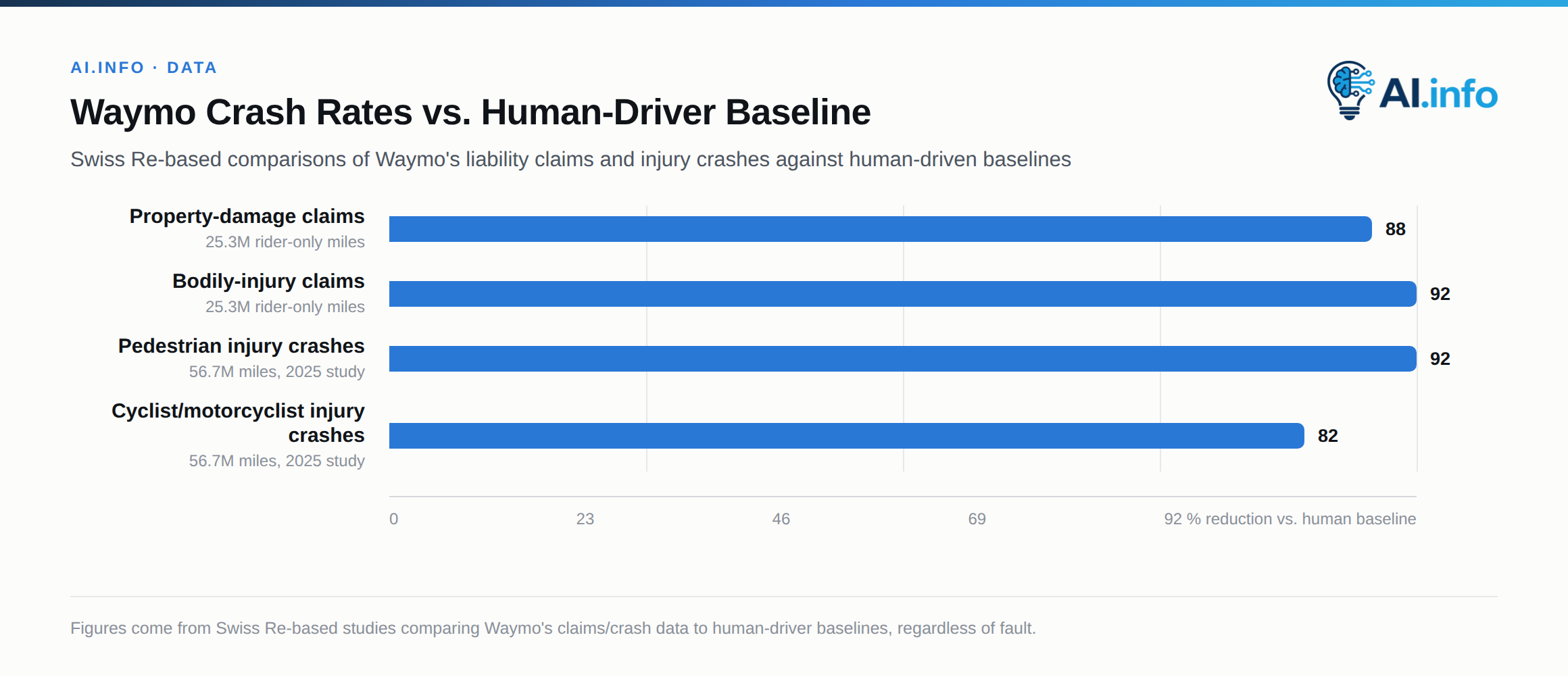
Those are real, third-party-validated numbers, not marketing copy, and the strongest evidence the industry has that Level 4 AVs can outperform human drivers in aggregate. But "in aggregate" is doing real work in that sentence: the school-bus and construction-zone recalls show a system can be statistically much safer overall while still containing specific, repeatable failure modes a human driver would almost never exhibit. Regulators evaluating AVs increasingly focus less on the aggregate safety ratio and more on whether categories of known-dangerous scenarios have been closed off — a much harder, much slower bar to clear market by market.
Tesla's bet: robotaxi in Austin, without the safety net (eventually)
Tesla launched its Austin robotaxi service in June 2025 with a small fleet — roughly ten vehicles — each carrying a Tesla employee "safety monitor" who could intervene. Tesla did not so much remove the safety monitors as relocate them. In January 2026 Musk said the company had "just started Tesla Robotaxi drives in Austin with no safety monitor in the car"; video from Austin showed each of those cars closely followed by a black Tesla carrying a monitor ready to intervene. Tesla has never said how many of its vehicles now run with nobody supervising, and in September 2026 it reported passing one million miles driven without a human supervisor.
The promised first-half-of-2026 expansion to Dallas, Houston, Phoenix, Miami, Orlando, Tampa and Las Vegas came in later and shorter than announced. Independent trackers count seven metros with Tesla robotaxi service by September 2026 — Austin, Dallas, Houston, Miami, Orlando, Tampa and the San Francisco Bay Area, where California law still requires a safety driver. Phoenix and Las Vegas, both on the original list, are not among them.
Independent trackers have pushed back on the pace of the rollout — Electrek's reporting in December 2025 and February 2026 described the Austin operation as considerably smaller in practice than Musk's public statements implied, with limited service-area coverage months into the launch.
On the data side, Tesla released a more detailed FSD safety report in November 2025 — reportedly prompted after Waymo's co-CEO publicly called for more transparency — claiming FSD (Supervised) vehicles go roughly 5 million miles between major collisions and citing sevenfold fewer collisions than the comparable manually-driven baseline, drawn from a fleet dataset now exceeding 10 billion cumulative FSD miles.
Independent safety researchers, including Carnegie Mellon's Philip Koopman, have publicly flagged methodology concerns with how Tesla's comparisons control for road type, driver population and crash severity — the claims are more transparent than Tesla's past disclosures, but not yet independently reproducible the way the Swiss Re-Waymo study is.
Zoox and Baidu: the rest of the field is moving too
Amazon's Zoox has been operating a fully driverless, purpose-built robotaxi (no steering wheel) in Las Vegas since September 2025 and added San Francisco in November 2025, reporting nearly two million autonomous miles and more than 350,000 riders. Zoox began charging for rides in Las Vegas in August 2026 and, by September, reported approaching one million riders across its markets, with San Francisco still free and waitlisted and Austin limited to employees and guests. The Uber-app booking it had promised for the middle of 2026 slipped; the company now points to later in the year. Choosing a distribution partnership over its own app was a notable signal from a company with Amazon's balance sheet; so is how easily it slid.
Outside the U.S., Baidu's Apollo Go is arguably the largest actual fully-driverless deployment on Earth by vehicle count: more than 1,000 driverless vehicles operating across Wuhan since mid-2024, with the service deployed or in testing across roughly 26 cities globally, including international pilots in Dubai and Abu Dhabi. Baidu reported 3.4 million fully driverless rides in the fourth quarter of 2025 alone, with weekly rides briefly surpassing 300,000.
The scale is real, and so is the risk it carries — the Wuhan mass-freeze incident is a reminder that centralized software deployed across a thousand-vehicle fleet can fail in a correlated way no human-driver fleet ever could.
The quieter frontier: trucking
While robotaxis dominate headlines, driverless freight may be a more tractable near-term business, because highway driving between fixed terminals is a narrower, more repeatable long tail than urban streets full of pedestrians, cyclists and school buses. Aurora Innovation began fully driverless commercial trucking runs between Dallas and Houston in May 2025 — the first company to run heavy-duty trucks on public roads with no one in the cab — and has targeted expansion to El Paso and Phoenix.
Kodiak Robotics reached commercial driverless operation even earlier, in December 2024, hauling fracking sand on private roads in West Texas for Atlas Energy Solutions; by June 2025 Kodiak had logged more than 7,300 autonomous loads, 2.8 million miles and 1,900-plus hours of paid driverless operation. Trucking's economics are also more forgiving: freight doesn't need door-to-door last-mile navigation through residential streets, and a driver's wage is a bigger share of a long-haul trip's cost than of a short urban ride.
Regulation: the patchwork that has to become a framework
Technology aside, the U.S. regulatory landscape is still catching up. In April 2025, the Department of Transportation under Secretary Sean Duffy introduced a new AV framework built around three priorities: safety oversight of current operations, removing unnecessary regulatory friction, and enabling commercial deployment. NHTSA has since proposed the voluntary AV STEP program — a structured evaluation and data-reporting scheme for AV developers — and, in March 2026, put forward rulemakings to modernize Federal Motor Vehicle Safety Standards that still assume a human driver with a steering wheel and pedals.
Congress has also taken up the SELF DRIVE Act (reintroduced in 2026 as H.R. 7390) to give NHTSA clearer statutory authority over ADS-equipped vehicles rather than leaving oversight to a state-by-state patchwork of permits.
That patchwork is precisely the bottleneck standing between "operating profitably in ten Sun Belt cities" and "everywhere." Every AV company currently must win separate approval, in effect, city by city and sometimes agency by agency — the same pattern visible in Waymo's expansion list and Zoox's employee-only soft launches. A durable federal framework that standardizes safety reporting and crash investigation triggers, without freezing the technology in place, is one of the genuine prerequisites for national scale — not a footnote to the technology story.
What actually has to happen
Put the pieces together and the honest forecast is not a single dramatic unlock but four separate, slow-moving convergences. First, the long tail has to keep shrinking through unglamorous, incremental means — more miles, more edge-case data, more geofenced expansion — rather than through some discontinuous leap to Level 5; nobody credible in the field is promising true all-conditions autonomy on a fixed date anymore.
Second, the sensor argument between camera-only and lidar-redundant systems needs to actually settle, either through cost collapse or through camera-only systems closing today's measurable safety gap, because the industry can't scale two incompatible hardware philosophies indefinitely. Third, regulation needs to move from a state-by-state permitting patchwork to a coherent federal framework with real crash-investigation teeth — the school-bus recall and the Cruise dragging incident both show that a single well-documented failure can freeze a market faster than any amount of aggregate safety data can unfreeze it.
Fourth, and least discussed, the economics need to work without robotaxi-specific subsidy: Waymo, Zoox and Tesla are all still burning capital to build out each new city, and "everywhere" requires the unit economics of a driverless ride to beat a human-driven one on cost, not just on novelty.
None of that argues the technology is fake or the hype is baseless — the Swiss Re numbers, the Wuhan ride volumes and the Dallas-to-Houston freight lanes are all real evidence that autonomous driving works. It argues that "everywhere" was always the wrong frame for how this technology arrives. It will look like what's happening right now: city by city, weather condition by weather condition, road class by road class, with genuine safety gains sitting uncomfortably next to genuine, occasionally serious failures — for years yet.